Against the Theory of ‘Dynamic Equivalence’
by Michael Marlowe
Revised and expanded, January 2012
Among Bible scholars there is a school which is always inquiring into the genres or rhetorical forms of speech represented in any given passage of the Bible, and also the social settings which are supposed to be connected with these forms. This approach is called form criticism, and it was developed largely by German scholars in the early twentieth century. Among these scholars, whether they be German or English-speaking, one constantly hears German phrases. The social setting is called the Sitz im Leben. The “oracle of salvation” introduced by “Fear not” is the Heilszusage, and so on. When I was in the seminary learning about all this, I at first wondered why it should be necessary to use these German words; but then I learned that the German words are used because they are recognized as technical terms, and the English equivalents are not. Students were expected to learn the terminology of the field, just as in any other field of study.
Likewise, there were many Greek and Hebrew words to be learned. These were the “technical terms” of the Bible itself. The professors often warned us students about the important semantic differences between various Greek and Hebrew words and their closest English equivalents. The Hebrew word תורה (torah), for instance, was not always equivalent to the Greek νομος (nomos) or the English law, and the Hebrew נֶפֶש (nephesh) did not always refer to the soul, etc. Anyone who has been to a theological school knows very well how often points like this are emphasized by scholars.
I mention this at the beginning of this book on Bible translation because I want the reader who has not been exposed to this kind of study to know how much is made of words and their precise usage in theological schools. Ministers in training cannot go through three years of seminary without being impressed with the undeniable differences between Hebrew, Greek, and English, and with the delicate problems of translating many key words of the Bible into our language. It is not a simple and easy task. Indeed, it is not fully possible, and that is why ministers are taught the biblical languages in seminary.
It is easy to get carried away with fine distinctions. Scholars are often accused of losing their common sense in a multitude of hair-splitting distinctions, and of using foreign words and difficult terminology merely to impress the unlearned. In some cases this undoubtedly happens. We also must be on guard against the elitist attitude taken by many in the Roman Catholic tradition, which in its extreme form caused the Roman Catholic Church to oppose the translation of the Bible into English in the first place. But I want to suggest here that those who are not used to careful study of the Bible may easily fall into an opposite error: the error of despising many distinctions which really do make an important difference in our understanding of the Bible, despising the role of trained teachers in the Church, and generally failing to recognize the bad effects that arise from vague and loose words on any important subject. The Bible is a very important book, and it deserves our utmost care. And if we believe that every word of the Bible is inspired by God, how can we be careless of these words?
I also mention form criticism, with its emphasis on the text’s situation in life, for another reason: I believe that a translation of the Bible must take account of the “sociological setting” in which the Bible came to be, and in which it belongs: namely, the Church of Jesus Christ. The translator must remember that this book was given to the Church and it belongs to her. And this fact, this Sitz im Leben of the Bible as a whole, is not without some consequences for our methods of translation.
And all the people gathered as one man into the square … and Ezra the scribe stood on a wooden platform … and Ezra opened the book in the sight of all the people, for he was above all the people, and as he opened it all the people stood. And Ezra blessed the Lord, the great God, and all the people answered, Amen, Amen, lifting up their hands. And they bowed their heads and worshiped the Lord with their faces to the ground. Also Jeshua, Bani, Sherebiah, Jamin, Akkub, Shabbethai, Hodiah, Maaseiah, Kelita, Azariah, Jozabad, Hanan, Pelaiah, the Levites, helped the people to understand the Law, while the people remained in their places. They read from the book, from the law of God, clearly 1 and they gave the sense, 2 so that the people understood the reading. — Nehemiah 8:1-8 (ESV).
 This passage from Nehemiah gives an account of the day when Ezra and his fellow-ministers of the Word gathered the people together and began to teach them the contents of the “Book of the Law of Moses.” It says that they read from it distinctly, and that they caused the people to understand the meaning of the words. Jewish tradition says that this was the beginning of those translations into Aramaic called Targums, free renderings of the Hebrew which were used by Jews in later times to explain the meaning of the archaic Hebrew text. But it is unlikely that such a translation is referred to here, because farther on in the book we read of Nehemiah’s indignation when he discovered that some of the children of the Jews who had married foreign women could not understand the “Judean” language.” 3 Nehemiah was not inclined to provide a translation for such, but rather, turning to their fathers, he “contended with them, and cursed them, and smote certain of them, and plucked off their hair, and made them swear by God …” (13:25) Hebrew was not forgotten by the Jews so quickly during their short captivity in Babylon. At a later time they did forget their mother tongue, but in the days of Nehemiah this had not yet come to pass. This passage therefore describes a situation which is very familiar to us as Christians. The people come together. The Scripture is read to them in portions, followed by explanatory comments. We would call it “expository preaching.” This is how most Christians in all ages have acquired a knowledge and an understanding of the Bible. But there are other ways:
And there was an Ethiopian, a eunuch, a court official of Candace, queen of the Ethiopians, who was in charge of all her treasure. He had come to Jerusalem to worship and was returning, seated in his chariot, and he was reading the prophet Isaiah. And the Spirit said to Philip, “Go over and join this chariot.” So Philip ran to him and heard him reading Isaiah the prophet and asked, “Do you understand what you are reading?” And he said, “How can I, unless someone guides me?” And he invited Philip to come up and sit with him. Now the passage of the Scripture that he was reading was this:
|
He was led as a sheep to the slaughter;
And as a lamb before his shearer is dumb,
So he openeth not his mouth:
In his humiliation his judgment was taken away:
His generation who shall declare?
For his life is taken from the earth.
|
And the eunuch said to Philip, “About whom, I ask you, does the prophet say this, about himself or about someone else?” Then Philip opened his mouth, and beginning with this Scripture he told him the good news about Jesus. (Acts 8:27-35.)
Here is a situation which is also familiar to many of us. The man is alone and reading his Bible. Probably he is reading the Septuagint version, because the passage cited from Isaiah 53:7-8 in Acts 8:32-33 is according to that version. In any case, he is having a problem understanding the passage that he is reading. When Philip comes along he asks the man if he understands the passage, and the man readily admits that he is in need of help. It is for this purpose that the Lord has sent Philip to him, who explains the passage he is reading and several others besides.
What do these two situations have in common? Both of them involve a Bible, an audience or reader, and a teacher appointed for the purpose of explaining the Bible. It is taken for granted that the Bible is not self-explanatory, and that the common reader or hearer stands in need of a teacher. The prologue to Luke’s Gospel states that it was written “that you may have certainty concerning the things (λόγων) you have been taught.” The word translated “you have been taught” here (κατηχήθης, katēchēthēs) pertains to a course of instruction in religious matters, κατήχησις, katēchēsis. The Gospel is thus presented not as a substitute for catechesis, but for the further education and confirmation of one who has already been catechized. 4 This is true of all the books of the New Testament, which were written, collected, and used for the edification of Christians. One scholar has briefly described the ecclesiastical setting of our New Testament in these terms:
When we remember how slowly the disciples assimilated the teaching of their Master, and what patient and careful labour it needed to perfect their faith, we shall realize the work which was involved in the instruction of new converts when the numbers of the Church were counted by thousands. And if this is true with regard to Jews, how much greater must have been the labour when the community included pure Gentiles, who had scarcely any knowledge of Jewish scriptures, and lacked the sound foundation of Jewish monotheism. The labour of ‘watering’ was not less than the toil of ‘planting.’ The instruction cannot have been confined to the discourse of the services, or the teaching of the apostle in person or by letter. Such a knowledge of the OT as St. Paul presupposes in Gentile converts (e.g. Rom. 7:1; 1 Cor. 6:16; 9:13; 10:1ff; Gal. 4:21ff) could only be the fruit of long and systematic instruction. This was the main work of men like Aquila and Apollos. There was a special ‘gift’ of ‘teaching,’ and a special class of men in the Christian Church who were called ‘teachers’ from the exercise of this gift. Of the content of this teaching we can only say on a priori grounds that it must have embraced the historical facts on which Christianity is based, together with their doctrinal significance, and the practical rule of life directly grounded on the doctrine. A systematic instruction in the OT writings must have been necessary for Gentiles to understand the very frequent allusions to them and interpretations of them which occur in the Pauline Epistles (e.g. Rom. 9:6ff; 1 Cor. 10:1-11; 2 Cor. 3:7-15; Gal. 4:21-31, cf. also 2 Tim. 3:16). This last passage shows how the doctrinal and hortatory elements are inextricably interwoven with instruction in a narrower sense. … The historical facts of the OT and of Christ’s life are regarded as facts of doctrinal significance (e.g. Gal. 4:21-31), and from doctrinal truths practical injunctions are drawn as their consequences (cf. the ‘therefore’ in 1 Cor. 15:58, Eph. 4:17; Col. 3:5, 12). The instruction proceeded on the Jewish method of repeated oral teaching (cf. the word κατηχεω, Luke 1:4; Acts 18:25; 1 Cor. 14:19; Gal. 6:6). In the NT a convert was baptized as soon as he declared his belief in Christ (Acts 2:41 and often), but later the practice arose of deferring baptism until the convert had been instructed in the rudiments of the faith, and during this period he was called a ‘catechumen’ (κατηχούμενος). The content of the teaching had for its kernel first and foremost sayings of the Lord which were remembered and treasured up by those who had known Him (cf. 1 Cor. 7:10, 12, 25; 9:14; 11:23; 14:37; 1 Thess. 4:2; 1 Tim. 5:18). These floating sayings were at an early date collected into a book of the ‘oracles of the Lord’ (Papias ap. Eus. iii. 39), which was one of the main sources of the Gospels of Matthew and Luke. To these sayings of Christ were added the divinely inspired teaching of the apostles and prophets. So there arose gradually a fixed body of teaching bearing the stamp of Christ’s authority (1 Tim. 6:3; 2 John 9) or the apostolic approval (Gal. 1:6-9; 1 Thess. 4:1-2; 2 Thess. 2:15; 2 Tim. 1:13; 2:2; 3:14; Titus 1:9). The danger arising from the free activity of the ‘teacher’ was thus lessened by this firm and unalterable foundation of ‘tradition,’ παραδοσις, the faith handed on from one to another (2 Thess. 2:15; 3:6; Rom. 6:17; 1 Cor. 15:3; 11:23; Luke 1:2), and guarded by each as a sacred deposit (παραθήκη, 1 Tim. 6:20; 2 Tim. 1:14; 2:2). This accredited teaching is also expressed by phrases such τύπος διδαχῆς (Rom. 6:17), ὑποτύπωσις ὑγιαινόντων λόγων (2 Tim. 1:13; cf. 2 Tim. 2:2), ὁ λόγος τῆς πίστεως (1 Tim. 4:6). The especial frequency of such expressions in the Pastoral Epistles illustrates the more stereotyped form which this teaching assumed when death and imprisonment were removing the apostles from personal contact with their churches. The frequent recurrence of isolated dicta with the introduction πιστὸς ὁ λόγος (1 Tim. 1:15; 3:1; 4:9; 2 Tim. 2:11; Titus 3:8), shows that such sayings were highly valued and carefully preserved. Finally, after the death of the apostles we have a specimen of the way in which their teachings were collected, in a work which has been preserved to us under the title ‘The Teaching of the Lord through the Twelve Apostles’ (Did. 1:1). 5
In addition to this teaching ministry in the Church we encounter several statements in the Bible declaring that the Bible cannot be rightly understood by those who lack the Spirit of God. In John 8:43 Jesus says to his questioners, “Why do you not understand my speech (λαλια)? It is because you cannot hear my word (λογος).” The number of those who understood and accepted his teaching was so small that John says, “no one receives his testimony” (John 3:32). Paul declares, “these things God has revealed to us through the Spirit … we have received not the spirit of the world, but the Spirit who is from God, that we might understand the things freely given us by God … connecting spiritual things with spiritual.” (1 Cor. 2:10-13, a passage which we will have more to say about below). In several places the Gospel writers mention that the words of Christ were not understood by his own disciples (Mark 6:52; 7:18; 9:32; Matt. 15:16; 16:11; Luke 9:45; 18:34; John 12:16; 16:18), or by his own family (Luke 2:50). Some things in the Bible require much patient reflection to be understood.
In the writings of John we even find things that seem deliberately mystifying. In the eighth chapter of his Gospel, the whole point of the dialogue between Jesus and “the Jews” is to show how incapable they are of understanding his sayings. Over and over again “they did not understand” what he was talking about (John 8:27). When he says, “the Truth shall set you free,” they answer that they have never been slaves to any man. When he denies that they are sons of Abraham, they protest that they were not born of fornication (8:41). When he says “if a man keep my word, he will never see death,” they think that he is speaking of physical death (8:52). Because their minds are stuck on the level “of this world” (8:23), they take everything in a worldly literal sense, and they cannot understand his metaphorical language. They are unregenerate, born “from below,” and “not of God” (8:47). Many other passages make this same point in both the Old and the New Testament.
The relationship, then, between the Bible and its intended readers is not simple and direct. It is conditioned by the reader’s relationship to Christ and to his Church. The Bible itself declares that it is not easy to be understood by all.
“My own mind is my own church”
Thomas Paine, The Age of Reason
Our observation that the Bible is a difficult book to those who are outside the church does not sit well with many people these days. “On the contrary,” they say, “the Bible is really quite simple: it is all a matter of translation. The old literal method of translation, which makes for such hard reading, is to blame. But if we will only put the Bible in simpler and more idiomatic English it will need no explanation. People who are unfamiliar with ‘church jargon’ might then read and understand it with ease.” This is the basic presupposition of the method of translation called “dynamic equivalence.”
 The name of Eugene Nida, an American linguist, is usually mentioned in connection with this method of translation, because it was he who coined the phrase “dynamic equivalence.” He is generally regarded as the seminal theorist behind it. Nida was for more than thirty years (1946-1980) the Executive Secretary of the Translations Department of the American Bible Society, and during this time he published a number of books and articles explaining and promoting this approach. 1 But in fact there is little that can be called original in Nida’s books. His contributions were more on the practical side than on the theoretical. He gathered up a number of ideas about language that were current among linguists in his time, he applied them to the task of Bible translation, and he presented these ideas in a very engaging and understandable way. He was essentially a popularizer of theoretical ideas and principles that might serve to bring some methodological discipline into “the pioneering efforts of missionaries translating the Scriptures for remote, primitive tribes.” 2 His books are packed with examples of translation problems drawn from the experience of missionary translators who were trying to put the Bible into the local languages of South-American and African tribes (most of which lacked even a system of writing at the time), and his examples show very plainly that if people were to have the Bible in these languages, in versions that were to be immediately intelligible to the uneducated, the only practical approach to the task was to use a paraphrastic method. Reading his books, one gets a vivid impression of how difficult the task is, and how wrong it is to think that an essentially literal translation could be produced in these languages in their present state of development.
For our purposes, it is important to notice that Nida was not primarily concerned with English translations. He was preoccupied with the problems of translating the Bible into the tongues of primitive tribes who were at that time being reached for the first time by Christian missionaries, and with the need for new approaches to deal with the kind of linguistic constraints that made translations into these languages so difficult. This missionary orientation is conspicuous in Nida’s writings on the subject. But it should also be noticed that in addition to the purely linguistic constraints that he discusses, Nida also imposes some constraints which are non-linguistic in nature. These come from his philosophy of ministry, in particular his conception of the task of the missionary translator. Nida believed that these missionaries should be unaffiliated with churches, and not at all concerned with the planting of churches, or with the perpetuation of any tradition of biblical interpretation.
Our communication is primarily sowing the seed, not transplanting churches. It is lighting a spark, not establishing an institution. This does not mean that the communication of the full revelation of God is unconcerned with the church; but the indigenous church we are committed to, whether in central Africa or central Kansas, is not the church we have structured, but one raised up by the Spirit of God. It is not enough for us merely to “indigenize” our own structures, by trying to insist on the superficial criteria of self-governing, self-supporting, and self-propagating. Many churches have these characteristics but still do not fit within the society where they exist. The development of an indigenous church will always be the living response of people to the life demands of the message. The source of the information, unless he is a full participating member of the society in question, is never more than a catalyst, but as such he is nevertheless an indispensable factor in the divine process. 3
From this and other similar statements we can see that Nida was concerned with producing versions of the Bible which might even be useful outside the context of any established church—outside of or prior to any teaching ministry, that is. Obviously, such a version could not be one which required explanations or any introductory preparation of the readers; the versions would have to be made as simple and idiomatic as possible — not only because of the nature of the languages into which it is being translated, and not only because of the primitive cultural state of the people who spoke these languages, but because the teaching ministry of the Church was simply left out of the equation. Nida asserted that “the real test of the translation is its intelligibility to the non-Christian,” and he even maintained that “there certainly must be something wrong with the translation” if phrases in it are misunderstood by “illiterates who have not been under the influence of the missionary’s teaching.” 4 The Bible is simply delivered into the midst of a society, in such a form that it may be immediately understood by the common people. Here Nida is making statements as a missiologist, not as a linguist; and he is using a particular philosophy of ministry as the basis for his philosophy of translation.
The influence of this rather questionable missiology on translation theory is noticed by D.A. Carson, who also suggests that an institutional bias is at work:
A great deal of Bible translation work has been tied to missionary movements. This is less true, of course, where Bibles are being produced to meet the needs of established ecclesiastical bodies. Still, it is very largely true, and from a Christian perspective this is a good thing.
What is perhaps overlooked is that this reality in turn influences the way translators think of their task. Translators commissioned by the National Council of the Churches of Christ to produce the NRSV will not see their role in exactly the same way as will translators struggling to produce the first New Testament for a remote tribe in Papua New Guinea, precisely because the envisioned readers are so different. I do not mean that the respective cultures of the two reader groups are very different. I mean that one translation effort is overtly and immediately interested in evangelism, and cannot think of its task apart from that goal, while the other serves a more established constituency. Internationally, however, a far greater proportion of translators immediately serve the missionary and evangelistic task than otherwise, and so the preponderance of thought and research and publication in the area is inevitably shaped to serve this large group. When we delve into this literature on Bible translation theory, and try to understand the way it works out in new Bibles, we are being influenced to think of the priorities of translation in a certain way.
I wonder if Bible translation theory has been shifted a little too far in the direction of simplification and clarity (even when the source text is obscure), precisely because the unstated assumption is that the only evangelistic ‘agent’ for the particular target group will be the Bible itself. Indeed, for all of its history the Wycliffe Bible Translators has adopted the policy of not sending out pastors or more traditional missionaries, of not setting up schools and hospitals and the like. Traditional missionary endeavor has been left to other organizations. This single-eyed commitment to Bible translation has been remarkably productive. However, it may slightly skew the vision of the translators themselves. We cannot help noting that when Paul established churches in highly diverse centers of the Roman Empire, he quickly appointed elders in every place. He did not simply distribute copies of the Septuagint. The New Testament that translators are putting into the vernacular frequently describes and mandates the tasks of pastors and teachers and evangelists. Of course, this does not rule out a place for specialized ministry, in this case the work of translation. But unless such work is coordinated with other work, it may take on a disproportionate importance. And it may establish a certain expectation of what all translations ought to be. 5
I would not minimize the problem by using the words “little” and “slightly,” as Carson does, because it must be said that many inaccuracies in the new versions are not so little, and the thinking behind them must be more than slightly wrong. Carson does not seem to be aware of how deep-rooted the theoretical problems are. But I think he has caught sight of one of them here. In a passage we have quoted above, Nida said that “establishing an institution” is not the purpose of “our” communication. But this “our” cannot include pastors, because obviously the founding of churches is a primary concern of the missionary pastor. A pastor does not merely come to strike a spark and then depart. Nida is speaking as a representative of the American Bible Society, and perhaps for other similar parachurch organizations, such as the Wycliffe Bible Translators, whose interests and goals are not coextensive with those of the Church. They have their own agenda, and their own institutional interests. One Wycliffe official states that “theological education has not typically been a part of the curriculum” of Wycliffe-sponsored translators, who “were not supposed to become too involved in local church affairs, and especially in its duties to teach, baptize, and theologize.” 6 Nida’s theories are designed to serve those interests and goals. The question is whether those institutionally-defined goals are fully compatible with the interests of the Church. It may not be in the best interests of anyone to hurry forward with a translation project before anyone who speaks the language has acquired a decent theological education, or before anyone who does have such an education has learned the language well enough to do the translating. One translation consultant working in the Far East reports:
… it has been the author’s experience, while conducting training workshops for mother-tongue translators in various countries, that the translators themselves generally do not understand why John the Baptist called Jesus a lamb. Those who are more aware of the background of the Bible often guess that the point of similarity is “gentleness,” which is not the intended point of similarity in this metaphor. 7
From the standpoint of an educated pastor the situation described here must seem absurd. How can a translation do justice to theologically important details of the text, when the translator himself is ignorant of biblical theology, having no education in the subject? Native speakers of the language who can read English have been recruited to translate the Bible (from a simplified English version provided by the ABS or Wycliffe consultant) because the native speakers are the best judges of what will be idiomatic and clear in their language. But their education is so deficient that they have no idea why John the Baptist called Jesus “the Lamb of God.” This is what we have in translation projects set up by the missionary Bible translation agencies today, in accordance with their priorities and in line with Nida’s view of missions. Naturally, the books and articles on translation theory that have been published by these agencies are designed to justify these methods.
The problems here are more than theoretical. At bottom they are theological. They stem from a defective ecclesiology. We note that the most prominent advocates of “dynamic equivalence” come from Baptist and Anabaptist backgrounds, where a minimalist ecclesiology tends to downplay the role of ordained ministers and blur the distinction between churches and parachurch ministries. Nida himself was an American Baptist, of the “moderate” type, and he surrounded himself with like-minded people. At the Summer Institute of Linguistics, where Nida served as co-director, his colleagues were mostly Baptists. 8 They included Kenneth Pike (who served with Nida as co-director), John Beekman, and John Callow (authors of Translating the Word of God). Charles R. Taber, Nida’s co-author for the book The Theory and Practice of Translation, started out in the Grace Brethren church and ended up in a Campbellite association, whose “restoration movement” ecclesiology is more like an anti-ecclesiology. The chief translators of the Mexican Spanish Versión Popular (1966) and the Good News Bible, with whom Nida worked closely, were Baptists. The same is true of the chief translator of the Contemporary English Version. The New Living Translation is a revision of a paraphrase done by a Baptist, Ken Taylor. The paraphrase was made popular by a Baptist evangelist, Billy Graham, and the revision was done by editors in the Baptist-dominated publishing company founded by Taylor. We are aware of the fact that not everyone involved in the production and promotion of these version was a Baptist, and that some of the most strident critics of these versions have also been Baptists, but nevertheless we do notice that the initiators and major figures in this movement are mostly Baptists. Probably this has something to do with the tendency of Baptists to become preoccupied with evangelism and numerical growth, often by the use of innovative but questionable methods. But we are also reminded of the populist streak in the Baptist heritage, which includes much preaching about the evils of clericalism, the futility of “head knowledge,” and the sufficiency of “the Bible alone.”
“The Bible alone” in this modern Baptist context does not mean what the early Protestants meant by sola scriptura in the sixteenth century. In the theology of the Reformers the slogan sola scriptura referred to their teaching that only the Scriptures could be relied upon as absolutely authoritative, as distinguished from the merely human traditions or inventions that had come to dominate religious life in the Middle Ages. It was not an assertion of the “autonomy of the vernacular Bible,” with the implication that commentaries should be rejected as “superfluous props,” as one modern missiologist puts it. 9 It pertained only to the original text in Hebrew and Greek. Of course Luther and others did aim to provide vernacular translations which would faithfully represent the original, but their translations of the Bible included a good deal of explanatory material in prefaces and marginal notes. It is said that Tyndale once claimed that he would make “the boy who drives the plough” know Scripture better than his Popish adversaries did, 10 but to this end he supplied the ploughboys with prefaces and footnotes. His preface to the Epistle to the Romans (which was for the most part a translation of Luther’s) was longer than the epistle itself! The makers of the Geneva Bible included thousands of explanatory marginal notes. These early versions were in fact “study Bibles.” Luther and Calvin gave much of their time to writing commentaries, catechisms, and theological treatises. The “Bible alone” idea of modern American evangelicalism derives not from the venerable Reformers of the sixteenth century, but from American sectarians and revivalists of the early nineteenth century, who discarded everything in the Protestant heritage that was not congenial to American libertarianism, individualism and egalitarianism. David F. Wells describes the egalitarian mentality that prevailed among Baptists, Methodists, Campbellites, and other movements that began to reshape Christianity in America after 1820:
As this psychology took root … certain predictable characteristics began to emerge. First, in all of these movements, the distinction between clergy and laity was erased and with it the deference toward leaned opinion. Leadership was redefined on the basis of new democratic assumptions … In place of the old respect for learning, which the clergy had embodied, was a new confidence in personal intuitions of the unlearned, untrained person about what is right and true. Second, the ability to judge doctrine, even to formulate it, was therefore assumed to be part of a common rather than a privileged inheritance, something that inherently belonged to the people. It was not a matter for which great learning was necessary but for which common instincts were sufficient. 11
In this indigenization of Christianity the assertion that the meaning of the Bible is (or ought to be) clear to the common man was actually more important than any particular determination of the meaning. No matter how discordant the interpretations grew, the one thing that could not be questioned was the idea that the right interpretation was obvious.
Within the subculture of a long-established church it is possible to maintain the illusion that the Bible does not need to be explained, because people who have been raised in the church forget how many explanations they have absorbed over the years; but when the Bible is taken outside the church, the error of this notion becomes painfully obvious. At that point, the modern “Bible alone” idea, which insists that the common man can understand everything in the Bible without any help from an educated class of teachers, can be maintained only by the use of a highly interpretive and simplified Bible version. If we were to follow the example of the early Protestants, we would solve the comprehension problem by placing explanatory notes in the margin, but this would only undermine the idea that no explanations are needed. We might then expect a movement in the direction of paraphrase wherever there is a reluctance to acknowledge the explanatory role of pastors, teachers, and interpretive tradition in general. However, if the Bible is going to be separated from the church ministry and sent forth to speak for itself, we had better be very careful about what is being presented as “the Bible alone.” If the translation is grossly inaccurate or biased, it cannot go unchallenged. If we find that a body of theory has been designed to justify such treatment of the text, and its proponents deploy it in the defense of every bad and biased rendering, then that whole body of theory cannot go unchallenged either.
I would first of all challenge one of the theological presuppositions of the theory: the idea that the Bible precedes the Church. This is an alluring idea for us Protestants, because it agrees with our idea that the Church is founded on the Scriptures, not the other way around, as in Catholicism; but in fact Nida’s idea represents an extreme position which does not comport with other elements of Protestant ecclesiology. Strictly speaking, the Bible as we have it did not precede the Church. The Church was founded by the oral ministry of the prophets and the apostles, which is incorporated in the Bible; but the writings which we have in the Bible in their present form are addressed to the Church as already founded. As S.C. Carpenter says, “S. Paul and others wrote their letters, and the Evangelists wrote their records, for the benefit of the Church or some part of it. They wrote as Churchmen to Churchmen about things with which Churchmen are concerned.” 12 This is evident even on a superficial level, in the forms of address used throughout the Scriptures; and it is true at much deeper levels also, in the many things that go unspoken or unexplained in the Bible. There is much in the Scriptures which cannot be appreciated rightly or even understood—not even in a “dynamic equivalence” version—without preparation of some kind.
At the first verse of Genesis, one popular study Bible notes that “the Bible begins with God, not with philosophic arguments for His existence.” This is well said. The ministry of Moses and the prophets was to Israel, not to modern agnostics, and so their writings take much religious preparation for granted. The first sentence of the Bible assumes that the reader believes in God. In New Testament times the apostles enjoyed the advantage of what theologians have called the preparatio evangelica, “preparation for the gospel.” This groundwork was laid not only by the writings of the Old Testament and the influence of Judaism, but also by parallel religious developments of the ancient Mediterranean world. To give just one example, when Paul arrived in Greece he did not have to teach anyone that after death a person might pass into a blessed afterlife. The idea of paradise was already familiar to the common people, as an element of their own religious culture. 13 The great question to be answered by Paul was, how could a person attain this blessedness? On many subjects the inquiring Greeks and others were asking the right questions, at least. The most serious communication problems that ministers have today are usually connected with a lack of such preparation. The good news of God’s mercy means nothing to impious people who feel no need for it, and it is often misconstrued by the superficially religious, who take it for granted. This problem is not caused by “church jargon” in Bible versions. It makes no difference whether we translate ἄφεσιν with “forgiveness” or “remission” if the hearer does not even accept the idea that he is a sinner. The ministry of the Law therefore is a necessary preparation for the ministry of the gospel (Romans 3:20; 7:7). Although Paul’s mission was to the Gentiles, his gospel was most readily received by those Gentiles who had been prepared to hear it by attending worship services in the synagogues of the Jews, as persons “who fear God” (Acts 10:2, 13:16, 26, etc.).
Even where such preparation is not lacking, Protestants have never supposed that people could be converted to Christ merely by giving them copies of the Bible. Everyone knows that the gospel must first be preached, and that people must be introduced to the Christian faith and the Bible by various summaries and explanations, whether they be written out in the form of catechisms, or conveyed from the pulpit, or included in editions of the Bible. The Protestant Reformation came about through much more than the mere circulation of copies of the Bible. The Church does not spring from the Scriptures in the simple manner that Nida envisions, and God did not intend for it to do so. The Bible is much more than a “spark.” It is not a rack of cartoonish tracts, to be picked up willy-nilly by mildly interested individuals who are unwilling to give time and effort to understanding it.
The focus on individual Bible-reading that we see in Nida and other champions of “dynamic equivalence” does not even make much sense in the context of tribal missions. Private book-reading is rare enough among the common people even in civilized countries. It would be very unwise to make evangelism or discipleship depend much on independent Bible-reading. A strong teaching ministry, conducted by educated pastors, is absolutely necessary. A theory of translation that assumes the absence of this ministry is expecting us to eliminate the one thing that cannot be missing. There is no biblical warrant or apostolic precedent for the idea of a merely literary mission; and as John Wesley said, “The Bible knows nothing of solitary religion.” In the days of the Apostles very few people could possess copies of the Scriptures. Most could not read, 14 and they would never have heard the Scriptures read aloud without a teacher’s comments. There was no such thing as “the Bible alone.” Only in our era could a private Bible-reading scenario become the focus of attention, and predictably enough this is the focus in a publishing organization based in America, where a rampant spirit of individualism has been destroying all sense of community for the past century. People are assumed to be reading the Bible at home alone, in their leisure time. And so of course the idea comes that the translation of the Bible must be made free of difficulties, easily understood throughout. It should be unambiguous, simple, and clear even to the “first-time reader” who has not so much as set his foot in a church. But however much these versions may smooth the way for such a lonely reader on the sentence level, they cannot solve the larger questions of interpretation which must press upon the mind of any thoughtful reader, such as question asked by the Ethiopian in Acts 8:34. After all the simplification that can be done by a translator is done, there is still the need of a teacher.
Now as we have chiefly observed the sense, and labored always to restore it to all integrity, so have we most reverently kept the propriety of the words, considering that the Apostles who spake and wrote to the Gentiles in the Greek tongue, rather constrained them to the lively phrase of the Hebrew than enterprised far by mollifying their language to speak as the Gentiles did. And for this and other causes we have in many places reserved the Hebrew phrases, notwithstanding that they may seem somewhat hard in their ears that are not well practiced and also delight in the sweet-sounding phrases of the Holy Scriptures. — Preface to the Geneva Bible (1560).
So said the makers of the Geneva Bible in their preface. It is very interesting that the Puritans who gave us this version would find in Scripture itself their guidance for a method of translation. The Apostles themselves were translators, after all. They did not give us a complete translation of the Old Testament, choosing rather to use the familiar Septuagint in their ministry to the Greek-speaking nations; but in a number of places where they quote from the Old Testament they do not use the Septuagint, and give us their own rendering. From these examples we can see readily enough that the inspired authors of the New Testament favored literal translation, with Hebrew idioms and all carried straight over into Greek. 1 And why? Undoubtedly they believed that there was something significant in every word of the Scripture, as do some of us today. In any case, the Bible was certainly not written in idiomatic and colloquial Greek, as some defenders of dynamic equivalence have claimed. A truer estimate is made by E.C. Hoskyns:
The New Testament documents were, no doubt, written in a language intelligible to the generality of Greek-speaking people; yet to suppose that they emerged from the background of Greek thought and experience would be to misunderstand them completely. There is a strange and awkward element in the language which not only affects the meanings of words, not only disturbs the grammar and syntax, but lurks everywhere in a maze of literary allusions which no ordinary Greek man or woman could conceivably have understood or even detected. The truth is that behind these writings there lies an intractable Hebraic, Aramaic, Palestinian material. It is this foreign matter that complicates New Testament Greek … The tension between the Jewish heritage and the Greek world vitally affects the language of the New Testament. 2
I do not think that the promoters of simple everyday language in Bible translation have any appreciation for the important conceptual differences which uncommon “biblical” phrases and words often serve to convey. In the Good News Bible at 2 Cor.12:2 we read, “I know a certain Christian man.” The expression εν Χριστω “in Christ” is often rendered “Christian” in this version. But they are not really equivalent expressions. The phrase “in Christ” conveys a whole package of meaning. It implicitly teaches the relationship of the man to Christ, and emphasizes Christ himself over the man. It makes a metaphysical statement: the man is in Christ. They are in vital union with one another. 3 The man is not merely one of a category of people who go by the name of “Christian” as a descriptive adjective. This is important. It is not trivial. The language teaches us something that cannot be translated into banal newspaper language. This is the kind of thing that is always being discarded in “dynamic equivalence,” and the cumulative effect of so many changes like this is that it prevents us from entering fully into the concepts that are unique to the Scriptures. We are allowed to remain in the newspaper-world of twenty-first century America, and this is not for our benefit.
The Scriptures say in several places that God spoke his words through or by means of the prophets. For example, in Matthew 1:22 we read that the Lord spoke δια του προφητου “through the prophet,” and in Hebrews 1:1, εν τοις προφηταις “by means of the prophets.” This manner of speaking is meaningful. It is not equivalent to the expression, “God’s prophets spoke his message to our ancestors” as in the Contemporary English Version at Hebrews 1:1, or “the Lord’s promise came true just as the prophet had said” at Matthew 1:22. These renderings do not convey to the reader the emphasis on God as the initiator and author of the prophetic message, and it does not convey the concept of mere instrumentality on the part of the prophets. The word “through” is a little preposition which carries a lot of meaning here.4 But the literal translation was avoided by the CEV translators because they thought it too difficult. Barclay M. Newman explains, “The use of through with persons or abstract nouns has been rejected by the CEV translators because doing something ‘through someone’ is an extremely difficult linguistic concept for many people to process.” 5 Indeed this manner of speaking may seem strange to someone who is unfamiliar with the concept of inspiration which it expresses, but in such a case would not this verse and several others like it, as literally translated, serve well as a means of explaining inspiration?
A similar case is in John 3:21, “But he who does what is true comes to the light, that it may be clearly seen that his deeds have been wrought in God” (RSV). In his commentary on John’s Gospel, Westcott explains that the phrase “wrought in God” (ἐν θεῷ ἐστιν εἰργασμένα) means that the works of a believer are produced “in union with him, and therefore by his power. The order [of the Greek words] lays the emphasis on God: ‘that it is in God, and not by the man’s own strength, they have been wrought.’” 6 Compare this with the New Living Translation: “But those who do what is right come to the light gladly, so everyone can see that they are doing what God wants.” This is indeed simpler and more natural-sounding than any literal rendering could be; but the meaning of the Greek, as explained by Westcott, is completely hidden by it. Instead of the believer working with and through God (ἐν θεῷ) to bear the fruit of righteousness, he simply does “what God wants.” Even worse is the rendering of Today’s New International Version: “… so that it may be seen plainly that what they have done has been done in the sight of God” — in which the words “sight of” have been inserted quite arbitrarily. In both versions the distortion of meaning is caused by forcing the statement into something that sounds more idiomatic in everyday English.
In the passage quoted from E.C. Hoskyns above, he mentions the presence of “literary allusions” in the Bible. In literary criticism, an “allusion” is an indirect reference to something written by another author, as distinguished from a direct quotation. One standard handbook of literary terms defines “allusion” as follows:
A figure of speech that makes brief, often casual reference to a historical or literary figure, event, or object. Biblical allusions are frequent in English literature … Strictly speaking, allusion is always indirect. It attempts to tap the knowledge and memory of the reader and by so doing to secure a resonant emotional effect from the associations already existing in the reader’s mind … The effectiveness of allusion depends on there being a common body of knowledge shared by writer and reader. 7
It is perhaps misleading to talk about the allusions in the Bible as a “literary” phenomenon, however, because the allusions in the Bible are not just artistic literary touches to be appreciated by those who read the Bible “as literature.” In Edmund Spenser’s Faerie Queen and John Milton’s Paradise Lost there are many allusions to the epic literature of pagan antiquity, but these literary allusions do not carry the same religious significance as their allusions to the Bible. They did not believe the pagan myths and legends to which they allude. In the same manner some authors of the Victorian Era allude to the Bible without any serious religious purpose. Their allusions are merely literary.
A more serious purpose is served by allusions when an author uses them to signal the tradition of thought to which he belongs, and within which he wants to be understood. In my reading on the subject of translation theory, I recently encountered a fine example of this kind of allusion in the second paragraph of Werner Winter’s essay “The Impossibilities of Translation.” 8 Winter begins:
It seems to me that we may compare the work of a translator with that of an artist who is asked to create an exact replica of a marble statue, but who cannot secure any marble. He may find some other stone or some wood, or he may have to model in clay or work in bronze, or he may have to use a brush or a pencil and a sheet of paper. Whatever his material, if he is a good craftsman, his work may be good or even great; it may indeed surpass the original, but it will never be what he set out to produce, an exact replica of the original.
In a nutshell, we seem to have here all the challenge and all the frustration that goes with our endeavors to do the ultimately impossible. We know from the outset that we are doomed to fail; but we have the chance, the great opportunity to fail in a manner that has its own splendor and its own promise.
The word “splendor” in the last sentence is certainly an allusion to the classic essay in translation theory by José Ortega y Gasset: “the Misery and the Splendor of Translation.” 9 Winter, who is writing for an audience of scholars who would be familiar with Ortega’s essay, effectively brings it to mind by using the unusual word “splendor” in this context. We notice then how Winter’s essay takes up, confirms, and develops the ideas about translation expressed earlier by Ortega.
Allusions to Scripture in sermons often greatly deepen the meaning. An example of this kind of allusion may be seen in the first words of Charles Spurgeon’s sermon “Feeding Sheep or Amusing Goats?” which begins with the clause, “An evil is in the professed camp of the Lord …” The word “camp” is used here instead of “church” because Spurgeon is comparing the Christian church to the camp of the Israelites before they came into possession of the Promised Land. In particular, he would bring to mind the story of the sin of Achan (Joshua 7), which brought a curse on the whole camp and prevented the Israelites from prevailing against their enemies as they were coming into the land. It was necessary to eliminate the sin in the camp before proceeding. For those who are familiar with the story, this is all brought to mind by the phrase “evil … in the camp.” Communication like this can take place only in the context of a highly developed religious culture. As one Jewish historian has observed, after the rise of Puritanism in England a whole “complex of images and metaphors which were understood and recognized” could be invoked merely by the use of “a partial biblical phrase, a sanctified word or two,” and such phrases and words may even give to the thoughts expressed “the stamp of divine authority.” 10 Likewise C.S. Lewis observed, “For three centuries, the Bible was so well known that hardly any word or phrase, except those which it shared with all English books whatever, could be borrowed without recognition. If you echoed the Bible everyone knew that you were echoing the Bible. And certain associations were called up in every reader’s mind—sacred associations.” 11 The effect described here is not only literary, it is found in all communication that depends upon a shared culture. 12 The specifically Christian culture that Spurgeon depends upon is part of the heritage of all the European countries. If someone were translating Spurgeon’s sermon into German and used Kirche or Gemeinde instead of Lager here, so as to “make the meaning clear,” he would not be making the meaning clear at all. There is no way of making Spurgeon’s meaning clear to a German reader who would not understand what is meant by im Lager des Herrn. The elimination of such biblical allusions in Spurgeon’s sermons would impoverish the meaning, not only of words and phrases here and there, but in general, by failing to convey any sense of the religious solidarity of the speaker with his audience. If an author assumes and depends upon a shared body of religious knowledge in his writing, then that is part of the “meaning” of his writing.
This is what we find in the writings of the Apostles. They are immersed together with their readers in a religious culture. They “speak as the oracles of God” (1 Peter 4:11). Their language is thoroughly imbued with images and verbal reminiscences of the Old Testament. They habitually draw upon Scriptural models and patterns as they apply the Word of God to their situation. The modern reader of a modern translation can never be like one of the original readers if the translation fails to convey these allusions.
Some of the allusions in the New Testament are so obvious that very little knowledge of the Old Testament is required to perceive their meaning. When John the Baptist says “Behold the Lamb of God” (John 1:29, 36), this is an allusion to something in the Old Testament, and the meaning of it would have been clear to any Jew of the first century. It expresses the atoning purpose of God in Christ, by comparing him with the sacrificial lambs of the Mosaic Law. This does however require some knowledge of the Old Testament to be understood. The New Testament contains hundreds of such allusions to the Old Testament, some of them more obvious than others. Some depend upon just a word or two, when an unusual expression or combination of words serves to bring to the reader’s mind something in the Old Testament. They often consist of verbal echoes that are muffled if not completely suppressed in English translations. When John the apostle says that ὁ λόγος σὰρξ ἐγένετο καὶ ἐσκήνωσεν ἐν ἡμῖν (John 1:14) his use of the uncommon word ἐσκήνωσεν suggests much more than the reader might suppose from the common English rendering “dwelt among us.” The word means “tabernacled,” and it has some important Old Testament associations. 13 To the original Greek readers—who would have been familiar with the traditional Greek version of the Old Testament—this would probably have brought to mind how God had promised to “tabernacle” in the midst of his people (κατασκηνων Joel 3:17, κατασκηνωσω Zechariah 2:10, κατασκηνωσει Ezekiel 43:7, comp. σκηνωσει in Revelation 7:15, 21:3). The allusion thus further emphasizes the divinity of Christ, which is one of John’s main purposes in the Prologue.
In Galatians 1:15 most scholars are likely to agree that there is an allusion to Jeremiah 1:5. 14 When Paul says that God set him apart “even from the womb” of his mother, and called him to preach “among the Gentiles (or, nations),” one is reminded of the word of the Lord to Jeremiah: “Before I formed you in the belly I knew you, and before you came forth from the womb I consecrated you; I have appointed you a prophet unto the nations.” The allusion is signaled here by the use of the Hebraic expression “from the womb” (ἐκ κοιλίας, comp. מבטן or מרחם) in connection with being sent “to the nations,” and the effect of this allusion is to suggest that Paul conceived of his calling as being like the prophet Jeremiah’s. But the allusion is weakened if the words that constitute the verbal link are not translated literally. In modern versions we have in Galatians 1:15 the renderings “before I was born” and “from birth” instead of “from the womb.” These renderings expresses the sense in a general way, but the very generality of them weakens the allusion, which depends upon distinct verbal cues. In many cases this loss is wholly unnecessary. Readers who are not very familiar with the Old Testament would of course fail to recognize the allusion in cases like this, and we admit that the literal rendering “from the womb” may seem rather odd or unusually graphic for modern Americans; but few readers will fail to see that it means “from birth” or “from before birth,” 15 and if the verbal correspondence with Jeremiah 1:5 is preserved, the allusion may be noticed in due time.
Words that are unremarkable, bland and ordinary can never be very allusive. In order to be allusive, words must somehow stand out and point to a special context elsewhere. Translators who are more interested in making the text “idiomatic” for the reader than in preserving significant verbal connections like this have practically erased most of them from the New Testament in recent Bible versions.
Consider Acts 5:30, which in the New Living Translation is rendered, “The God of our ancestors raised Jesus from the dead after you killed him by crucifying him.” 16 Literally Peter’s words are, “The God of our fathers raised up Jesus, whom you killed by hanging him on a tree.” This expression as literally translated ought to give some pause to the reader. Why does Peter say “hanging him on a tree” (επι ξυλου) instead of “crucifying him”? Anyone who has read Galatians will know where the unusual phrase comes from, and what it means. It is from Deuteronomy 21:22-23, quoted in Galatians 3:13-14, “Christ redeemed us from the curse of the Law by becoming a curse for us; for it is written, Cursed is everyone who is hanged on a tree.” See also 1 Peter 2:24 and Acts 13:29. And so by this phrase “hanging him on a tree” Peter evokes the whole theology of the cross! But apparently the translators missed it, or found this to be unimportant. By flattening out and simplifying the language they have caused the reader to miss this thought-provoking allusion.
In 1 Peter 1:13 the expression “girding up the loins of your mind” was rendered “prepare your minds for action” in the 1978 New International Version, and “with minds that are alert” in the 2011 revision. Nida claims that this expression would “surely be meaningless if rendered literally.” 17 We grant that Peter’s use of the peculiar “girding up the loins of your mind” may at first sight seem clumsy and even a little weird to many people. It certainly is not idiomatic in English. But neither was it idiomatic in Greek. Peter deliberately uses this Hebraic expression as a way of bringing to his readers’ minds the words spoken to Israel concerning the Passover: “and thus you shall eat it, with your loins girded, your shoes on your feet, and your staff in your hand” (Exodus 12:11). This would have been one of the most familiar passages of the Old Testament to a Jew like Peter, because it was recited every year at the Passover holiday. One commentary on the Greek text here states that the reference is “unmistakable.” 18 But readers of the NIV (and most other modern versions as well) will miss it entirely. Instead of an accurately translated verbal allusion, they are given an “equivalent” expression.
Someone may ask, What exactly is gained when we see an allusion to the Passover here? Isn’t Peter’s main purpose here to exhort his readers to be prepared, and doesn’t “prepare your minds for action” serve this purpose well enough, without an allusion to some ancient Jewish commemoration? In answer to this, we must concede that those who have never identified with the Israelites will gain little. But for a Jew who has been taught to identify with them, 19 and for all those who are able to identify with Israel on that night, it can make a very great difference when an allusion invites them to do it. The effect of an allusion like this—when it is recognized as an allusion—is to add a whole new dimension of meaning. The few words of the allusion are invested with all the historical and religious associations of the passage alluded to, and so the amount of meaning gained by allusions can be very large. We might compare a sentence without allusions to a house built up in the usual way, with individual boards, bricks, and panels being fasten together on site. These pieces correspond to the words of a sentence under construction. But when an allusion is introduced, the construction goes modular. A prefabricated “living room” arrives on the truck, and at one stroke, a large and complex module of meaning is added to the sentence. The same meaning might perhaps be built on the construction site, but it would require several chapters of additional text to build it there, and there is no reason to do that if the prefabricated unit already exists in the reader’s mind, to be summoned by an allusion. Of course the reader must have the “module” in his head, or else the allusion fails; but the writers of the New Testament assume that their readers’ minds are stocked with the usual “modules” of popular Hellenistic Judaism.
Another allusion in 1 Peter which will be missed by readers of some modern versions is in 4:12-19. Here the 1978 NIV renders the Greek word πυρωσει in verse 12 as “painful trial” instead of the more literal “fiery ordeal,” and in verse 17 the word οικου is rendered “family” instead of “house.” These renderings are defensible enough in the immediate context, and we grant that some readers may be helped by a translation which explains that “house” often means “family” in Scripture, but it may be doubted whether any considerable number of Bible-readers really need this explanation, and, as so often happens in paraphrastic renderings, the “helpful” interpretation here really hinders the reader’s ability to discern the correct meaning. As Dennis Johnson points out, “a proper application of the principle of context in word studies must give attention not only to the word’s immediate literary context but also to more distant literary contexts to which the author may be making conscious allusion,” 20 and he convincingly shows that there is an allusion here to Malachi 3:2-6, “… he is like a refiner’s fire … and he shall purify the sons of Levi … that they may offer unto the Lord an offering in righteousness.” The reader who is familiar with this passage from Malachi will catch the allusion to it in 1 Peter 4 when the phrases “fiery ordeal” and “house of God” are in the translation before him, but who would perceive it in the NIV? The phrase “house of God” may refer to the “family” of God in some contexts, that is true, but here we see that it is probably an allusion to the Temple, with which the Church is being compared.
An extreme example of this erasure of allusions is found in Isaiah 31:5 in the Good News Bible. In the last clause of this verse, Isaiah uses the Hebrew verb פסח, lit. “pass over,” which occurs elsewhere only in the Passover narrative of Exodus, chap. 12. The allusion may be seen in a literal rendering:
|
As birds flying, so will the LORD of Hosts defend Jerusalem;
Defending also he will deliver it;
And passing over, he will make it escape.
|
When Isaiah says that the Lord will cause Jerusalem to escape (that is the proper meaning of the hiphil of מלט) from destruction by “passing over” it, he is of course alluding to that great deliverance of the children of Israel, when he “passed over” their houses while slaying all the firstborn of the Egyptians, allowing them to escape from death. But apparently the translator of the Good News Bible regarded this last clause as a mere repetition, adding nothing meaningful to the preceding one. Therefore, being warned by Nida that “in most parts of the world … receptors are often irked by what they regard as obnoxious repetition and tautology in Semitic poetic forms,” and following his counsel that “synonymous expressions” in adjacent lines may be deleted if they serve only to impart emphasis, 21 he left out the whole clause:
Just as a bird hovers over its nest to protect its young, so I, the LORD Almighty, will protect Jerusalem and defend it.
The translators of some other versions use the word “spare” instead of “pass over” for פסח here, and translate the hiphil form of מלט as “rescue” (RSV, NRSV, ESV), which is better than nothing, but still inadequate for the purpose of conveying the allusion. 22 The NIV gets bonus points here for putting the words “pass over” in quotation marks, drawing the reader’s attention to the allusion.
In all of these examples of lost allusions, the loss is caused by a philosophy of translation which seeks to eliminate anything unusual in the diction. Because allusions depend upon relatively uncommon expressions that stand out from the immediate context and point to another, they are bound to suffer this fate in a version that systematically “normalizes” the style and diction.
This tendency to normalize anything that strays from the beaten path of everyday language affects not only allusions, but all sorts of interesting linguistic features of the text.
In Isaiah 57:15 there is a striking expression in the Hebrew text: שכן עד (shokeyn ad), lit. “he who inhabits eternity,” which theologians commonly point to as an expression of God’s transcendence. God is not bound by time, nor does he live within time; rather, he transcends time and space. He “inhabits eternity.” 23 D.A. Carson calls this memorable phrase one of Isaiah’s “fine expressions that stretch the imagination” of readers, as they ponder the transcendence of God. 24 Unfortunately, the reader of the NIV will not encounter Isaiah’s expression here. Instead of “he who inhabits eternity” the NIV has a rather unsatisfactory and prosaic rendering, “he who lives forever.” This is certainly easier to understand, but it is not equivalent to the original. It would be better to translate literally, and advise the reader that one should “never expect that what is sublime, immense, and extraordinary in the original language will be easily and immediately comprehensible in the translation.” 25
In Mark 1:12 we find a typical example of the NIV’s tendency to turn what is semantically sharp and colorful in the Greek text into something very bland in English: “the Spirit sent him out into the desert.” Here the Greek αυτον εκβαλλει, lit. “pushed him out,” is translated as “sent him out”; but this is unsatisfactory, because the Greek word carries a connotation of command and compulsion, which is why more literal versions try to express the meaning with “drove him out” (ESV), “impelled him to go out” (NASB), etc. One of the NIV translators later recalled that this expression was the subject of irreverent levity at the committee’s meeting, with some of the editors “facetiously wondering what kind of a car the Spirit used” to “drive” Jesus into the wilderness. 26 But Mark’s word is no joke. Commentators have often observed that it is a strong word, descriptive of our Lord’s “sense of urgency” (Meyer) his “intense preoccupation of mind” (A.B. Bruce), and the “dynamistic” working of the Spirit in Him (F.C. Grant). 27
Words that are normal and ordinary for the average modern reader inevitably convey only thoughts that are ordinary for such readers. But what if the things expressed in the original are not ordinary for modern American readers?
Recently while giving a lesson on the topic of modesty I referred to 1 Timothy 2:9, where the Greek text has the phrase μετα αιδους και σωφροσυνης. These are words that ancient authors commonly used in their teachings about personal virtues, and they describe attitudes or states of mind, not merely (or even primarily) outward actions. The first noun here, αιδως, denotes a capacity to feel shame, in a good sense, as opposed to shamelessness or impudence. In modern English versions it is usually translated “modesty,” but “bashfulness” may sometimes be a more adequate way of expressing its connotations. John Wyclif’s “shamefastness” is nearly perfect, and would still be the best rendering if that word had not become obsolete. 28 The second noun, σωφροσυνη, denotes an habitual self-regulation or moderation of desires and thoughts, as opposed to mania, self-indulgence and excess, and it is usually translated with “sobriety” or “self-control.” My purpose in referring to these words was to emphasize that “modesty” in the Bible is not merely outward compliance with some dress code, but a state of mind characterized by a capacity for shame and self-inhibition, and that the biblical authors connect this cultivated “sense of shame” with virtue and honor, especially in the case of women. This is a commonplace of exegetical writings, and it needs to be emphasized, because it is so foreign to the modern liberal ethos that dominates our society. 29 My students on that occasion had copies of the NIV translation, and so I asked them to turn to that place, expecting to find something close enough to build the lesson on. But to my surprise, I found that μετα αιδους και σωφροσυνης was translated “with decency and propriety.” Evidently the translators felt that these prissy words would be in some manner equivalent to the original. 30 I suppose they are the sort of words that a modern American would fall back on when recommending clothing that is suitable for Christians. But they do not begin to convey the meaning of Paul’s words. People associate “decency” with conformity to minimum standards of social behavior, and “propriety” with things like proper etiquette, but Paul speaks of something much more personal — a virtuous sense of shame, coupled with self-control. The problem here is not just about an archaic word that needs to be updated, it has to do with an ancient moral concept that has no name in the modern idiom. I am not sure what should be done in this case. Even “modesty” seems very inadequate. Perhaps we need to reclaim the word “shamefastness.” But there is no use pretending that “decency” will convey the meaning of αιδως. The inadequacy of colloquial modern English in this instance brings to mind an observation of J.D. Michaelis:
Some virtues are more sedulously inculcated by moralists and philosophers when the language has fit names for indicating them; whereas they are but superficially treated of, or rather neglected, in nations where such virtues have not so much as a name. 31
Perhaps most serious of all is the normalizing treatment that χαρις (charis) receives in some modern versions. This word lies at the heart of the gospel message, and I think it is no exaggeration to say that its translation and interpretation is crucial to a true understanding of Biblical theology in general. The first English versions of the New Testament translated it “grace,” and this English word has been used in most translations right up to the present day. In English dictionaries the range of meanings for the word in biblical and ecclesiastical contexts is given under the heading of “theological” usages, as in the Oxford Universal Dictionary:
6. Theol., etc. a. The free and unmerited favor of God … b. The divine influence which operates in men to regenerate and sanctify, and to impart strength to endure trial and resist temptation … c. The condition of one who is under such influence … d. An individual virtue or excellence, divine in its origin.
All of these “theological” senses of the word are quite old, dating from the period of Middle English (c. 1150-1450), and are well-established in our language. None of them is obsolete. Nevertheless, certain linguists who think that readers cannot understand what is meant by “grace” in the Bible have urged translators to use “kindness” and “favor” instead, and so that is what we find in the Good News Bible, the God’s Word version, and the New Living Translation. But the χαρις of God is much more than kindness or favor. As James Dunn says, “In Paul … χαρις is never merely an attitude or disposition of God (God’s character as gracious); consistently it denotes something much more dynamic—the wholly generous act of God. Like ‘Spirit,’ with which it overlaps in meaning (cf., e.g., [Rom] 6:14 and Gal 5:18), it denotes effective divine power in the experience of men.” 32 Again, Louis Berkhof says it ordinarily denotes the “operation of God in the heart of man, affected through the agency of the Holy Spirit.” 33 It is probably true that many non-Christian readers will not understand “grace” in this biblical sense, and will think that it means “graciousness.” We do think, however, that the biblical meaning of “grace” can be gathered easily enough from the context in many places, even if the reader does not make use of an English dictionary, or have the benefit of explanations. Substituting “kindness” for “grace” only ensures that the reader will not understand what the biblical authors mean by χαρις.
One gets the impression that the editors of the New Living Translation did not understand it either: Acts 4:33, “God’s great favor was upon them all”; 11:23, “he saw the proof of God’s favor”; Romans 1:5, “given us the privilege and authority”; 3:24, “God in his gracious kindness”; 5:17, “gracious gift of righteousness”; 5:20, “kindness became more abundant,” and so on, throughout the New Testament. We notice that in Romans 6:14 the word “grace” is used, but the translation ensures that the word will not be understood as a divine influence: “for you are no longer subject to the law, which enslaves you to sin. Instead, you are free by God’s grace.” This makes good sense within the framework of a false interpretation of Paul’s gospel, and a popular one, to be sure; but it differs substantially from what Paul means by ἁμαρτία γὰρ ὑμῶν οὐ κυριεύσει, οὐ γάρ ἐστε ὑπὸ νόμον ἀλλὰ ὑπὸ χάριν — “For sin shall not have dominion over you, for you are not under law, but under grace.” By ὑπὸ χάριν “under grace” he means not “freedom” or “forgiveness” but a condition in which one is subjected (ὑπο) to the sanctifying influence (χαρις) of the Holy Spirit, which breaks the dominion of sin in the heart, more than the Law ever could. 34 The New Living Translation, by injecting the word “free,” and using the word “grace” in the sense of “kindness,” practically converts this into the opposite of what Paul really said.
We should have thought that a long-established English word which perfectly corresponds to the meaning of the Greek would be cherished by translators, even if some readers might need help understanding its “theological” sense. But no. Because the perfect word in this case is not sufficiently ordinary, and hence might not be understood by everyone, a more “everyday” word is used, as being the “closest natural equivalent,” though it obviously fails to convey the true meaning in many places.
Our discussion of “biblical words” here might go on, to include remarks on the biblical senses of justification, righteousness, redemption, atonement, sanctification, covenant, gospel, repentance, and other key words that are handled with care in theological writings. These are all dismissed as “gobbledygook” by Barclay Newman in an argument on behalf of the Contemporary English Version. 35 Newman shows no awareness of what linguistic purpose is served by such terms, saying only that they are “cherished by believers who grew up reading traditional Bible translations,” as a sort of “insiders’ jargon.” It should be obvious enough to a linguist that these words are especially valued because they have special religious meanings which are not conveyed by the everyday, secular words that he prefers. But Newman and other linguists of Nida’s school seem strangely obtuse in this matter, and seem to have no understanding of the need for Christian terminology. In their own field of study they understand the need for special terms quite well. We would not deny that the technical vocabulary of linguistics serves a good purpose, although for the uninitiated it must sometimes be more mystifying and anything found in Bible versions. Why, for instance, does Nida feel a need to use such a barbarous term as “extraorganismic” in his discussion of semantics? 36 It is hard for us to say, but Nida believes that this term “has the advantage of providing a much more detailed and precise manner of describing the relationship of the communicative event to the total cultural context in which it occurs.” The profusion of such terms in linguistics has led one linguist to explain:
Every discipline has its own technical vocabulary. Linguistics is no exception. Most of the technical terms used by linguists arise in the course of their work and are easily understood by those who approach the subject sympathetically and without prejudice. The objection is sometimes made that the terminology, or jargon, of linguistics is unnecessarily complex. Why is the linguist so prone to the creation of new terms? Why is he not content to talk about sounds, words and parts of speech, instead of inventing such new technical terms as “phoneme,” “morpheme,” and “form class”? The answer is that most of the everyday terms that are used with reference to language—many of which, incidentally, originated as technical terms of traditional grammar—are imprecise or ambiguous. This is not to say that the linguist, like all specialists, may not be guilty at times of misplaced terminological pedantry. In principle, however, the specialized vocabulary of linguistics, if it is kept under control and properly used, serves to clarify, rather than to mystify. It eliminates a good deal of ambiguity and possible misunderstanding. 37
We can accept this explanation. But how is it that linguists like Nida and Newman do not admit the need for a special religious vocabulary, even in the translation of a religious text? It is hard to believe that persons with their training would not understand the advantages of a specialized religious vocabulary. We suspect that they are not really as obtuse as they seem to be. Their failure to acknowledge the advantages of a special vocabulary is probably due to the fact that, in the context of their theorizing about Bible translations, any acknowledgement of this is just too inconvenient for a theory which is designed to support only paraphrastic “common language” versions. Nevertheless, the inadequacy is plain to see. A “covenant” is not merely an “agreement.” The word “good” does not have the same religious meaning as “righteous.” When we speak of “repentance” we mean more than “feeling sorry.” To think rightly about such things, it is necessary to call them by their right names. The versions that deliberately avoid “Christian” words like this can hardly express the Christian meaning of the Greek words.
The reader of these versions has not been required to enter into the conceptual framework of the Bible as it is expressed over and over again in its terminology and phraseology; he has been deprived of the opportunity to perceive the network of allusions and verbal associations which give the Bible such richness of meaning; and he is protected from exposure to anything very demanding or unusual. The reader is left in his own familiar and everyday world of thinking. And this is the whole purpose—and the explicitly stated purpose—of those who are promoting “dynamic equivalence” in Bible translations. The whole idea is to present nothing to the reader which is strange. Nothing foreign or “offensive.” Nothing evocative. Nothing which requires a pause for reflection, orientation, and discovery. Nothing that stretches the imagination. 38 I submit that this theory of translation is not only unscriptural, but self-defeating and perverse.
Apologists for “dynamic equivalence” commonly make a distinction between it and “transculturation,” which involves an adaptation of the text not only to the language but also to the cultural and historical context of the modern reader. Robert Bratcher, the chief translator of the Good News Bible, makes this distinction while criticizing Eugene Peterson’s The Message:
Peterson goes beyond the acceptable bounds of dynamic equivalence in that he will often divest passages from their first-century Jewish context, so that Jesus, for example, sounds like a twentieth-century American. Look at Mt 5.41-42: ‘And if someone takes unfair advantage of you, use the occasion to practice the servant life. No more tit-for-tat stuff. Live generously.’ No longer are we in first-century Judea, where the Roman occupation troops had the right to require Jews to carry their packs. In Jn 2.4 the money changers in the Court of the Gentiles become ‘loan sharks.’ Besides indulging in transculturation, Peterson at times pads the text with additional details for increased vividness and drama …” 1
It must be said, however, that Nida’s own explanation of the goals and characteristics of a “dynamic equivalence” version makes this distinction somewhat questionable. In his book Toward a Science of Translating (1964), he introduces the theory thus:
Since “there are, properly speaking, no such things as identical equivalents” (Belloc, 1931a and b, p. 37), one must in translating seek to find the closest possible equivalent. However, there are fundamentally two different types of equivalence: one which may be called formal and another which is primarily dynamic.
Formal equivalence focuses attention on the message itself, in both form and content. In such a translation one is concerned with such correspondences as poetry to poetry, sentence to sentence, and concept to concept. Viewed from this formal orientation, one is concerned that the message in the receptor language should match as closely as possible the different elements in the source language. This means, for example, that the message in the receptor culture is constantly compared with the message in the source culture to determine standards of accuracy and correctness.
The type of translation which most completely typifies this structural equivalence might be called a “gloss translation,” in which the translator attempts to reproduce as literally and meaningfully as possible the form and content of the original. Such a translation might be a rendering of some Medieval French text into English, intended for students of certain aspects of early French literature not requiring a knowledge of the original language of the text. Their needs call for a relatively close approximation to the structure of the early French text, both as to form (e.g. syntax and idioms) and content (e.g. themes and concepts). Such a translation would require numerous footnotes in order to make the text fully comprehensible.
A gloss translation of this type is designed to permit the reader to identify himself as fully as possible with a person in the source-language context, and to understand as much as he can of the customs, manner of thought, and means of expression. For example, a phrase such as “holy kiss” (Romans 16:16) in a gloss translation would be rendered literally, and would probably be supplemented with a footnote explaining that this was a customary method of greeting in New Testament times.
In contrast, a translation which attempts to produce a dynamic rather than a formal equivalence is based upon “the principle of equivalent effect” (Rieu and Phillips, 1954). In such a translation one is not so concerned with matching the receptor-language message with the source-language message, but with the dynamic relationship (mentioned in Chapter 7), that the relationship between receptor and message should be substantially the same as that which existed between the original receptors and the message.
A translation of dynamic equivalence aims at complete naturalness of expression, and tries to relate the receptor to modes of behavior relevant within the context of his own culture; it does not insist that he understand the cultural patterns of the source-language context in order to comprehend the message. Of course, there are varying degrees of such dynamic-equivalence translations. One of the modern English translations which, perhaps more than any other, seeks for equivalent effect is J.B. Phillips’ rendering of the New Testament. In Romans 16:16 he quite naturally translates “greet one another with a holy kiss” as “give one another a hearty handshake all around.” (p. 159)
In connection with this last paragraph, we would also notice what Nida said in an earlier book about the kind of interpretation conveyed in the example from Phillips. In a chapter on “Symbols and Their Meaning” in Message and Mission (1960) Nida describes one type of meaning thus:
What do authorities in circumstances later than the original communication say that M [the message] ought to mean to R [the receptor], quite apart from what S [the source] may have intended? Here can be treated the exposition of the “holy kiss” and “tongues” in our present-day churches and the meaning of the Constitution of the United States for present-day American life. Few Biblical expositors interpret Paul’s admonition of the holy kiss as immediately applicable to our congregations. And the judges of the Supreme Court know quite well that their interpretations have for many years gone far beyond what the founding fathers intended—though not necessarily different from what some of them would have prescribed were they living today. (p. 85)
We would prefer to see the word “significance” used rather than “meaning” for this kind of pragmatic use or interpretation of the text, to avoid theoretical confusion. 2 But Nida does not make such a clear distinction, and regards the attempt to communicate this variety of “meaning” as a legitimate part of the translator’s task. Although it may represent a “degree” of dynamic equivalence which some may not wish to attempt, he does not rule it out, but instead includes Phillips’ “hearty handshake” (as an equivalent for “holy kiss”) under the term “dynamic equivalence” as a good example of what the approach might entail in practice. And it is hard to see how this could be approved on the same principles that would rule out Peterson’s “takes unfair advantage of you” (as an equivalent for “forces you to go a mile”). In fact it really seems to us that of these two, the former is more of a “transcultural” rendering than the latter. Peterson at least refrains from turning the original saying here into something specific to our culture, and merely generalizes the thought. We might call this de-culturation. But the “hearty handshake” is unquestionably an instance of transculturation. It is a relatively unimportant instance, but in view of the fact that Nida himself chose to illustrate his theory with it, one can hardly claim that his theory rules out any kind of transculturation. And moreover, his description of the method’s goal even seems to require this kind of adjustment. It aims “to relate the receptor to modes of behavior relevant within the context of his own culture.” Other statements in the same chapter show that this call for cultural accommodation is not a mere slip of words:
In contrast with formal-equivalence translations others are oriented toward dynamic equivalence. In such a translation the focus of attention is directed, not so much toward the source message, as toward the receptor response. A dynamic-equivalence (or D-E) translation may be described as one concerning which a bilingual and bicultural person can justifiably say, “That is just the way we would say it.” … since a D-E translation is directed primarily toward equivalence of response rather than equivalence of form, it is important to define more fully the implications of the word natural as applied to such translations. Basically, the word natural is applicable to three areas of the communication process: for a natural rendering must fit (1) the receptor language and culture as a whole, (2) the context of the particular message, and (3) the receptor-language audience. The conformance of a translation to the receptor language and culture as a whole is an essential ingredient in any stylistically acceptable rendering. (pp. 166-7.)
Here Nida twice repeats his dictum that a dynamic translation must be adapted to the culture as a whole. If left unqualified, the practical implications of this principle are enormous. But to be quite fair, we must hasten to add that Nida also warned against attempts to completely “naturalize” the text. He writes:
No translation that attempts to bridge a wide cultural gap can hope to eliminate all traces of the foreign setting. For example, in Bible translating it is quite impossible to remove such foreign “objects” as Pharisees, Sadducees, Solomon’s temple, cities of refuge, or such Biblical themes as anointing, adulterous generation, living sacrifice, and Lamb of God, for these expressions are deeply imbedded in the very thought structure of the message.
It is inevitable also that when source and receptor languages represent very different cultures there should be many basic themes and accounts which cannot be “naturalized” by the process of translating. (pp. 167-8.)
A key phrase here is “all traces.” The idea is that transculturation is theoretically desirable and should be carried to a certain point for the sake of “dynamic equivalence,” but unfortunately, not everything can be “naturalized” for the modern reader without seriously compromising the meaning of the text, and so the cultural accommodation cannot be perfect. After giving some examples, Nida leaves it to the wisdom of translators to discern what other “foreign” features of the text should be allowed to remain in a Bible version.
In The Theory and Practice of Translation (1969), written by Nida and Charles Taber, we find more warnings against cultural transformations of the text that would involve major distortions or loss of meaning:
The best translation does not sound like a translation. Quite naturally one cannot and should not make the Bible sound as if it happened in the next town ten years ago, for the historical context of the Scriptures is important, and one cannot remake the Pharisees and Sadducees into present-day religious parties, nor does one want to, for one respects too much the historical setting of the incarnation. In other words, a good translation of the Bible must not be a “cultural translation.” Rather, it is a “linguistic translation.” Nevertheless, this does not mean that it should exhibit in its grammatical and stylistic forms any trace of awkwardness or strangeness. That is to say, it should studiously avoid “translationese”—formal fidelity, with resulting unfaithfulness to the content and the impact of the message. (pp. 12-13.)
A conscientious translator will want the closest natural equivalent. It has been argued, for example, that in present-day English a natural equivalent of “demon-possessed” would be “mentally distressed.” This might be regarded by some as a natural equivalent, but it is certainly not the “closest equivalent.” Moreover, “mentally distressed” is a cultural reinterpretation which does not take seriously the cultural outlook of the people of Biblical times. (p. 13.)
There are situations, however, in which culturally strange objects must be retained because of their symbolic values. For example, one cannot dispense with a term for sheep or lambs, for these animals figure so largely in the entire sacrificial system. Moreover, there are important analogies employed in the New Testament, e.g., Jesus Christ as the Lamb of God. Similarly, though crucifixion may not be known in the local culture, the use of some expression for “cross” and “crucifixion” is essential, though it may be necessary to provide some fuller explanation in a glossary or marginal note. (p. 111.)
We may then contrast a linguistic translation, which is legitimate, and a cultural translation or adaptation, which is not. This is because we believe in the significance of the historical events and situations just as they occurred. It is the job of the pastor and teacher, not of the translator, to make the cultural adaptation. (p. 134.)
Probably these statements were prompted by criticism received from persons who objected to Nida’s statement in Toward a Science of Translating that a Bible translation should be adapted to “the culture as a whole,” and to his use of the Phillips paraphrase as a model. He uses now a rendering from the Phillips paraphrase as a bad example: He says the rendering in Luke 13:11, “a woman who for eighteen years had been ill from some psychological cause” (πνεῦμα ἔχουσα ἀσθενείας, lit. “having a spirit of infirmity”) involves the introduction of “information from some nontextual source, and especially from some other cultural milieu.” It shows “the introduction of cultural ideas which are at least absent, if not foreign, to the culture of the text.” (p. 134.) But these cautionary remarks are not different in kind from the ones he made concerning “foreign objects” in his earlier work. Although a thorough-going application of the principles of “dynamic equivalence” actually requires transculturation, he recognizes that in general this is not acceptable, and so he tries to define the limit of legitimate application of his principles by drawing a line between “linguistic” and “cultural” adjustments of the text.
However, as Nida himself recognized and even emphasized in some places, it is not really possible to draw a line between “linguistic” and “cultural” matters. In an essay on lexicology published in 1958 he wrote:
Whatever we may personally think of structural analysis as divorced from meaning or of the influence of grammatical categories on thought processes, we must certainly admit the close relationship between language and culture. Language cannot be properly treated except in terms of its status and function as a part, a process, and, to some degree, a model of culture, with a high degree of reciprocal reinforcement. Though one may not wish to go all the way with Whorf, nevertheless, one cannot escape the fact that language seems to provide the “grooves for thought” in the same way that cultural patterns constitute the molds for more general modes of behavior. 3
This means that in the realm of lexical semantics any attempt to enforce a theoretical distinction between “linguistic” and “cultural” matters is unrealistic and even fallacious. The meanings of words and sentences can never be abstracted from their cultural setting and then conveyed in other languages without loss or change of meaning. Translations can make the meaning of the original accessible to people in other languages, but only if the reader understands that it is a translation he is reading, and that everything in the translation must be understood according to the context of the original work. The reader cannot simply stay where he is in his own culture, and have the meaning transferred to him there. He must enter into the world of the text. In the previous chapter I gave several examples of distorted meanings to illustrate this point, and many more will be given below. I will also show repeatedly that the demand for “complete naturalness of expression” (which continues to be characteristic of all versions produced under the banner of “dynamic equivalence”) constantly pushes the versions in the direction of deculturation if not transculturation. This happens even if the translators do not intend for it to happen, because culture will always have an effect on what is considered “natural” in any language.
It seems that it was natural enough for a woman to call her husband her “lord” in the days of Abraham, for we find in Genesis 18:12 that “Sarah laughed within herself, saying, After I am grown old shall I have pleasure, my lord being old also?” The Hebrew word translated “lord” here is אדני (adonai), and this definitely means “lord,” “master,” or “owner.” It is unlikely that this noun would have been used merely in the sense “husband” without the implication that the husband was in some sense the owner or master of the wife. Someone might argue from the usage here that “husband” should be recognized as a separate sense of the word adonai, but the evidence for this is very weak, and so the Koehler-Baumgartner Lexicon does not give a sense of husband for it, and lists Genesis 18:12 under the sense “master.” 4 Obviously this will not sit well with some modern readers, because it is “politically incorrect” when transferred to the modern context; but it is just the sort of thing we would expect in the context of ancient Hebrew society. A scholar might even dispute the genuineness of a text which does not contain such clear signs of agreement with the historical context. We could almost date the modern versions also, by their suitability in the modern context, when we find that in several of them Sarah does not call Abraham “lord,” but only “husband” (RSV, NEB, JB, TEV, CEV, NCV, NRSV). Perhaps the translators of these versions feared that their readers would not understand that “my lord” is Sarah’s way of referring to her husband. Or perhaps they were guided by the idea that the text should be translated “the way we would say it,” even if they thought readers would probably be able to understand what Sarah meant by “my lord.” But whatever reason might be given for it, this only illustrates how the culture determines what is natural to the language of a people. We grant that a literal translation of Sarah’s words is not natural in modern English. But her use of “lord” is meaningful, as Peter points out in 1 Peter 3:6. If it is not possible to convey the meaning of her words in language which is natural to modern American readers, then it follows that we must abandon that principle of translation. For the sake of the meaning we must use language that is not natural for the receptors. And this is the way it has to be, not because of some mindless literalism, but because of the indissoluble connection between culture and semantics.
People who are already familiar with the Bible and its background may not realize the extent of the changes that would be necessary for a version which really aspires to be “dynamically equivalent” for those who are completely ignorant of the cultural setting. The problem here is not even primarily verbal. For instance, in an old version of Judges 12:14 we read that Abdon the son of Hillel judged Israel for eight years, “and he had forty sons and thirty sons’ sons, that rode on threescore and ten ass colts.” The Good News Bible modernizes this language by saying that he had “forty sons and thirty grandsons, who rode on seventy donkeys,” but the meaning of this will not be any clearer to modern readers if they do not know that having many sons, and riding about on a donkey, were status symbols in Israel at that time. The forty sons could not have been possible without multiple wives, a sign of great wealth. We know that the infant mortality rate in ancient times was more than 50 per cent, even among the wealthy. Ludwig Köhler informs us that “Marcus Aurelius [Emperor of Rome] had thirteen children, but the majority of them died young. Sultan Murad III (1574-95) had one hundred and two children, but at the time of his death there were only twenty sons and twenty-seven daughters still living.” 5 Only when this kind of information is provided can the reader really appreciate what the text is designed to convey. American readers who are unfamiliar with status symbols of the second millennium before Christ are likely to associate donkey-riding with poor hillbillies and other rural folk of low degree. Having many sons, by several wives, is not a sign of status in modern Western society. So it cannot be taken for granted that uneducated readers will intuitively understand that the purpose of the statement is to indicate how wealthy, blessed, and prominent this man was. Implicit in this statement is quite a bit of cultural information. It is not hard for a teacher to explicate it, but what can a translator do with this verse to make explanations unnecessary? If any reference to the donkeys is retained, the reader needs to be brought into an ancient setting where riding on a donkey was a luxury.
Familiarity with ancient agriculture is necessary to understand many things in the Bible. As just one example of this, consider the complex metaphor used in Micah 4:11-13.
|
And now many nations are assembled against thee,
That say, Let her be defiled, and let our eye see its desire upon Zion.
But they know not the thoughts of the Lord,
Neither understand they his counsel:
For he hath gathered them as the sheaves to the threshingfloor.
Arise and thresh, O daughter of Zion:
For I will make thine horn iron,
And I will make thy hoofs brass:
And thou shalt beat in pieces many peoples:
And thou shalt devote their gain unto the Lord,
And their substance unto the Lord of the whole earth.
|
Why is the “daughter of Zion” (Jerusalem) suddenly transformed into a beast with horns and hoofs in this passage? Because in ancient times, the sheaves of the harvest were often threshed by driving oxen over them on the threshingfloor. Thus the nations who know not God shall be threshed, as the wheat is beaten from the chaff by the hoof of the farmer’s ox. Now, this metaphor should be interpreted, and a Christian preacher would do well to explain it in a spiritual sense, after the example of Edward Pusey:
The very image of the ‘threshing’ implies that this is no mere destruction. While the stubble is beaten or bruised to small pieces, and the chaff is far more than the wheat, and is carried out of the floor, there yet remains the seed-corn. So in the great judgments of God, while most is refuse, there yet remains over, what is severed from the lost heap and wholly consecrated to Him. (The Minor Prophets, 1885.)
But the translation of the passage cannot and should not be adapted to the limits of someone who does not know anything about threshing. It is very instructive to see how this passage is handled in some “dynamic equivalence” versions. In the New Living Translation, instead of “Arise and thresh (דּוּשׁ), O daughter of Zion,” we read “Rise up and destroy the nations, O Jerusalem.” In the Good News Bible we find, “People of Jerusalem, go and punish your enemies! I will make you as strong as a bull with iron horns …” Likewise in the Contemporary English Version, “Smash them to pieces, Zion! I’ll let you be like a bull .…” These loose translations depart from the threshing metaphor in the Hebrew text, presumably because the translators felt that it would not be understood. Instead of a literal translation of דּוּשׁ, “thresh,” which implies the ox, two of them substitute the figure of a rampaging bull. Although both figures involve an animal with horns and hoofs, the meaning is quite altered. And in the rendering of the New Living Translation we note how “destroy the nations” clashes with the observation made by Pusey, that “the very image of the ‘threshing’ implies that this is no mere destruction,” and practically excludes it. Thus readers and preachers alike are paying a high price for this pottage of “equivalence,” which is really no equivalence at all.
The meaning of many expressions in the Hebrew Bible cannot be conveyed in ordinary English without explanations. One literal translation of Jeremiah 7:29 reads,
|
Cut off thine hair, O Jerusalem, and cast it away,
And take up a lamentation on the bare heights;
For the Lord hath rejected and forsaken
The generation of his wrath. (ERV)
|
Here the translators of the English Revised Version have done what they could. The words O Jerusalem have been added to express the force of the feminine singular forms used in the sentence. These forms are used because Jeremiah is employing a common trope in which cities are figured as women (cp. 6:23). When he tells Jerusalem to cut off her hair he is partly alluding to an ancient mourning custom — a form of self-humiliation practiced by women in extreme demonstrations of mourning, like the tearing of garments. 6 But a marginal note on “thine hair” indicates that a more literal rendering of the Hebrew word נזר (nezer) is “crown,” which provides a clue to even more meaning. Actually the primary meaning of נזר is “consecration,” as symbolized by a crown or by the uncut hair of one who has made a Nazarite vow. When used in reference to the hair of the Nazarite, it denotes the hair as a sign of consecration. 7 Only here does the word seem to be used in reference to the long hair of a woman. The word שׁפים shephayim “bare heights” probably refers to the barren and wind-swept hills of the Judean Wilderness east of Jerusalem. We note that the word is used here for poetic reasons, indicating not only a desolate location away from Zion, but also one which is bare, like the head of the mourner. 8 Even casual readers of English versions might discern that the complex figure used here, of a defiled and grieving Jerusalem crying out in waste places, symbolizes the desolation of the coming exile. But an English translation cannot convey all that Jeremiah means by “cut off your nezer.”
 Nida has said that “the relationship between receptor and message should be substantially the same as that which existed between the original receptors and the message.” But how, exactly, can the message of Jeremiah 7:29 be so translated? Let us try to imagine what could be done to make this verse seem “natural” to a reader living now, in a location like Ohio. This reader has never heard anyone speak to a whole city as if it were a woman. He does not, of course, live in Jerusalem. He has never heard of a woman cutting her hair in mourning, and he is not sure what a “lamentation” might involve. Does it mean crying? He doesn’t know a Nazarite from a Jebusite. There are no “barren heights” in Ohio. And perhaps he does not accept the idea that God sometimes gets angry. I think this would describe the average person in my home town. Just how are we supposed to make the message of Jeremiah here seem “natural” to him and his culture, like something he hears every day, expressed “just the way we would say it,” while also seeing to it that there is an “equivalent effect” when he reads our translation?
The impracticality of these goals should be obvious in this case. We can modernize the language somewhat, using “your” and “has” instead of “thine” and “hath”; and perhaps instead of “take up a lamentation” we could have “sing a funeral song,” as in the Good News Bible. But this does not bring us very far in the direction of Nida’s goals. Our naive reader will only wonder what is meant by “a funeral song.” At the last funeral I attended we sang Jesus Loves Me, because it was the favorite song of the deceased; but this is not the kind of song that Jeremiah has in mind. Few people in America have ever heard anything like the קִינָה (kinah) to which Jeremiah refers, a heart-rending elegy sung at funerals in ancient Israel. There is nothing even remotely equivalent to it in modern American culture. We cannot make this verse say things “the way we would say” them if it says things that we never have any occasion to say. How can a distortion or loss of meaning be avoided in the attempt to make all this seem “natural” to our reader, when it is inherently not natural to him or his culture?
 The New Living Translation makes things easier here with its “weep alone on the mountains,” but much of the meaning is lost in this paraphrastic rendering. Instead of the poetic “bare heights” we have “mountains” — as if the barrenness of the location were not an important part of the meaning intended by Jeremiah. The articulate “lamentation” is reduced to mere weeping alone. This reduction of meaning is typical of the “dynamic equivalence” versions. While claiming to make the meaning accessible, they make much of it inaccessible. In theory, the purpose is to convey the meaning to everyone; but in practice, anything that requires an explanation for the average reader is simply eliminated.
The hard truth is, there is no easy and familiar form of colloquial language that can express in English what Jeremiah says in the Hebrew. The use of familiar words like “song,” “weep,” and “mountains” only prevents readers from recognizing that Jeremiah is talking about something that is unfamiliar to them—something outside their experience, which they must learn about. I do not think it is unrealistic to expect people to learn things about the ancient culture and geography of Israel while reading the Bible. Ordinary readers of the Bible will pick up items of knowledge like this from a properly translated and annotated text. The word “lamentation” will convey the meaning of kinah if readers infer its biblical meaning from other places in which the word is used, as in the Book of Lamentations. The very unusualness of the word will suggest to them that it refers to something unusual or even foreign to their experience, and will facilitate the linguistic process whereby English words acquire biblical senses in the mind of the reader. The meaning of nezer is more difficult to convey, but it can be explained in a footnote. The “bare heights” (shephayim) can be explained with a map and a picture. The advocates of easy-going “dynamic equivalence” will naturally scoff at this old-fashioned method, which requires the reader to avail himself of the help provided in the margin, and to learn through study. But the patronizing and reductionistic tendencies of their own method are much too obvious to be denied. Instead of providing an accurate translation which requires the reader to do some thinking and learning, they would keep their readers in perpetual tutelage.
The impracticality of attempts at “dynamic equivalence” become even more obvious if we turn our attention to units of discourse larger than the sentence or paragraph. Readers of the Bible will find that in order to understand it one must give up any expectations that the narratives will be composed according to modern Western conventions. This is one of the common expectations of naive readers, and it generates many problems for them. Take, for example, the famous question about Cain’s wife. In Genesis 4:17 we read “And Cain knew his wife,” before the existence of any woman (other than Eve) has been mentioned, and so the skeptic captiously asks, “Where did Cain get his wife?” The answer is simple (he married a sister), but many are temporarily baffled by the question, because they would have expected at least some mention of the fact that daughters were born to Adam and Eve before one is abruptly brought on the scene as Cain’s wife. The reader has to reckon not only with the fact that the sons of Adam would have only their own sisters to marry, but he must also get used to the fact that the narrators of the Bible tend to omit things that we would certainly not omit if we had composed the stories. The difficulty felt by readers here arises from false expectations about the Bible’s literary form, and it disappears only when it is recognized that the biblical writers felt no need to mention the birth of daughters, 9 or to explain the existence of Cain’s wife. When these narratives were first written and compiled, they satisfied the expectations of an ancient Near Eastern audience; but nothing short of a re-writing of the Bible, after the manner of Sholem Asch’s The Apostle or Walter Wangerin’s The Book of God, could bring them into line with modern expectations. It is for this reason that works of biblical fiction like Asch’s and Wangerin’s have been written. They alone can satisfy the culturally-determined expectations of modern readers.
Modern readers who lack an education in literature sometimes fail to understand the Bible correctly because of a natural tendency to interpret things literally. I once attended an adult Bible-study class at a Baptist church, led by a layman, who asserted that Sarah, the wife of Abraham, was a Hittite. He referred to Ezekiel 16:3, “your father was an Amorite and your mother a Hittite.” This man was not an idiot. In fact he was a dean of the College of Arts and Sciences at the local university. But his background was in engineering, and I suppose he must have had little exposure to literature, for it did not occur to him that the prophet was speaking metaphorically. Another convention of prophetic speech often misconstrued by the literal-minded reader is hyperbole—rhetorical exaggeration to make a point. A typical example is when Ezekiel says that God “will make the land of Egypt an utter waste and desolation, from Migdol to Syene, as far as the border of Ethiopia; no foot of man shall pass through it, and no foot of beast shall pass through it; it shall be uninhabited forty years.” (29:10-11.) If we interpret this literally, we must say that it never happened. But that is not at all necessary. Bible commentaries usually explain it along these lines:
Forty years—answering to the forty years in which the Israelites, their former bondsmen, wandered in the wilderness. Jerome remarks the number forty is one often connected with affliction and judgment. The rains of the flood in forty days brought destruction on the world. Moses, Elias, and the Saviour fasted forty days. The interval between Egypt’s overthrow by Nebuchadnezzar and the deliverance by Cyrus, was about forty years. The ideal forty years’ wilderness-state of social and political degradation, rather than a literal non-passing of man or beast for that term, is mainly intended. 10
I am not aware of any Bible version that tries to prevent overly literal interpretions of this and many other verses, and I do not think it would be wise, because Christians disagree about what should be taken literally, and any attempt to steer people away from literal interpretations woud require quite a bit of tendentious paraphrasing. What can be done? If we want people to understand the Bible, we can hardly ignore this problem. But it cannot be solved by a translator. The only practical method of helping uneducated people to recognize the use of symbolic numbers and hyperbole in Scripture is to educate them about it.
The New Testament presents similar problems for the uninitiated. In his preaching, Jesus often used exaggerated language to make his point, and the modern reader who is not used to this rhetorical technique must learn to recognize it. And all the writers of the New Testament assume that the reader is familiar with the Old Testament, or at least with some important elements of Jewish religion based on it. Paul’s argument in Galatians 3 is addressed to recently-converted Gentiles, but it would not have made much sense to a reader who did not already know who Abraham was. Even the title χριστος “Christ” would be confusing to Greeks who knew nothing about the Old Testament, because the sense “anointed one” is a Hebraism introduced by the Septuagint, used only in Jewish Greek, and the custom of anointing kings was unknown outside of Judaism. In ordinary secular Greek the word χριστος was an adjective meaning “to be used as an ointment,” specifically a pharmaceutical ointment. So “Jesus the Christ” would have meant “the ointment Jesus,” if it meant anything at all to the heathen. But it seems that they commonly confused χριστος with χρηστος, meaning “benevolent,” and understood it as a name. 11 Despite this, we do not find in the New Testament any explanation of the term, or any avoidance of it. The writers simply required readers to know what “Christ” means.
The New Testament also assumes that the reader is familiar with many aspects of ancient Jewish culture that cannot be learned from the Old Testament. Luke’s use of the phrase “a sabbath day’s journey” in Acts 1:12 assumes that the reader is familiar with the Jewish custom of limiting travel on the Sabbath day to about two thirds of a mile (two thousand cubits, to be exact). 12 And the knowledge assumed by the writers consists of far more than isolated bits of information like this. Consider what the reader must know to understand Matthew 12:38-41.
Then certain of the scribes and Pharisees answered him, saying, Teacher, we would see a sign from thee.
But he answered and said unto them, An evil and adulterous generation seeketh after a sign; and there shall no sign be given to it but the sign of Jonah the prophet:
for as Jonah was three days and three nights in the belly of the whale; so shall the Son of Man be three days and three nights in the heart of the earth.
The men of Nineveh shall stand up in the judgment with this generation, and shall condemn it: for they repented at the preaching of Jonah; and behold, a greater than Jonah is here.
In order to fully understand these three sentences, readers must know who the scribes and Pharisees were, and what kind of “sign” they were asking for. They must know the story of Jonah, and of Christ’s death and resurrection. They must also know the meaning of the phrases “Son of Man,” “the judgment,” “adulterous generation,” and “heart of the earth” — the last two being understood as figures of speech. If I were giving an unhurried lesson on this passage, I would also like to explain that “generation” does not express all that is meant by γενεα here, because γενεα refers not only to a group of people born at about the same time, but also to people of a common origin and nature (something like “brood” or “kindred”). And I would think readers must have some explanation about how Old Testament stories present types of the Messiah, in order to understand why Christ focuses on the “three days … in the belly of the whale.” Again, what can a “dynamic equivalence” version do to convey all this?
I chose this last example (Matthew 12:38-41) because Nida himself, in a sentence we have quoted above, mentioned the “Pharisees” and the “adulterous generation” concept as examples of “foreign” elements which cannot be converted into something more familiar to modern Americans without a loss of meaning. To say that they are “deeply imbedded in the very thought structure of the message” is a rather obscure way of putting it. A better way of describing this linguistic situation would be to say that these words have meaning within the context of first-century Judaism that they cannot retain when taken outside the whole interconnected system of people and ideas that constitutes the religious culture of the time. The phrase “adulterous generation” serves to invoke a concept developed in the writings of the prophets, that the people of Israel have violated the terms of their covenant with God like an adulterous wife, and have estranged themselves from the covenant, like the Gentiles who worship other gods. Jesus, who speaks as a prophet here, describes the γενεα that “desires a sign” in these terms because he is comparing them (unfavorably) to the heathen people of old Nineveh. One cannot convert “adulterous” into “faithless,” as in the New Living Translation, without losing important culturally-specific content. The complex metaphorical concept represented by the phrase “adulterous generation” is a cultural specialty for which there is no ready-made equivalent in other cultures and languages. Again, Nida recognizes this in the case of “Pharisees” and “adulterous generation,” in his short list of “foreign objects.” But the point I would make now is this: the same may be said for all of the things I mentioned in connection with Matthew 12:38-41 above. None of the key words of the passage can retain their meaning outside the total context of people and ideas to which they belong. Acknowledging a few terms as exceptions really misrepresents the situation, because the meaning of words and sentences in a discourse like this cannot ordinarily be abstracted from the cultural context. The mind of the reader must become acculturated to the world of the Bible to get the meaning.
“Foreign objects” that require some degree of linguistic acculturation are especially abundant in the words of Christ. In the dominical saying recorded in Matthew 11:11 and Luke 7:28 we find the expression γεννητοις γυναικων “those born of women” used in reference to humanity. This is a Hebraism, corresponding to the phrase ילוד־אשה used in Job 14:1, 15:14, and 25:4. The expression used in these places is not idiomatic in secular Greek or English, and doubtless many readers who are unfamiliar with idioms of Scripture will fail to perceive its import, but it is not merely another way of saying “all who have ever lived,” as the NLT translates it in the Gospels, or “humanity,” “human,” or “who in all the earth,” as we find it translated in Job. In Scripture the facts pertaining to the birth of a man are supposed to indicate his nature. Therefore אדם ילוד־אשה is not just a pleonastic way of saying אדם, “mankind.” It refers to man according to his condition from birth, or even according to his inherited nature, which is often associated with weakness and impurity in Scripture. The meaning of “born of woman” includes the concept expressed elsewhere in Scripture by “that which is born of flesh” (John 3:6, compare 1:13) and “born according to the flesh” (Gal. 4:23, 29). 13 If we translate it simply as “humanity,” the most interesting part of the meaning is neglected and made completely invisible to the English reader.
Someone may object that a more literal translation leaves the uninformed reader in no better position, because the background information must be supplied in either case. But it is only the promoters of the “dynamic” approach who claim to remove the need for such a learning process, by making the text immediately understandable to people of widely different cultures. We grant that a smoother path is made for the reader when awkward and foreign-sounding expressions like “those born of women” and “sons and sons’ sons” are converted to something which flows better in our ears. But even small adjustments like this, which might seem to be only a matter of style to many, often leave out part of the meaning, or involve little transculturations which distort the meaning in subtle ways. 14
In Matthew 1:19 the New Living Translation describes Joseph as Mary’s fiancé. But the Greek text calls him ὁ ἀνὴρ αὐτῆς “her man,” the usual way of referring to a woman’s husband. The Jews made no verbal distinction between a husband and a fiancé. In fact they would not even have understood what we mean by fiancé. They observed a custom more accurately called betrothal, and they had no practical need for a verbal distinction between a husband and a fiancé because the betrothal in itself established a state of marriage, and was legally binding. The only thing lacking in betrothal was the physical consummation of the marriage. The NLT’s use of fiancé here is anachronistic and misleading, because it implies that the relationship was like a modern “engagement” to be married. We see the same thing in Luke 2:5, where Mary is described as Joseph’s fiancée. The word μεμνηστευμενη here denotes not a modern-style “engagement” but a state of betrothal. This is a good example of why it is impractical to try to translate the Bible into a form of English which is entirely natural for “today’s readers … while also accurately communicating the meaning and content of the original biblical texts,” as the version’s preface claims. A modern and familiar style is suitable for modern and familiar ideas. But very often the ideas of the biblical text are not modern, and they are unfamiliar to modern people who have not received any prior instruction in the historical background of the text. It would be better to translate ὁ ἀνὴρ αὐτῆς accurately as “her husband” and μεμνηστευμενη as “betrothed,” and to provide an explanation in a footnote.
There are other places in this version where the marriage customs have been accidentally modernized through the use of modern expressions. In ancient Israel, a girl was “given” to a husband by her father, usually when the girl was about sixteen years old; and so in the Hebrew text of Deuteronomy 7:3 Israelite fathers are instructed, “You shall not give your daughter to [a Canaanite’s] son, nor take his daughter for your son.” But the NLT paraphrases this sentence, “Do not let your daughters and sons marry their sons and daughters,” as if the father had only to “let” a son or daughter marry. Now, presumably the NLT translators had the Hebrew text in front of them and were able to read it, and yet they chose not to translate it literally. Why? Is it because they felt that modern readers would not be able to understand what is meant by “giving your daughter”? This seems unlikely, because we all know what it means when a father “gives a daughter” in marriage, and we even make fathers go through a ritualistic giving of the bride in our wedding ceremonies. The expression may be old-fashioned, but it is understood. It seems that the NLT translators avoided the literal rendering here because they wanted to use a more modern-sounding and idiomatic expression. “Do not let your daughters and sons marry …” is more idiomatic in modern English, to be sure, but there is a cultural reason why this is more idiomatic today: it reflects modern Western realities of courtship, engagement, and marriage.
The most important kind of cultural background information concerns items of mental culture, which often cannot be conveyed in quick explanations. Take for example the usage of the word αληθεια (“truth”) in John’s Gospel. This has been the subject of many discussions among scholars, and not all agree in their conclusions; but one thing agreed upon by all is that John’s usage is anything but “modern” or even common in its day. When John quotes Christ saying Εγω ειμι … η αληθεια “I am the truth” (14:6) he is not just using some idiomatic Greek expression meaning “I am truthful.” Εγω ειμι η αληθεια is no more idiomatic in Greek than “I am the truth” is in English. In two places we find αληθεια used as the object of ποιεω (“do the truth,” in John 3:21 and 1 John 1:6), apparently after the pattern of the Hebrew expression עשה אמת, which means “keep faith,” i.e., “act faithfully” (Genesis 32:10, 47:29, Nehemiah 9:33). 15 This may indicate that John’s αληθεια bears connotations, at least, derived from the Hebrew equivalent אמת. But the dualistic meaning attached to αληθεια in Hellenistic philosophical writings — eternal spiritual “reality” as opposed to the unsubstantial and temporary things of this world — is clearly intended in most places where the word is used.
“My kingdom is not of this world … You say that I am a King. For this I was born and for this I have come into the world—to bear witness to the Truth. Everyone who is of the Truth hears my voice.” (John 18:37)
The meaning of these pregnant words, concerning a spiritual kingdom, to which those who are “of the truth” belong, cannot be adequately conveyed by any English translation if the reader is not familiar with the background of Jewish-Hellenistic thought, in which αληθεια “truth” and αληθινος “true” refer to “the realm of pure and eternal reality, as distinct from this world of transient phenomena.” 16 We have no word or any stock phrases that could evoke the Hellenistic concept of αληθεια in modern colloquial English, because it is mystical and foreign to anything that might be expressed in an ordinary conversation. For most readers of the Bible, who lack this background, an explanation is necessary. What we find in versions that try to make explanations unnecessary, by use of “equivalent” expressions that are easily understood by everyone, is something rather different from the true meaning. For example, in John 18:37 the New Living Translation has, “I came to bring truth to the world. All who love the truth recognize that what I say is true.” This banality is the “closest natural equivalent” that the translator could find in the conceptual scheme of uneducated modern people—but it is not equivalent to the original, and it will only interfere with a teacher’s efforts to convey what Jesus is really saying here. A true understanding requires some study or instruction, in which the English word “truth” receives a “biblical” sense borrowed from αληθεια in its Hellenistic milieu. Any English words used for this purpose must be adapted and bent to the meaning of the ancient Greek. There is no possibility of conveying the meaning in “Common English.”
It sometimes happens that the “common English” requirement works indirectly to avoid or suppress certain biblical attitudes and ideas. In most versions of the Bible it will be noticed that the people of God are sometimes called “the saints.” The words commonly translated thus are קדשׁים in Hebrew, קדישׁין in Aramaic, and ἁγιοι in Greek. When these words are used in reference to people, they mean the people set apart and sanctified or consecrated to God. Our word “saint” began as “sanct,” borrowed from Latin (sanctus, holy one), as an exact equivalent for the original words. But in the New Living Translation קדשׁים is translated with such phrases as “the Lord’s people” (Psa. 34:9), and ἁγιοι as “his very own people” (Rom. 1:7), “God’s children” (Rom. 12:13), “God’s people” (Phil. 1:1), “believers” (Rom. 8:27) “Christians” (Rom. 15:25), and so forth, in which the basic idea of sanctification goes unexpressed. The same is true of the Good News Bible, and of the 2011 revision of the New International Version. Clearly the reason for this is that modern Christians do not usually call themselves the “saints” or “the sanctified ones.” And a translation that adheres to habits of “common English” must use words as they are commonly used today.
But why is it that we do not we call ourselves “the saints” or “holy ones”? Probably because in our modern church culture it would be seen as presumptuous, or perhaps we just don’t feel that we deserve the name of saints. It is a name that makes some uncomfortable demands upon us. This same feeling, a thousand years ago, may be one reason why some began to reserve the term “sanct” for only the holiest Christians, so that “saint” came to have the ecclesiastical sense: “persons who are formally recognized by the Church as having by their exceptional holiness of life attained an exalted station in heaven” (Oxford English Dictionary). The history of this word illustrates the fact that ordinary language is not always to be accepted as theologically neutral. It is shaped by our culture, and it sometimes promotes a culturally-determined mentality that is incongruent with the teachings of the Bible.
 In the famous story of Don Quixote, a Spanish nobleman who has been reading legends about giant-slayers, among other things, goes forth to live the life of romantic adventure. Coming upon some windmills on a plain, he sees them as giants, and attacks them. One might say that the windmills were the closest thing to giants in his environment. But what a difference there is between giants and their “closest equivalent”! Still, he goes from one adventure to the next, “translating” the stories he had read into real life, using whatever equivalents he can find around him.
I would describe Nida’s theory as Quixotic, in the sense that it leads to many incongruous identifications. A translator should not be trying to bring the original message into a present-day context to make it directly “relevant,” if in fact it does not belong in the present. Cultural differences are not just an inconvenient barrier to conveying “the message” to modern people. The original message itself pertains to the original situation, and it cannot always be abstracted from its situation and transferred to another setting, as if the cultural context were just some accidental stage-scenery. The attempt to “naturalize” a text that comes from so long ago, and so far away, is bound to come to grief. Readers should instead be conscious of a distance between themselves and the original receptors of the biblical writings, because an awareness of the differences as well as the similarities is necessary for right interpretation and application. Whether they realize it or not, all Bible-readers are interpreters of the Bible, and they must take into consideration the historical context. This is one more reason why the Bible should not be “naturalized” in a translation.
I do not want to discourage the natural impulse of Christians to apply the teachings of the Bible to themselves personally, insofar as possible. This is actually very important, and I think most people do not do enough of it. But it must be recognized that not everything in the Bible is equally relevant for everyone.
Consider, for example, Christ’s polemic against the Pharisees of his day. It presupposes their dominance at the time, as the established authorities in a very legalistic religious regime. In this context, his teachings often stand out as relatively “liberal.” Certainly many of his sayings were designed to promote an attitude more liberal than the prevailing one, concerning such things as sabbath observance and fasting. So an “equivalent response” in our own times would be for us to become more liberal than usual, and less careful about the Sabbath, fasting, prayer vigils, and so forth. But is that really appropriate for us, who are already so liberal, and so much at ease in Zion? If Jesus were to return now, I doubt that his arraignment against our generation would have much to do with excessive traditionalism, legalism, and works-righteousness. He is more likely to convict it of complacency: “Remember then from what you have fallen, repent, and do the works you did at first!” (Rev. 2:5). In our effete times, harping on the evils of legalism, and using the most rigorous or scrupulous people as bad examples, is like sparring with shadows. The opponents are now absent and largely imaginary. We cannot edit Scripture to suit our ideas of what needs to be said today, of course; and in any case, different things need to be said to different people within the same cultural setting; but a proper interpretation and application of Christ’s polemic against the Pharisees comes when the reader knows just who the Pharisees were, what the religious culture of the Jews was like in the middle of the first century, and how radically different it was from the culture of today. The “dynamic equivalence” principle leads instead to the transformation of the Pharisees into timeless bogeys, to be equated with anyone in the modern Church who would criticize the prevailing complacency and lukewarmness. Or worse still, it may lead to a facile equation of the Pharisees with modern-day Jews — who are more like modern Episcopalians than ancient Pharisees. Ultra-observant Jews who do resemble the Pharisees are today a marginal group which does not represent modern Judaism any more than the Amish represent Christianity, and they do not pose any threat to the Church.
David Burke, former Director of Translations for the American Bible Society, has warned that “poorly informed” readers are likely to interpret the polemic against “the Jews” in the New Testament as if “Jews of all time are somehow implicated.” 1 His concern is well-founded, because for more than forty years his organization has been promoting the idea that poorly informed readers should be able to read (and thus interpret) the Bible for themselves. How can the reader of a “dynamic equivalence” version avoid equating “the Jews” who persecuted the early Church with “the Jews” of their own time and place, when the whole purpose of the translation is to produce an “equivalent effect” in “the language of today”? Burke’s solution to the problem is to eliminate the word “Jews” from Bible translations, so that the reader will not think of modern Jews wherever Jews are criticized in the Bible. He boasts that Bible versions produced by the ABS have been most innovative in this regard, and criticizes more literal versions (specifically the RSV and NRSV) for not being “sensitive to this issue.” But Burke fails to recognize that the problem is created by “dynamic equivalence” in the first place. A version that preserves the forms of antiquity and does not try to force the Bible into modern molds does not invite such anachronistic equations. But when Jesus and his apostles are disguised as modern Americans, the reader can hardly be blamed for interpreting them as if they were.
An outstanding example of inappropriate contemporization is the use of “Israelis” instead of “Israelites” in the Living Bible (Exodus 9:4; 12:34; 14:20; 19:1; Judges 7:14; 1 Sam. 14:21; Isaiah 14:1, etc.). The use of “Israelis” in these contexts equates the ancient people of Israel with the occupants of the modern-day state of Israel.
But the Lord will have mercy on the Israelis; they are still his special ones. He will bring them back to settle once again in the land of Israel. And many nationalities will come and join them there and be their loyal allies. The nations of the world will help them to return, and those coming to live in their land will serve them. Those enslaving Israel will be enslaved—Israel shall rule her enemies! (Living Bible, Isa. 14:1-2)
This is congenial to certain literalistic interpretations of prophecy, to be sure; but it involves the same kind of cultural foreshortening that would equate modern-day Jews with the “scribes and Pharisees” of ancient Palestine. On the same principle, one might also translate םלך בבל (“King of Babylon”) as “President of Iraq.” But surely it is better to translate the text in such a way that readers can sense the cultural and temporal gap that intervenes between the ancient civilizations and our own. Whatever is proper to the ancient world should not be domesticated.
The general point made here is, not everyone should identify with the original receptors in all respects, because these original receptors were often addressed in situations radically different from our own. If the shoe fits, we should by all means wear it. But in order to know whether it fits or not, we must have knowledge of the original cultural context. In Scripture there are many lessons that are always pertinent, for which the historical setting makes little difference. But very often it does make some difference when, where, how, why, and to whom something is said.
I beseech you therefore, brethren, by the mercies of God, to present your bodies a living sacrifice, holy, acceptable [ευαρεστον] to God, which is your spiritual service [λογικην λατρειαν]. And be not conformed to this age [αιωνι], but be transformed by the renewing of your mind, that ye may approve [εις το δοκιμαζειν υμας] what is the will of God—good and acceptable and perfect. (Romans 12:1-2)
In this passage the Apostle Paul implies that people whose minds are fashioned by the culture of the present αιων are not acceptable to God, and that they will not discern or approve what is acceptable to him. But many Bible-translation pundits of our time seem to have a higher view of “the age.” Some even advocate making the Word of God more acceptable to our age by toning down or eliminating things that might offend modern readers.
In an article published in The Bible Translator, Arie de Kuiper and Barclay Newman 1 inform us that literal renderings of υἱος θεου “Son of God” and similar expressions in the New Testament are so offensive to Muslims that many refuse to read a text which contains them. In order to remove this hindrance to Bible-reading among Muslims, they suggest the use of “a functional translation, like ‘God’s Servant’” wherever such a rendering can be justified on exegetical grounds. In an effort to provide an exegetical justification for this rendering in the first three Gospels and in the Acts, they argue that in those books “son of God” is a Messianic title which expresses an adoptionist Christology, not the Christology of John’s Gospel or of “the later Christian confessions and creeds.” Furthermore, they maintain that “Jesus himself certainly did not call upon the people of his day to believe in him as the Son of God.”
How much does a person have to know or believe in order to become a Christian? Must one believe in the virgin birth, or in the “bodily” resurrection? Must one affirm that Jesus is the Son of God in the full sense of the later Christian confessions and creeds? Jesus himself certainly did not call upon the people of his day to believe in him as the Son of God — his message was the proclamation of God’s Rule, not of himself as the Son of God.
A few observations about the content and the original setting of Mark will illustrate what we are trying to say. Although Mark does refer to Jesus as the Son of God, the meaning that he gives to this term is far different from what John calls upon his readers to believe about Jesus’ sonship. One of the difficulties that we face is that Mark’s context, for example, is changed as soon as we place it side by side with another Gospel. We immediately understand Son of God in Mark in the light of the meaning that it has in the other Gospel(s) to which it is joined in the NT collection. This is just as serious an error as taking a verse out of its context and interpreting it freely, without regard for its original contextual setting. It is in fact almost the same as the translator who wanted to remove a verse from Romans and place it in the Gospel of John, where he thought it was more fitting. Mark’s own context is not the NT setting, but its historical context in the life of the Christian community to which Mark wrote, long before it became a part of the sacred collection. So then, if on the basis of Mark’s Gospel we say that a person must believe in Jesus as the Son of God in the sense of any of the other Gospels, we are demanding of that person a faith that Mark’s own readers were not expected to have.
It does not escape our notice that this involves the promotion of the unitarian Christology favored by liberals, along with the whole critical approach to the Bible that sets aside John’s Gospel as a spurious “later” development, among other things — ostensibly for the purpose of making Bibles less offensive to Muslim readers.
One finds this same kind of advice in the writings of Nida. In From One Language to Another (1986) Nida and his co-author Jan de Waard advise translators to take care that their translations are not only readable and intelligible, but also “acceptable” to prospective readers. This criterion of “acceptability” refers very broadly to “the readiness with which people are happy to receive such a text and read it” (p. 205). In an example of how this principle should be applied, they suggest that something which is offensive to the version’s “constituency” should be eliminated if some additional reason can be given for its elimination:
Readability is simply a measure of the ease with which people can read a text. Intelligibility is a measure of the capacity of people to understand the text correctly, and acceptability is a measure of the readiness with which people are happy to receive such a text and read it.… Acceptability of a text depends very largely upon the style, but for certain constituencies some texts of the Scriptures may be more acceptable than others. For example, in the Muslim world the Gospel of Matthew is generally more acceptable than the other Gospels. For one thing, it begins with a genealogy starting with Abraham, and it contains a number of references to fulfilled prophecy cited from the Old Testament. But for the Gospel of Mark, Muslim anathema is waiting at the first verse when the variant reading “Jesus, the Son of God” [sic] is put into the text. Since many scholars believe that there are strong reasons for not considering this text as original, such a stumbling block should not be introduced in the very first verse (Slomp, 1977, 143-50), especially if the translation is being prepared primarily for an Islamic constituency.
Subsequently Nida published an article on “Intelligibility and Acceptability in Bible Translating” in which he again pointed out that “a perfectly intelligible translation of the Scriptures may not be acceptable,” and emphasized the need for “paying greater attention to acceptability through increased concern for more satisfactory stylistic features,” or “stylistic appropriateness.” 2 But here the main point seems to be that “acceptability” is improved by avoiding things that are ideologically offensive, or in some way objectionable on religious grounds. The primary reason for the elimination of “Son of God” is to avoid offending Muslims. The text-critical reason is secondary. 3
One might expect advice like this to be received most readily by translators working under the auspices of the liberal-dominated United Bible Societies. But in fact it was not well-received in the UBS, and the first translators who followed this advice were advised by SIL and the Wycliffe Bible Translators. One member of the SIL Board of Directors, D. Richard Brown, has published a series of articles on the subject which largely agree with Newman’s arguments, and for many years has promoted these ideas in the Wycliffe organization. 4 Brown maintains that “Son of God” is unacceptable because it is misunderstood by Muslims, who think Christians believe that Jesus is the Son of God because he was begotten by a physical union of God with Mary. He also claims that the Arabic word for son (ibn) can only be understood in this biological sense, and never metaphorically. And he insists that even if Muslims are taught the true meaning of “Son” in Christian theology, they still cannot accept the word, because they can never quite get the unbiblical notion of its meaning out of their heads. We have good reason to think, however, that at least two of these claims are false, and that more than anything it is the true meaning of “Son,” in the doctrine of the Trinity, which is the real cause of stumbling for Muslims, just as it has always been for Jews. 5 We grant that this article of faith is not well understood by those who lack competent teachers, and indeed it has been a stumbling block for millions who could not believe. But the futility of Brown’s arguments are manifest when we simply turn to 1 John 5:1-20 and ask, Is it really possible to avoid words meaning Father and Son in a translation of this passage, without changing its meaning? If such terms cannot be avoided here, and in other places, what is the point of avoiding them elsewhere? Acceptibility is improved only for the moment, by a device which will eventually be seen as misleading, if the reader goes on to learn Trinitarian interpretations of the New Testament. The “acceptable” translation not only assumes, but also depends upon the reader’s continued ignorance of Christianity, and it may even foster outright opposition to Trinitarian teachings among converts who are influenced by it. Whatever their professed motives may be, the organizations that support this missionary tactic are sowing seeds of discord and heresy in the Church.
The goal of “avoiding offense” has led some translators to worry about how their translations will be perceived by Jews also. One senior member of the New Revised Standard Version committee has stated that a Jewish scholar was included on the committee so as to provide “an assurance that the NRSV translation of the Hebrew Scriptures (the Christian Old Testament) would contain nothing offensive to our Jewish neighbors.” 6 Of course there are many passages of the Old Testament that were especially designed to “offend” those who imagined that they are the chosen people of God merely because of their ethnicity, but we cannot suppose that the elimination of these are in view. Probably “offensive” in this context refers to distinctively Christian interpretations, which were in fact carefully excluded from the NRSV Old Testament. Unfortunately for these revisers and their readers, the principled exclusion of Christian interpretations necessarily involved the adoption of an heretical Marcionite approach to the interpretation of the Bible as a whole, 7 although it was not possible for them to remove Christian interpretations of the Old Testament from the New Testament, as Marcion did.
Another controversial application of this principle may be seen in some recent Bible versions that aim to suppress the “patriarchalism” of the Bible for readers who would find it offensive. In preparation for the Inclusive Language Edition of the NIV published in Great Britain in 1996, the NIV Committee on Bible Translation adopted a policy statement which included the following paragraphs:
Authors of Biblical books, even while writing Scripture inspired by the Holy Spirit, unconsciously reflected in many ways, the particular cultures in which they wrote. Hence in the manner in which they articulate the Word of God, they sometimes offend modern sensibilities. At such times, translators can and may use non-offending renderings so as not to hinder the message of the Spirit.
The patriarchalism (like other social patterns) of the ancient cultures in which the Biblical books were composed is pervasively reflected in forms of expression that appear, in the modern context, to deny the common human dignity of all hearers and readers. For these forms, alternative modes of expression can and may be used, though care must be taken not to distort the intent of the original text. 8
The NIV committee also explained in the Preface of this revision that their purpose was “to mute the patriarchalism of the culture of the biblical writers through gender-inclusive language,” and claimed that “this could be done without compromising the message of the Spirit” (p. vii). It is to be noticed here how the NIV translators have turned the tables on St. Paul, by saying that he and the other authors of Scripture “reflected” (i.e. conformed to) the age, and that we enlightened modern people, being more spiritual, have good reason to be offended by the unfortunate cultural “patriarchalism” of the biblical text.
An examination of the new “inclusive” edition of the NIV shows that most of the “forms of expression” that are thought to “deny the common human dignity of all hearers and readers” are perfectly ordinary expressions which use various words meaning “man” (אישׁ and אדם in the Hebrew, ανθρωπος and ανηρ in the Greek) and masculine pronouns to express general truths. For instance, we find that in Psalm 1:1 the NIV committee has changed “Blessed is the man [אישׁ] who does not walk in the counsel of the wicked” to “Blessed are those who do not walk in the counsel of the wicked.” Apparently the revisers feared that the Psalm’s focus on a “man” here would be seen as “sexist.” In 2005 this committee also produced another revision of the NIV known as Today’s New International Version (TNIV), in which the same principles were followed. In this revision they have changed the rendering “brotherly love” (φιλαδελφία, Romans 12:10) to “love”—removing “brotherly” from the text. We also find that in Isaiah 19:16, where the prophet says יִהְיֶה מִצְרַיִם כַּנָּשִׁים וְחָרַד וּפָחַד (“Egypt shall be like women, and shall tremble and fear”), the revisers have changed the original NIV’s “the Egyptians will be like women” to “the Egyptians will become weaklings.” We can only suppose this was designed to avoid giving offense to readers who might object to Isaiah’s use of a “stereotype” about women (similarly Jeremiah 50:37, 51:30, and Nahum 3:13). Yet another “inclusive language” revision of the NIV was published in 2011, and in this latest edition we find the same kinds of neutered renderings that had been adopted in 1996 and 2005. Over a thousand occurrences of “man” and “men” were eliminated in these NIV revisions, along with several hundred “fathers,” “brothers” and “sons.” Nearly three thousand personal pronouns were neutralized. 9 In their efforts to avoid masculine pronouns, the revisers have sometimes used a clumsy “that person” instead of a “he,” and they have even resorted to using the colloquial “singular they”—a substandard usage never before seen in a Bible version. Thus the 2011 revision of Psalm 1:1-3 reads, “Blessed is the one who does not walk in step with the wicked ... That person is like a tree ... whatever they do prospers.” Proverbs 14:7 now reads, “Stay away from a fool, for you will not find knowledge on their lips.” All this squirming to avoid “he” is necessary to protect the “dignity” of female readers, they insist, although obviously this was no matter of concern for the biblical writers, and even in our culture there are very few people who would pretend to be offended by it. Just today I noticed in an Associated Press news article the following sentences:
[After suffering brain damage] a person who used to find his way to work just by instinct may come to rely on memorizing the route more formally. … A patient who has trouble remembering what he sees may compensate by telling himself what he’s looking at, bringing in his verbal memory circuitry. 10
This usage of “his,” “he” and “himself” to refer back to antecedents like “a person” and “a patient” is quite normal, and it is familiar to everyone who reads the newspaper. The idea that it must be eliminated from a Bible version for the sake of the dignity of female readers is an idea that savours of fanaticism. It could only have arisen in an academic environment, under the influence of feminist ideology.
Quite aside from the gender issue, there is something distinctly modern about a solicitude for “human dignity” in the translation of the Bible. 11 When the biblical authors speak of mankind in general they are so often contrasting us with God, and emphasizing our unworthiness, that “man” and “men” even acquire a negative connotation in Scripture. 12 What sort of dignity is gained by women who are now expressly included in the translation of adam in a passage like Isaiah 2:9-22? The whole point of it is to destroy any sense of human dignity. Those who want “people” to be used instead of “man” will only have to learn that “people” are sinful and have no claim to dignity before God. We notice however that the gender-neutralized versions tone down this severe teaching about humanity also, by avoiding the words “humanity,” “humans” or “people” in contexts like this. The New Revised Standard Version (NRSV) uses the quaint “mortals.” The revised NIV and the New Living Translation add derogatory adjectives (e.g. “mere humans” in Isaiah 2:22) to avoid a contemptuous use of the word “human” itself.
Some of the gender-neutralized renderings that have appeared in recent Bible versions completely obscure the main point of the writer. In Psalm 133:1 the word אחים “brethren” is used to express the spiritual kinship of Israelites gathered in Jerusalem; but the Contemporary English Version translates the verse, “It is truly wonderful when relatives live together in peace.” The problem is, “relatives” does not have the connotation of closeness or the extended religious sense that “brothers” has in such contexts. When אחים is rendered “relatives,” the verse seems to be nothing but a comment about the importance of friendly relationships between cousins. The Good News Bible and Today’s New International Version use “God’s people” here, which is referentially more adequate, but fails to convey the kinship connotation. Again, the editors have ruled out “brothers” because they fear that it would be seen as a “sexist” expression; but there is no other word which can convey the full meaning of אחים in English.
Taken in isolation, some of these changes may be seen as naive attempts to make the text conform to the gender-neutral style that is now expected in published books, merely because that is what many people now expect in books. It must be said, however, that this style does not really reflect what is normal in modern English, but has been arbitrarily imposed by editors for political reasons. Recently I found the following sentences in a book published in 1993: “In common parlance, the term [‘professional’] may mean nothing more than ‘skilled.’ One might observe, for example, that a plumber did a tricky piece of repair work ‘very professionally’ and mean simply that he or she joined the pipes cleanly and successfully.” 13 Here, by a unflinching application of some academic “inclusive language” rule, the words “or she” have been added, in reference to a hypothetical plumber. The “or she” here is unnatural, obtrusive, irrelevant to the purpose of the sentence, and gives the impression that the author is determined to be politically correct, by “plastering his prose with feminist bumper-stickers,” as one writer aptly puts it. 14
Some writers have tried to represent this sort of thing as an attempt to make the text more “accurate” in some sense. 15 This has led to some novel claims about the meaning of Hebrew and Greek words. It has been claimed, for instance, that the word ανηρ (aner), which is the ordinary word for “man” as opposed to “woman” in Greek, has a gender-neutral meaning in some contexts, and therefore it may be translated “person” instead of “man.” 16 Naturally, this questionable assertion about the meaning of the word in “some contexts” is promptly used to justify a gender-neutral rendering in all but a few places. No one who knows Greek is likely to be fooled by this. It has also been claimed that the ordinary word for “father” in Hebrew (אב) has the gender-neutral sense of “parent.” 17 No one who knows Hebrew will find this claim plausible, or fail to see the motive behind it. We all recognize that such claims are designed to provide some justification for gender-neutral renderings that are demanded for ideological reasons. Liberal scholars can make claims like this without fear of damaging their credibility among other liberal scholars, because they all wink at it. But the statements quoted above show that most of the NIV committee members were not prepared to sacrifice their credibility among the more honest scholars by taking this route. They affirm what we have observed above, that the usus loquendi of a society tends to reflect certain attitudes; and, according to their own explanation, their purpose was to suppress the signs of “patriarchalism” which “offend modern sensibilities.” This is honest enough, but it goes far beyond the common-sense principle that a translation should be intelligible. It involves a theory of translation which requires the elimination of expressions which are potentially “offensive” or perhaps simply unusual in the common speech of the receptors, so that the text presents everything “the way we would say it.” This way of thinking may be illustrated by the arguments presented by Grant Osborne, who, in defense of gender-neutral revisions, invokes several ideas belonging to dynamic equivalence theory (which he calls “functional” equivalence):
Whether or not to use inclusive language in Bible translation is not a gender issue but a matter of translation theory.… The true question is whether formal equivalence or functional equivalence, as Bible translation theories, produces the best translation for our day. Formal equivalence (sometimes called “literal translation”) believes that the original wording, grammar, and syntax should be retained so long as the resulting translation is understandable (KJV, NASB, and RSV are examples). Functional equivalence (also called “dynamic translation”) believes that the text should have the same impact on the modern reader that the original had on the ancient reader. According to this approach, it is not the original terms but the meaning of the whole that is important, asking the question, “How would Isaiah or Paul say this today to get his meaning across?” (the Good News Bible and NLT are examples; NIV and NRSV are sometimes literal, sometimes dynamic). The first is a “word-for-word” translation and the second a “thought-for-thought” translation.… The use of inclusive pronouns in translations falls within the realm of dynamic translation theory. In the ancient world it was common to say “man” or “he” when speaking of all people. The influence of the KJV has made it common until recent years to do the same. Within the last two decades, however, this is practiced less and less, and those who have not grown up in the church can misunderstand such male-oriented language. (You do hear it now and then in newscasts, but normally by older commentators who grew up with the idiom.) Even if the inclusive he is retained in some stylebooks, it is impossible to deny that its occurrence is becoming rarer or that ultimately it is on its way out in modern language. A basic principle of all translation theory is to express the ancient text in the thoughts and idioms of the receptor language.… Let us remember Paul’s principle in 1 Corinthians 9:22—“I have become all things to all people so that by all possible means I might save some” (NIVI). This has become an important missiological mandate. It means that, in any receptor culture that does not oppose the gospel, the missionary/Christian must adapt to make the gospel proclamation accessible to the people. The task is to be culturally relevant without being culture bound. Whenever a detail within a culture is not inimical to biblical Christianity, the church should adapt its proclamation to that practice. Replacing man with people or he with they does not contradict the meaning of the biblical text, while retaining them can be, at worst, offensive and, at best, misleading to many modern people. The American Heritage Book of English Usage states, “It is undeniable that large numbers of men and women are uncomfortable using constructions that have been criticized for being sexist. Since there is little to be gained by offending people in your audience, it makes sense … to try to accommodate at least some of these concerns.” It is likely that Paul today would not use such unnecessarily offensive language as man or he when it refers to men and women. (For instance, see Psalm 32:1, “Blessed is he whose transgression is forgiven,” which Paul quotes in Romans 4:7 as “Blessed are they whose transgressions are forgiven,” NIV.) This is not capitulating to a feminist agenda but exercising evangelistic sensitivity toward those (including many evangelicals!) who can be offended by such.… The difficulty comes when men are being addressed in the ancient setting, but men and women would be addressed in the modern setting. In many of those instances, communication is better served by changing the pronouns lest the modern reader mistakenly think only males are being addressed. 18
As in the examples given above from De Kuiper, Newman, Nida and De Waard, we see that Osborne does not apply the “acceptability” principle purely and simply, without bringing in other considerations to help justify the desired changes. He claims that using “man” as a translation for the corresponding Hebrew and Greek words would be “at best, misleading to many modern people.” But this claim appears rather weak when we look at how “man” is used in the text. For example: “Blessed is the man who does not walk in the counsel of the ungodly.” Who could think that this verse is saying that only men are blessed for godliness? Changing this to “Blessed are those …” is certainly not necessary to prevent misunderstandings, or “to make the gospel proclamation accessible.” So in addition to these statements he brings in several other concepts from dynamic equivalence theory to help justify the revision. Here we wish to notice in particular the demand for transculturation that is implicit in the “missiological mandate … to be culturally relevant” (i.e. conformed to this age) and the idea that an equivalent “impact” might be achieved by adapting the text to “thoughts” of the “receptor language.” There is much to disagree with here. But it can hardly be doubted that his quotation of the style manual that says “large numbers of men and women are uncomfortable using constructions that have been criticized for being sexist” comes closest to the actual thinking of the editors who have produced gender-neutral revisions of the Bible. In the case of the NIV revision, the translators’ own explanations clearly indicate that it was done mainly (if not exclusively) for this reason.
Again, we observe that not all proponents of “dynamic equivalence” have spoken like this. Probably they realize that a translation theory that wants to eliminate things that are “uncomfortable” for modern people will not be accepted without qualms by responsible Christian teachers, and would even be rejected as intellectually dishonest by most non-Christians. The whole principle of “acceptability” is indeed very questionable from a moral standpoint, because it seems to promote what we would ordinarily call a fraud. The original preface of the Good News Bible (1976) seemed to reject this principle when it claimed that the translators were guided by a contrary principle: “Faithfulness in translation also includes a faithful representation of the cultural and historical features of the original, without any attempt to modernize the text,” it said. But we note that the words “without any attempt to modernize the text” are omitted in the revised preface to the second edition (1992). Clearly the translators do modernize the text, because they are guided by Nida’s prescription: “the conformance of a translation to the receptor language and culture as a whole is an essential ingredient in any stylistically acceptable rendering.” 19 And although they do not admit it, this principle is not compatible with “a faithful representation of the cultural and historical features of the original.” There can be no dynamic equivalence, as Nida defines it, without transculturation and modernization; and the “acceptability” principle is quite in keeping with this goal. After all, if the original text was not offensive to its original audience, then doesn’t “dynamic equivalence” require the translation to be inoffensive to the culture and ideology of its intended readers also? And if we balk at this, as being manipulative and dishonest, what becomes of the whole theory of “dynamic equivalence”?
In any case, we are bound to maintain our integrity, and the ideas about the Bible’s relationship to culture that have brought us to these questions are clearly incompatible with a high view of Scripture. Surely we must register a protest when people are tinkering with the Bible to remove things that are “offensive” to other religions or to the secular culture of our times.
Language influences thought in several ways. When we have a word for some object of thought, it focuses and clarifies the thought. When we distinguish between things by making a distinction in words, it sharpens our perception of the difference. When we use the same word for different things, it tends to keep them together in the mind. The development of multiple meanings for one word (called polysemy by linguists) usually reflects a train of conceptual associations, and is commonly spoken of under the figure of a branching tree. Various meanings diverge from a primary “root” meaning which may contribute something to the extended meanings. We should beware of the “etymological fallacy,” in which the branches are mistaken for the root, 1 but below I will argue that polysemy does sometimes establish conceptual bridges and connections between things. When a single word is used in Scripture for things that we would ordinarily distinguish by the use of different words, we ought to consider the possibility that the original words establish or facilitate a conceptual relationship that would be weakened if different words were used. A translator should not hastily or unnecessarily separate what the biblical languages put together. The regular use of a certain English word to translate a certain Greek or Hebrew word is desirable, within limits, because it allows the English reader to see the verbal connections that exist in the original.
The desirability of this has often been emphasized by biblical scholars who have written on the subject of translation. For example, George Campbell:
I admit that it is impossible, in translating out of one language into another, to find a distinction of words in one exactly correspondent to what obtains in the other, and so to preserve uniformity, in rendering every different word by a different word, and the same word by the same word. This is what neither propriety nor perspicuity will admit. The rule, however, to translate uniformly, when it can be done, in a consistency both with propriety and perspicuity, is a good rule, and one of the simplest and surest methods I know, of making us enter into the conceptions of the sacred writers, and adopt their very turn of thinking. 2
To prevent any misunderstanding of my meaning here, I would first emphasize the limits of this “concordant” approach to translation.
As Campbell says, it is not always possible to translate concordantly, using the same English word for all occurrences of a Hebrew or Greek word. For example, both the Hebrew word כַלָה (kallah) and the Greek word νυμφη (nymfē) mean “bride” in some contexts and “daughter-in-law” in others, and we cannot consistently use only one English equivalent to translate these words in every place, ignoring the demands of the context, because we do not have a word that can refer to both. 3 Sometimes it is impossible to translate a word concordantly even within the same context, as for example in Romans 12:13-14, where Paul uses forms of the word διωκω in two different senses, “pursue,” and “persecute.” The word-play here cannot be fully reproduced in English. And it would be foolish to try to represent the Hebrew idiom אֶרֶךְ אַפַּיִם (meaning “slow of anger”) with a rendering like “long of nostrils” in order to preserve a verbal identity with other occurrences of אֶרֶךְ where it means “long” or אַפַּיִם where it means “nostrils.” It is merely an accident of language that אַפַּיִם can mean “anger” or “nostrils/nose” or “face,” and this has no more semantic importance than the fact that כַלָה can mean either “bride” or “daughter-in-law.” 4 However, it sometimes happens that the whole point of a verse may escape the notice of the reader when verbal connections are broken in translation. An example of this is in Ephesians 3:14-15, which in the KJV reads, “For this cause I bow my knees unto the Father … of whom the whole family in heaven and earth is named.” The point of the relative clause in verse 15 is more readily grasped when it is known that there is a play on words here. The word translated “family” (πατρια) also means “clan, ethnic group” and “fatherhood,” being derived from the word translated “father” in verse 14 (πατηρ). 5 In ancient thinking, a family or ethnic group is constituted and defined by its “fatherhood,” and so the same word is used for both.
One very important word in the Greek New Testament that cannot be translated concordantly in English is the word λογος (logos). This word occurs often in the New Testament (about 300 times), and it is translated several different ways in English versions. In the great majority of cases it is translated “word,” but it ordinarily refers to a “saying” or “statement” that expresses an idea or a series of connected thoughts, especially those which involve reasoning. Some of the connotations of λογος may be seen from the fact that it has entered the English language as logic, and as part of the words prologue, epilogue, and Decalogue (the “ten statements” inscribed on the “tables of the testimony”). The suffix logy at the end of many English words (biology, theology, psychology, etc.) reflects the meaning “treatise” or “reasoned discourse.” Λογος may also refer to a “calculation” (hence our word logistics), “an accounting,” a particular “reason,” etc. In at least two places in the New Testament, it is used in a special metaphysical sense, referring to the personified Λογος of God (John 1:1, 14, and in the Johannine Comma). Although it is usually translated “word,” it does not have the sense that “word” usually has in English: “a speech sound or series of speech sounds that symbolizes and communicates a meaning without being divisible into smaller units capable of independent use.” That it does not refer to the mere sound of words, may be seen in John 8:43 — “Why do you not understand my speech [λαλια]? It is because you cannot hear my λογος.” The λογος here refers to the mental concept expressed by the audible speech. Lattimore translates it “reasoning” in this place.
Ironically enough, some versions misinterpret this saying, by failing to distinguish the λαλια and the λογος. The RSV (followed by the ESV) does this, and tries to give point to the saying by interpreting “hear” as “bear to hear.” (“Why do you not understand what I say? It is because you cannot bear to hear my word.”) The NEB effectively conveys the meaning with, “Why do you not understand my language? It is because my revelation is beyond your grasp.” The NLT’s rendering provides an outstanding example of how much meaning can be lost in a “dynamically equivalent” translation: “Why can’t you understand what I am saying? It is because you are unable to do so!” Here λογος is simply quashed, and the saying is reduced to an empty tautology, losing virtually all of its meaning. 6
The semantic associations of λογος are also inherited by words derived from it, such as the adjective λογικος (borrowed into English as logical). Because the word λογος acquired spiritual significance through association with the Word of God, the derived adjective can mean “spiritual” in addition to “reasonable.” And thus in 1 Peter 2:2 the λογικος milk would be understood as “spiritual” milk, but λογικος also suggests a connection with the “living and abiding Λογος of God” which has just been mentioned. And hence we find in some English versions “milk of the word” (KJV, NKJV, NASB). It is not helpful to ask which of the alternative renderings gives the meaning; rather, what needs to be seen is that no English rendering can be entirely adequate, because we lack a word like λογικος which suggests both concepts, or invokes the same cluster of associations. As one scholar observes, in this context λογικος implies that “the spiritual food the believers consume comes to them verbally through the Word of God.” 7
Again, it is important to bear in mind that a word often has different meanings in different contexts. One should not try to find all of the senses of a word in every context where it occurs. But, as I hope to illustrate with this example, it sometimes happens that the sense-distinctions we would make for the purpose of English translation are not so distinct in the original word, which may represent a complex concept that combines ideas in ways that English does not. Consider the following sentence from Athanasius’ treatise On the Incarnation.
He did not merely create men as he did the irrational [αλογος] living creatures on the earth, but made them after his own image, imparting to them a share even of the power of his own Word [λογος]; in order that, possessing as it were certain reflections of the Word [λογος], and being made rational [λογικος], they might be able to continue in blessedness, living the true and only real life of the saints in paradise. 8
This is not a mere play on words. Athanasius (who is among the least playful of authors) is linking ideas in a way already prepared by his language. He makes these connections quite naturally in his language because he has a set of terms that refer to “reason,” “word,” and the Logos of John’s Gospel. It is really almost inevitable that a Greek theologian would connect the image of God with the Logos, and the Logos with rationality in particular. Anything created as a reflection of the divine Logos must first of all be logikos, rational. The tendency of the Greek language to combine these things is very evident here. But the connection fails in English, because we habitually make a linguistic distinction between the internal reasoning and the external speech, and so we have no word that refers to both. Someone might say that the Greek vocabulary lends itself to the confusion of two different things here, but from another point of view the Greek λογος represents a concept that disintegrates in English. In any case, the translator who would bring the full meaning of this sentence across the language barrier has no choice but to override the restrictions of the English language and bring over the Greek words themselves, either in brackets or footnotes, to exhibit the chain of thinking. Despite the fact that these same words have already been adopted into English in several ways, expressing various meanings belonging to them, we still do not have a word that means both reason and word!
English translators have always sensed the inadequacy of their language when faced with the problem of translating λογος in the prologue of John’s Gospel. There is no English equivalent for the metaphysical sense in which it is used there. In such cases it may be best simply to borrow the word in a transliterated form, as James Moffatt did in his “Modern Speech” version of the New Testament (“The Logos existed in the very beginning …”), and allow teachers to explain the meaning of it. It would not be the first time this word has been borrowed.
If borrowing is ruled out, and the common English “word” continues to stand in the place of λογος, then an explanation is needed to establish a particular biblical sense for “word” here. Explanations like this are often given in expository preaching. For example, Augustine in his Homilies (or Tractates) on the Gospel according to St. John had to face the same problem in Latin as we do in English, because Latin also lacks an entirely adequate equivalent for λογος. The Latin version uses Verbum (‘word’) in John 1:1, but Augustine explains that Verbum here does not mean what it ordinarily means in Latin. The divine λογος can be called a Verbum only if we understand that this Verbum is really more like a cogitatio (thought) or a consilium (purpose). It is like “a word in the man himself which remains within” (in ipso homine, quod manet intus), not the spoken word, “but that which the sound signified, and was in the speaker as he thought of it” (quod autem significavit sonus, et in cogitante est qui dixit). For “you can have a word in your heart, as it were a design born in your mind, so that your mind brings forth the design; and the design is, so to speak, the offspring of your mind, the son of your heart” (Si tu potes habere verbum in corde tuo, tamquam consilium natum in mente tua, ut mens tua pariat consilium, et insit consilium quasi proles mentis tuae, quasi filius cordis tui). With this explanation he invests the common word Verbum with a special biblical meaning that reflects the meaning of λογος in Hellenistic Greek, although he does not even mention the Greek word. Any preacher today could do the same with an English translation that represents λογος with “word.” Instead of borrowing the Greek λογος, the English “word” can be made serviceable (if not entirely adequate) by explanations or by contextual indications which give it a modified biblical meaning.
For the purpose of biblical translation, it is unfortunate that in modern non-literary English the words “faith” and “faithfulness” have divided up the senses that belong to the Greek word πίστις, and to the Hebrew word אמונה. The fact that these biblical words mean both faith and faithfulness (i.e. fidelity) obviously has great importance for an understanding of the Bible. In the languages of the Bible it is not easy or natural to speak of a “faith” without “faithfulness,” because the two concepts are bundled into one word, and, as Sanday and Headlam put it, “the one sense rather suggests than excludes the other.” 9 Dunn warns against “the danger of treating the meanings of πίστις as though they were sharply distinct (or even polarized points), rather than a continuous spectrum where the meaning ‘faith’ merges into the meaning ‘faithful’”; 10 but because we commonly use different words for these things, English readers are very prone to make this mistake. Here again it is necessary to teach people a biblical meaning for the English word. In the Bible, where the word “faith” stands for πίστις or אמונה, it should ordinarily be understood in the theological sense of “a conviction practically operative on the character and will, and thus opposed to the mere intellectual assent to religious truth” (Oxford English Dictionary).
The vocabulary of Biblical Hebrew includes several important words that resist translation. One prominent Old Testament scholar has complained that when we try to translate the ancient Hebrew text into modern English, we come up against the problem that the two languages belong to “two worlds of life and thought.” “The undertones and overtones of each written word—all the associations it calls up to one who uses it familiarly—are necessarily wanting in the foreign word that replaces it, often with a very different set of associations.” Therefore “it is frequently impossible to find an English word with content adequate to the corresponding Hebrew term,” and we must “trust to the reader to put as much of the meaning as he gathers from the context into the English equivalents.” 11
The word חֶסֶד (chesed), for instance, combines the concepts “covenant obligation,” “loyalty,” “act of kindness” and “love” in a way that no English word can match. It denotes a kind of dutiful love, connected with promises, family relations, and covenants; and also any action that is motivated by such love. When attributed to God, חֶסֶד implies much “mercy” within the context of a covenant. The word thus has different shades of meaning in different places; but it is not as if it meant “kindness” in one place, “mercy” in another, and “loyalty” in another. It represents a complex concept which cannot be reduced to just one of these English nouns in any of its occurrences. The חֶסֶד concept goes to pieces in English.
The Hebrew word נֶפֶש (nephesh) refers to the “soul” of a human being, but its connotations are not nearly so ghostly as the English word’s are in modern usage. It denotes the soul as embodied, and so it is used in reference to such primal bodily urges as the appetite, along with the deepest emotions. A man’s נֶפֶש is what really motivates him, either spiritually or carnally. 12 Being the name for an entity which causes a creature to be alive, it came also to be used in the sense of “life” itself, as a condition of the body; and by a synecdoche (the most important part standing for the whole) it acquired also the sense “living being.” (It is important to note that in the Bible, all animals have souls. The soul is what makes any creature alive. Man is not set apart from the beasts by the possession of a soul, he is set apart by being created in the image of God.) All of this is also true of the Greek word ψυχη (psyche), which was used to translate נֶפֶש in the Septuagint, and is used in all these senses in the Greek New Testament. Concerning the translation of ψυχη the BAGD Lexicon rightly says, “It is often impossible to draw hard and fast lines between the meanings of this many-sided word” (p. 893), because the different senses blend into one another, producing ambiguity, and the concept of “the soul” as an entity casts its shadow over all the various usages of ψυχη and נֶפֶש. As an example of this linguistic chemistry in action, consider the following words of Isaac to Esau in Genesis 27:4.
Prepare a savory dish for me, such as I love, and bring it to me that I may eat, so that my נֶפֶש may bless you before I die.
Syntactically, the phrase “my נֶפֶש” here is functionally equivalent to the personal pronoun “I,” or to any other way of referring to oneself, but semantically it is not just another way of saying “I,” because in addition to serving the function of self-reference, it refers to the soul. And this is generally true in cases where an expression with נֶפֶש refers to persons. It is used in contexts where the fact that they are living is pertinent, where a matter of life and death is prominent, or where the most primal desires of the person are in view. In this context, both the carnal appetite and the impending death of Isaac have made a reference to his soul especially appropriate. Obviously it means more than “I,” and so the NIV’s “that I may give you my blessing” fails to express the whole meaning. 13 The only way to convey the whole meaning in a case like this is to translate literally, “that my soul may bless you,” and to explain in a note that the word translated “soul” may also refer to the “appetite.”
A more complex example is in Leviticus 17.
10 If any man of the house of Israel or of the strangers who sojourn among them eats any blood, I will set my face against that נֶפֶש who eats blood and will cut it [i.e. the נֶפֶש] off from among its people. 11 For the נֶפֶש of the flesh is in the blood, and I have given it [i.e. the blood] for you on the altar to make atonement for your נֶפֶשות [plural], for it is the blood that makes atonement by the נֶפֶש.
This important text briefly sets forth a theology of the atonement. The first נֶפֶש evidently refers to a person, but again, its function is not merely referential, it is used for the sake of its “soul” connotations. Moreover we note that the participle and pronouns connected with it are grammatically feminine, which gives the impression that it is the soul (a feminine noun) which eats and is cut off. In its second and fourth occurrences נֶפֶש might seem at first to mean vitality or life, but in the intervening “atonement for your נֶפֶשות” it must be understood as “souls” or “selves” (the NRSV’s “atonement for your lives” makes no sense), and this reacts upon the interpretation of the other occurrences, because the sentence clearly equates the נֶפֶש of the sacrificial victim with the נֶפֶש of its presenter, for the purpose of explaining how atonement is accomplished. If the word is translated three different ways in these two verses, the connections which are obviously being made in the mind of the author are dissolved. But that is exactly what happens in many English versions. Some versions give no indication that a “soul” is ever mentioned in this passage. The NLT renders it thus:
10 And I will turn against anyone, whether an Israelite or a foreigner living among you, who eats or drinks blood in any form. I will cut off such a person from the community. 11 For the life of any creature is in its blood. I have given you the blood so you can make atonement for your sins.
Observe here that not only is the “soul” missing, but also the “altar,” and any indication of the substitution of one life for another on the altar. The substitutionary idea was expressed in the original by verbal connections which are completely eliminated in the English translation.
No version can entirely avoid this phenomenon of translation, in which the semantic connections of important words “disintegrate” in the passage from one language to another, but the problem becomes most acute in versions produced under the dynamic equivalence philosophy, which demands complete naturalness of expression in the receptor language. This demand is often incompatible with the requirements of an accurate translation. A translator must sometimes employ the principle of concordant rendering, even if it goes against the idiomatic grain of the receptor language, in order to preserve the meaning. Some have argued that “soul” is a misleading translation for נֶפֶש because in popular usage it does not have the range of meaning that belongs to נֶפֶש. But what is the alternative? If the translator gives several different renderings, according to his ideas of what the word means in each context, then the reader who relies upon his translation will never acquire the knowledge of the general concept that נֶפֶש represents. Concepts without names are like souls without bodies. They become invisible. And furthermore, avoiding the word ‘soul’ has the effect of leaving the naive reader’s concept of the soul undisturbed by Scripture. So we cannot agree with Gerhard von Rad when he says, “we should refrain from translating this term as ‘soul’ wherever possible.” 14 Rather, we should refrain from rendering it otherwise, and allow the context to indicate how ‘soul’ must be understood. In this way the reader’s concept of the ‘soul’ will be shaped and informed by Scripture.
Fortunately, the defects of our language are not so numerous and serious that we are unable to produce a serviceable, tolerably accurate translation of the Bible. But the linguistic capacity we do enjoy is often owed to the historic influence of Greek and Hebrew upon English, as mediated by literal translations of the Bible. The English word grace owes its range of meaning to the fact that for so many centuries it was used in English Bibles as a translation of χαρις, and in this way had acquired all the meanings of the Greek word. When such a process of linguistic preparation has occurred, it is foolish not to use the especially prepared words. Our ability to produce a fully adequate translation really depends upon them.
One biblical concept that has suffered unnecessary disintegration in recent versions is the concept expressed in Scripture by the Hebrew word בָשָׂר and the Greek word σαρξ, traditionally rendered “flesh” in English versions. These words refer not only to “flesh” in the narrow sense, but to creatures made of flesh, humanity in distinction from God, and human nature in general. Often the words are used in a pejorative sense, emphasizing the mortality, corruptibility, and weakness (both physical and moral) of mankind. This usage is not confined to musty old Bibles, it is a recognized sense in common use. People do not assume that “the flesh” in a phrase like “the world, the flesh, and the devil” refers only to skin and muscle tissue, anymore than they would assume that “the world” refers simply to the planet earth. They understand that “flesh” in such a context refers to the impulses of the flesh, that is, the natural or instinctive desires of the body. But the NIV does not use “flesh” in that sense; it uses the word only where it is thought to refer to the material of the body. Elsewhere it offers, as translations of the word σαρξ, such abstractions as “sinful nature” (Rom. 7-8, etc.), “sinful mind” (Rom. 8:7), “human ancestry” (Rom. 9:5), “human standards” (1 Cor. 1:26), and “human decision” (John 1:13). In some places the word is not translated at all (Rom. 4:1), or its place is filled with a mere pronoun (Matt. 24:22, Rom. 3:20, 1 Cor. 1:29, etc.). One of the NIV translators, Ronald Youngblood, has responded to criticism of its renderings thus:
To render the Greek word sarx by “flesh” virtually every time it appears does not require the services of a translator; all one needs is a dictionary (or, better yet, a computer). But to recognize that sarx has differing connotations in different contexts, that in addition to “flesh” it often means “human standards” or “earthly descent” or “sinful nature” or “sexual impulse” or “person,” etc., and therefore to translate sarx in a variety of ways, is to understand that translation is not only a mechanical, word-for-word process but also a nuanced thought-for-thought procedure …” 15
We do not deny that the word has this range of meaning. Our point is, when the word is rendered in so many different ways, the reader cannot perceive how these things are associated and sometimes even identified in the Greek language. With regard to two of them Herman Ridderbos observes that it is an “indication of the universality of sin, in that flesh on the one hand is a description of all that is man, and on the other of the sinful in man.” 16 We might also observe that the same word is used for corruptibility, sinful tendencies, and biological descent, which suggests not only the universality but also the inheritability of the sinful nature. The whole matrix of semantic connections and connotations is destroyed when different words are used for the different aspects of this complex concept.
Youngblood apparently believes that Hebrew and Greek readers are able to discern the intended meaning of the word in each context, but he does not seem to recognize that the context will in the very same way indicate the meaning to readers of English versions that translate σαρξ consistently as flesh. Why should the defining effect of the immediate context be acknowledged for the one and not for the other? It is as if the constraints and indications of the immediate context are not really thought to be adequate. Readers are assumed to be incapable of inferring the meaning of the term from the context. But is there really any basis for the idea that readers cannot perceive what is meant by “flesh” in places where it means something more than the physical substance? In some places it quite obviously refers to unregenerate human nature in general (e.g. Galatians 5).
More recently Douglas Moo has explained that members of the committee who revised the NIV in 2002 “thought that the word flesh in contemporary English would either connote ‘the meat on our bones’ or (where context rendered that particular meaning impossible) the sensual appetites, and especially sexual lust.” 17 But the special association of “the flesh” with sensual desire is not just a quirk of contemporary English. The word σαρξ also had this connotation in first-century Greek. 18 It is no coincidence that Paul in his list of “works of the flesh” (Galatians 5:19ff.) begins with three items associated with sensuality. Martin Luther complained that the Latin equivalent caro and the German das Fleisch were also commonly understood as referring either to “meat” or to “lust” in his day. 19 But notwithstanding this, Luther found such significance in the Bible’s use of “flesh” as a designation for humanity and human nature, that he preferred to translate σαρξ and בָשָׂר literally as Fleisch. 20 The approach taken by Luther may be illustrated by comments in his Preface to the Epistle of Paul to the Romans.
To begin with we must have knowledge of the manner of speech and know what St. Paul means by the words, law, sin, grace, faith, righteousness, flesh, spirit, and so forth. Otherwise no reading of it has any value.
He goes on to define these key words for his readers. The difference between Luther and the translators of the NIV is that Luther had higher expectations of his readers, despite the fact that in his time illiteracy was much more of a problem than it is today. 21 He did not believe that a Bible version without explanatory notes and prefaces could convey the whole meaning while making all misunderstandings impossible. He expected readers of his translation to read his notes and prefaces, and he expected preachers to explain the Bible in their sermons also. But the NIV is shaped by much lower standards and expectations, as Moo explains:
A careful reader of the Bible would no doubt eventually acquire a sense of the significance of “flesh” in Romans. Yet, no matter what our hopes might be, how many readers of the Bible today are that careful? If one is translating for the well-read churchgoer—the person who goes to Bible studies where the Bible is really studied—then “flesh” is probably the best rendering of sarx. But the unpalatable fact is that only a minority of Christians anymore fall into that category—to say nothing of non-Christians, who, we hope, will pick up and read the Bible. For many readers, then, translating Paul’s sarx as “flesh” would not effectively communicate.
… Every indication is that the ability of people to read is steadily declining. If we are to hope for a Bible that an entire congregation can use, the readability of a more contextually nuanced translation such as the TNIV may be the best option. 22
Moo agrees that a concordant and literal translation of σαρξ is probably best for “the careful reader” and for those who have received instruction, but he assumes that the majority of Christian readers will not be careful and will not receive instruction. So, careful readers are marginalized by the NIV, while the careless readers are treated as normal. But we do not share such low expectations. We object to the idea that the entire congregation should be using a Bible version adapted to the limitations of those who will not read it carefully, and who are expected to learn nothing from teachers.
I wish to emphasize here that any discussion of what is thought to be best in a translation must inevitably bring under consideration pedagogic and ecclesiastical questions for which a biblical scholar may have no special qualifications or wisdom. There is no reason for us to think that Moo, for example, is a better judge of what people can understand, or of what reading level is best for a Bible version to be used by the whole congregation, or of how much explanation should be left to pastors and teachers. These are questions that lie outside his area of expertise. I assume that we are in agreement about the meaning of the word σαρξ. At least I find nothing in Moo’s remarks which causes me to think otherwise. My disagreement with Moo is about his assumptions concerning the readers of the English version, and what is best for a Christian congregation. Again, I would point out that he admits that concordant renderings will benefit careful readers in this case.
The desirability of concordant renderings may also be seen when we consider the metaphorical relationship that often exists between different senses of the same word. In Hebrew the word שָׁמַיִם (shamayim) means both sky and heaven, and the same is true of the Greek word ουρανος (ouranos). It is by a metaphorical extension of meaning that the word for “sky” came also to mean “heaven,” in the sense of God’s dwelling-place. The metaphorical sense no doubt originated in the intuition that divinity must be “above” our world, because power and authority is naturally associated with being in a “higher” position. God is so high, he is above the clouds. This is a way of expressing the transcendence of God, and it contrasts with pantheistic conceptions that prefer an immanent world-spirit or nature deity. Scripture often uses variations of this “God is high” metaphor, and some events recorded in Scripture give sanction to it. At the Baptism of Christ, “the heavens were opened.” When he ascended into heaven, he quite literally went up into the sky. This must be understood as a symbolic action, as Bruce Metzger explains:
Though Jesus did not need to ascend in order to return to the immediate presence of God, the book of Acts relates that he did in fact ascend a certain distance into the sky, until a cloud received him out of sight (Acts 1:9). By such a dramatic rising from their midst, he taught his disciples that this was now the last time he would appear to them, and that henceforth they should not sit about waiting for another appearance, but should understand that the transitional period had come to an end. The didactic symbolism was both natural and appropriate. That the lesson was learned by the primitive church seems to be clear from the fact that the records of the early centuries indicate that his followers suddenly ceased to look for any manifestation of the risen Lord other than his second coming in glory. 23
This symbolism will seem “natural and appropriate” to people who ordinarily associate the transcendent realm of heaven with the sky above, and this association is facilitated by the linguistic fact that ουρανος means both “sky” and “heaven.” But when a language requires us to use different words for these things, it works against the semantic association upon which the scriptural symbolism depends. Polysemy often lays the groundwork for symbolism, and it can play a large part in establishing mental associations that are taken for granted and seem only natural to members of a linguistic community.
Although it may seem poetic, until recently no one thought it would be hard to understand if ουρανος were translated “heaven” in places where it denotes the sky. But it seems that many Bible translators now think that “heaven” must be distinguished from “the sky.” Even the NASB reflects this, by giving two different renderings for the same word in Acts 1:10-11, and the Good News Bible consistently avoids calling the sky “heaven” or “the heavens” even in poetic contexts (e.g. Psalm 19, “the sky reveals God’s glory”). What is lost when the sky can no longer be called “the heavens” in the Bible? We lose the power of a scriptural metaphor, which sets the throne of the Most High God upon the stars, and also the symbolic meaning of Christ’s ascension. 24
The teaching concerning death and resurrection is sometimes expressed in Scripture by extended senses for words meaning “sleep” and “awake.” In Daniel 12:2 we read, “And many of those sleeping (ישׁני) in the dust of the earth shall awake (יקיצוּ), some to everlasting life, and some to shame and everlasting abhorrence.” The word translated “sleeping” here is an adjective derived from ישׁן (“sleep,” BDB Lexicon p. 445). The word translated “awake” is a form of קיץ (“awake,” BDB p. 884). See also the use of these words in 2 Kings 4:31, Job 14:12, Psalm 13:3, Isaiah 26:19, and Jeremiah 51:39, 57. In the New Testament, see the use of the verbs καθευδω (“sleep,” BAGD Lexicon p. 388) in Matt. 9:24 (= Mark 5:39, Luke 8:52), 1 Thes. 5:10; and κοιμαω and its cognates (“sleep,” BAGD p. 437) in Matt. 27:52; John 11:11, 13; Acts 7:60, 13:36, 1 Cor. 7:39, 11:30, 15:6, 18, 20, 51; 1 Thes. 4:14; and 2 Pet. 3:4. I would also point out the parallelism in Ephesians 5:14. Surely it means something that words which in their primary sense mean “fall asleep” are also used in reference to the death of the body. To say that one of the senses is “fall asleep” and the other is “die” is to miss the significance that derives from the connection of the senses. 25 For if the dead “sleep,” they will awake! As Louis Berkhof observes, it is likely that Scripture uses this expression “in order to suggest to believers the comforting hope of the resurrection.” 26 But the connection is lost in the NLT rendering of Daniel 12:2 (“those whose bodies lie dead and buried will rise up”), 2 Kings 4:31 (“the child is still dead”), Psalm 13:3 (“I will die”), 1 Thes. 5:10 (“dead or alive”), Matt. 27:52 (“who had died”), Acts 7:60, 13:36 (“he died”), and in all places where a word meaning “sleep” is used to speak of death in the epistles. 27
A memorable word used seven times in Jeremiah is הַשְׁכֵּם (hashekkem), lit. “set out early.” In what appears to be a bold anthropomorphism, Jeremiah represents God “rising up early” for the work of sending his prophets to Israel (7:13, 25; 11:7; 25:4; 29:19; 32:33; 35:14). Lexicographers from Gesenius on have supposed that in these places the word is used in an extended sense of “doing with a sense of urgency” or something similar, which is not unlikely. Less likely is the recent idea that it had also a sense “repeatedly.” 28 But however that may be, everyone acknowledges that the same word is used in the sense “setting out early” nearly everywhere else, so it surely must have connoted early morning activity in Jeremiah also. In the more literal versions of the Bible the word is consistently translated “rising up early.” In the less literal versions we have the weakened renderings “repeatedly” (NLT) and “again and again” (NIV) in Jeremiah. “Persistently” (RSV and ESV) is scarcely better. Why not use “urgently” or “earnestly” at least? We want a rendering that gives some indication of the word’s proper meaning. The rendering “rising up early” may not be the most perspicuous one for literal-minded readers of Jeremiah, but it certainly does indicate the primary meaning of the word, and there is really no compelling reason to think that it was not the only meaning of the word for the biblical authors. Why should it not be understood as a lively and metaphorical way of speaking in Jeremiah?
When we compare English translations of James 1:3 and 1 Peter 1:7, we sometimes find diverse renderings of the word δοκίμιον. In the Revised Standard Version, for instance, it is translated “testing” in James 1:3 and “genuineness” in 1 Peter 1:7. We do not object to the idea that there is a slight difference in the meaning of the word in these two places. However, the difference in meaning is certainly exaggerated in the English here, because the “genuineness” denoted by δοκίμιον is that genuineness which is discovered or proven by testing. This does not need to be explained to anyone reading the Greek, because it is the same word used in James 1:3, and it is very obvious that the two senses of the word are conceptually related. Therefore it is better to translate δοκίμιον more concordantly as “tested genuiness” in 1 Peter 1:7 (ESV).
Earlier in this book, under the heading of “Transculturation,” I discussed the semantic range of the words אָח and αδελφος. The primary meaning is “brother,” but in addition to referring to one who was born of the same mother and father, they may also refer to a “member of a religious community,” “fellow countryman,” “neighbor,” etc., and these various senses are enumerated in the lexicons. Here again the meaning has been extended metaphorically, and so the extended senses retain the connotation of the primary sense, “brother.” It certainly means something that a fellow-Christian is called an αδελφος in Scripture. Therefore, in order to preserve the meaning, a concordant rendering is desirable. We should translate it as brother in all places. If we avoid the word brother and use expressions like “member of the church” or “fellow-Christian” when αδελφος refers to someone who is not literally a brother, then the metaphorical meaning is lost.
Apologists for “dynamic equivalence” typically ignore such considerations. Some have even denied, on a theoretical level, the reality of the linguistic phenomenon we have been talking about here. One new member of the NIV committee, Mark Strauss, has written:
First, Greek and Hebrews words (called lexemes), like words in any language, seldom have a single, all-encompassing meaning, but rather a range of potential senses. This range of senses is called the lexeme’s semantic range. The context and co-text in which the lexeme is used determines which sense is intended by the author. Most words do not have a single literal (core, basic) meaning, but rather a semantic range — a range of potential senses which are actualized by the utterance in which they appear. Second, words normally have only one sense in any particular context. … While there may be some interplay between senses in various contexts, these senses do not necessarily force their meanings on one other. James Barr speaks of “illegitimate totality transfer,” the fallacy of assuming that the whole of a lexeme’s semantic range is somehow contained in any single occurrence. 29
In an illustration of this, Strauss discusses various meanings of the Greek verb ποιεω (“do,” “practice,” “make”, “cause,” “give,” etc), and belabors the rather obvious point that ποιεω cannot always be translated the same way. And so he concludes:
The literal translator recognizes that ποιεω often does not mean “make,” but still argues that, inasmuch as possible, the same English word should be used for each word in Hebrew and Greek. But what is the justification for this? If the goal of translation is meaning, then the correct question is not, Is “‘make’ an adequate translation?” but “What is the meaning of ποιεω in this context?” and “What English word, expression or idiom best captures this sense?” It is irrelevant whether the same English word is used in any particular case, or even whether a whole English phrase or idiom is introduced. 30
The issue is thus framed by a refusal to acknowledge that the primary sense of a word commonly gives connotations to the extended senses. A semantically mercurial word like ποιεω is offered as proof of this, as if it were typical. After a little specious reasoning we then come to a point where people are even claiming that “member of the church” is an entirely adequate translation for αδελφος, and anyone who thinks that it must still connote “brother” when it refers to a member of the church is said to be guilty of a linguistic fallacy.
We are not here ignoring the theoretical possibility that a word-meaning which began as a metaphorical extension of the primary meaning may lose its metaphorical liveliness after generations of frequent use. There is such a thing as a “dead” metaphor, which has become merely referential in meaning, having lost its original connotations; or if not entirely “dead,” the metaphorical force may have become “dormant.” A good example of this would be the meaning of the verb ordinarily used for “sin” in the New Testament, ἁμαρτάνω, which in the Illiad of Homer sometimes has the concrete sense of “miss the mark” (i.e. in archery). Most philologists think this concrete sense is the original sense of the word, and that the meaning “sin” arose as a metaphorical extension of the more concrete meaning. But “sin” became the ordinary meaning of the word long before the writing of the New Testament, by which time the meaning “miss the mark” was archaic, and would probably never occur to readers—unless of course they were reading Homer. And so the assertion often made in sermons, that the biblical word for “sin” meant literally “miss the mark,” is quite misleading. In the Bible “sin” denotes a turning away from God, a disobedient and corrupt state of mind, manifesting itself in attitudes and behaviors that are much more blameworthy than a mere failure to achieve one’s goals. To define “sin” as a “missing of the mark” is deeply unbiblical, and the preacher who defines it thus merely on the basis of the history of the word ἁμαρτάνω is committing a serious error of interpretation, by something akin to the “etymological fallacy.” 31 But the same cannot be said of any statement that the primary meaning of αδελφος is “brother,” because “brother” was the ordinary meaning of the word at the time that the New Testament was written.
It is often hard to prove beyond any doubt what connotations a word had in ancient times. But it would be unwise to assume that the primary meaning of a word does not indicate its associative connotations when the primary meaning also happens to be the meaning that is most common.
Strauss is so contrary to our way of thinking that he will not even tolerate footnotes that give the primary meanings of words. He objects to a footnote in the ESV, in which the translators indicate that the Greek word σαρξ literally means “flesh,” though they have translated it as “human being” in the text. He says that with this footnote “they promote a false and misleading view of language and translation.” 32 Likewise he charges the translators of the NRSV with a “fallacy” when they give a footnote indicating that αδελφοι literally means brothers, though they have given the gender-inclusive rendering “brother and sisters” in the text: “This is a lexical fallacy. First, the Greek word is not ‘brothers’; it is adelphoi. Second, adelphoi does not have a literal meaning, but a range of possible senses.” 33
No one denies that Hebrew and Greek words usually have more than one sense, and that the context indicates which sense is meant. Anyone who is familiar with the languages knows that these senses often do not match up very well with English words. But theorists like Strauss and Nida fail to recognize the true extent of the problem. They assume that it can be solved by sharply segregating the senses and giving different renderings in different places. We, on the other hand, perceive that a variety in the rendering sometimes creates other problems which they do not acknowledge. When the senses of אָח are severed from one another in the “contextually nuanced” translation, much of the meaning is lost. The same is true of נֶפֶש and בָשָׂר and many other words.
English often does have the words needed to express these meanings, but not at the conversational “Common Language” level. Sometimes it is necessary to use borrowed words (e.g. Hades), and sometimes we must take advantage of the “biblical” senses acquired by English words through their usage in literal translations (“brother,” “flesh,” “heart,” “know,” “sleep,” and so forth). The earliest English versions established these senses by using literal equivalents for the primary sense of the words, and allowing the context to indicate the extended biblical senses.
“The best meaning is the least meaning”
Strauss’s emphasis on the range and diversity of the senses of words and his use of the phrase “illegitimate totality transfer” reflect the influence of James Barr, whose critique of unsound philological practices in biblical studies has greatly influenced many scholars of our generation, especially in America. In his book The Semantics of Biblical Language (1961) Barr coined the phrase “illegitimate totality transfer” to describe a tendency which he had often noticed in theological writings.
A term may be used in a number of places. Let us take the example of ἐκκλησία ‘church’ in the NT. If we ask, ‘What is the meaning of ἐκκλησία in the NT?’, the answer given may be an adding or a compounding of different statements about the ἐκκλησία made in various passages. Thus we might say (a) ‘the Church is the body of Christ’ (b) ‘the Church is the first instalment of the Kingdom of God’ (c) ‘the Church is the Bride of Christ’, and other such statements. The ‘meaning of ἐκκλησία in the NT’ could then be legitimately stated to be the totality of these relations. This is one sense of ‘meaning’. But when we take an individual sentence, such as ‘The Church is the Body of Christ’, and ask what is ‘the meaning’ of ‘the Church’ in this sentence, we are asking something different. The semantic indication given by ‘the Church’ is now something much less than ‘the NT conception of the Church’. The realization of this is of primary importance in dealing with isolated or unusual cases; the obvious example is ‘my ἐκκλησία’ in Matt. 16:18 (cf 18:17). In this case the TWNT article (K.L. Schmidt) gives separate treatment to the particular passages. The error that arises, when the ‘meaning’ of a word (understood as the total series of relations in which it is used in the literature) is read into a particular case as its sense and implication there, may be called ‘illegitimate totality transfer’.
We may briefly remark that this procedure has to be specially guarded against in the climate of present-day biblical theology, for this climate is very favorable to ‘seeing the Bible as a whole’ and rather hostile to the suggestion that something is meant in one place which is really unreconcilable with what is said in another (the sort of suggestion which under literary criticism led to a fragmentation of the understanding of the Bible). There may be also some feeling that since Hebrew man or biblical man thought in totalities we should do the same as interpreters. But a moment’s thought should indicate that the habit of thinking about God or man or sin as totalities is a different thing from obscuring the value of a word in a context by imposing upon it the totality of its uses. We may add that the small compass of the NT, both in literary bulk and in the duration of the period which produced it, adds a plausibility to the endeavor to take it as one piece, which could hardly be considered so likely for any literature of greater bulk and spread over a longer time. (pp. 218-19)
Barr’s book does not concern translations, it concerns theological writings which tend (in his opinion) to base their assertions on mere “linguistic fantasy” (p. 44) through the use of speculative etymologies, and which tend to see wildly improbable significance in biblical words. In my opinion, some of his complaints were valid and necessary. I would even say that Barr did not press his valid points far enough. 1 But not all of them were valid. His writing on this subject is polemical in spirit, and he tends to overcorrect, and veer to questionable positions on the other side. Like Adolf Deissmann (with whom he has much in common), his views are distorted by an animus against systematic theology as such, which I do not share. Most important for the present discussion is the fact that he does not draw a line between the fantastic conceits of the “etymologizing method,” as he calls it, and the entirely reasonable idea that polysemy commonly establishes connotations. His attack on the misuse of the “etymologizing method” is strong and compelling; but his “illegitimate totality transfer” charge is not so convincing. (In the paragraphs quoted above he does not even explain why ἐκκλησία should not bring to mind a general conception of the Church in Matthew 16:18.) But my purpose here is not to offer an evaluation of Barr. I am only interested in how his “illegitimate totality transfer” concept has been used in the climate created by Nida’s influence—a climate which differs substantially from the one in which Barr raised his protest.
Nida was of course interested in the implications for “dynamic equivalence” translations. In an article on “Implications of Contemporary Linguistics for Biblical Scholarship” Nida declared that “the correct meaning of any term is that which contributes least to the total context”:
This process of maximizing the context is fully in accord with the soundest principles of communication science. As has been clearly demonstrated by mathematical techniques in decoding, the correct meaning of any term is that which contributes least to the total context, or in other terms, that which fits the context most perfectly. In contrast to this, many biblical scholars want to read into every word in each of its occurrences all that can possibly be derived from all of its occurrences, and as a result they violate one of the fundamental principles of information theory. Perhaps this error is in some measure related to the false notion that when words are put together they always add their meanings one to another. The very opposite is generally the case. For example, green may denote a color, a lack of experience (he is green at the job), and unripe (green fruit); and house may indicate a dwelling, a construction for storing objects (warehouse), a lineage (the house of David), a legislative body and a business establishment; but in the combination green house the meanings of both green and house are restricted to only one each of these meanings. On the other hand, in the compound greenhouse the meanings of both green and house are somewhat different from what they are in green house. But in neither instance does one add all the meanings of green to all the meanings of house. In such instances there is a mutual restriction of meaning. Moreover, in combinations such as green house and greenhouse one must not attempt to see implied in the component parts all the related meanings which these terms have in other combinations. That is to say, words do not carry with them all the meanings which they may have in other sets of co-occurrences. Unfortunately, however, this is precisely what some students of the Bible would seem to imply by their treatments of meaning. For example, some persons would like to think that in every occurrence of the root dik-, in such forms as dikaios, dikaioo, and dikaiosyne, all of the diverse meanings are in some way or other implicit. This would amount to saying that essentially there are no differences between the Matthean and Pauline uses, or that despite the differences all the related meanings are still to be found embedded in each usage. For the Greek root dik- one might possibly argue for such a position, but surely with the Hebrew root kbd, which in different contexts may carry such widely diverse meanings as “heavy, much, many, slow, dull, grievous, difficult, burdensome, wealth, riches, prestige, glory, honor,” it would be folly to support such a “syncretistic” view of semantic structure. 2
It certainly would be foolish to try to roll together all the various meanings of words sharing the root כבד (which would include the verb כָּבֵד, the adjective כָּבֵד, and the noun כָּבוֹד) and to assert that the resulting mélange of meanings is intended whenever these words are used. But in fact no one is doing this, and it can have no relevance to questions of translation. More to the point would be some discussion of why, in the few places where the noun כָּבוֹד appears to have the meaning “abundance” or “riches” (maybe four times out of about two hundred occurrences), there can be no overtones of the usual meaning of “honor” or “glory.” Because it is not obviously contrary to the “soundest principles of communication science” to think that even in these contexts the meaning of כָּבוֹד would probably have this associative connotation, and therefore the meaning would probably be expressed more adequately with a combination, “wealth that brings honor,” or something similar. I can illustrate this point with the English word “honor,” which in certain contexts has a specialized sense, in relation to women, as in the following lines from Spenser’s Faerie Queene, Book IV, canto 1:
For Amoret right fearefull was and faint,
Lest she with blame her honor should attaint,
That everie word did tremble as she spake,
And everie looke was coy, and wondrous quaint.
|
“Honor” in this context means “virginity.” The word acquired this specialized meaning in relation to unmarried women because virginity was held to be especially honorable for them. But the general sense of “honor” is not so absent in these contexts that we may substitute “virginity” without a loss of meaning, because it means virginity as a condition of honor. Spenser even makes this connotation of the word stand out by the use of the antonym “blame” in the same line. This description of the meaning does not involve any fanciful “etymologizing” method, and it is the kind of observation that even the most cautious philologist would make. It is no “illegitimate totality transfer” when I merely point out that the connotations of the word result from the blending of the specialized with the basic meaning. I think we might need a term for the opposite error here, in which a community or continuum of meaning is arbitrarily broken into segments by analysis. Classical scholar Charles Martindale calls it the “lexicographical fallacy” because of its connection with the work of lexicographers, who often seem to be intent on distinguishing and listing as many senses as possible:
Again the metaphrast [i.e. the literal translator] will try to avoid falling prey to what might be called “the lexicographical fallacy.” Latin dictionaries (in this they are like all dictionaries) habitually give the impression that many common Latin words have numerous distinct meanings; in fact, like most English words, most Latin words have one basic core of meaning, but can be used in many contexts. A poet tends to use ordinary words in unfamiliar contexts, no poet more so than Virgil. Translators compete with each other in their efforts to conceal this fact from their readers by glossing over such abnormal usages. A couple of examples … 3
As for δικαιος, δικαιοω and δικαιοσύνη, I do not believe that “Matthean and Pauline uses” indicate that Paul and Matthew meant such different things by them that they should be translated differently, or that it is illegitimate for us to expect a shared concept of righteousness to be implicit in the meaning of these words when we encounter them in the New Testament. These are not like the word “green”—they are important religious terms. They refer not to physical objects but to ethical concepts, and their relationship to one another is transparent. We may assume that in the context of ancient Judaism and Christianity these words were packed with meaning, and that the three of them formed a self-consistent and integrated set of concepts for the apostles. In any case, the determination of their meaning will have far-reaching consequences for the interpretation of the New Testament, and I must say that I am not willing to give this question over to translators who are very bold to insert their own “contextual” interpretations.
Another path of influence for the same tendency has been the discussion of semantic analysis in a book by Moisés Silva, one of Barr’s students. In a chapter on “Determining Meaning” in his book Biblical Words and their Meaning (1983, revised 1994), Silva shows a tendency to treat words as if they had no fixed or ordinary meanings.
… the context does not merely help us understand meaning—it virtually makes meaning. A standard introduction to linguistic science informs us that “among the divers meanings a word possesses, the only one that will emerge into consciousness is the one determined by the context. All others are abolished, extinguished, non-existent. This is true even of words whose significance appears to be firmly established.”
Dealing also with words that have multiple meanings, B. Siertsema asserts that the “final interpretation” afforded by the context is what actually matters in communication. She adds that only those meanings are “called up, ‘activated,’ which are at that moment intended by the speaker or writer. The other aspects of meaning simply do not occur to us, neither to the speaker nor to the hearer.” (pp. 139-40)
The importance that Silva attaches to the immediate literary context may be seen in his discussion of the “lexical ambiguity” in Galatians 3:4.
A classic example of lexical ambiguity is Paul’s question in Galatians 3:4, τοσαῦτα ἐπάθετε εἰκῇ; We may take the verb in its usual negative sense, “Did you suffer so many things in vain?” We may also translate it in a neutral sense, “experience,” in which case the context would suggest a positive idea, that is, the blessings brought about by the Spirit. This ambiguity illustrates dramatically how two valid principles of interpretation can be brought into conflict. On the one hand, we could insist on choosing the predominant meaning of the verb. That is, since all other passages in the New Testament use πασχειν in malam partem, and since, with very few exceptions, the same holds true for Hellenistic Greek in general, we should presume this negative sense unless the context prohibits it. On the other hand, the principle of contextual interpretation would lead us to emphasize that nothing in the immediate context suggests suffering on the part of the Galatians—indeed, that nowhere in the letter is there an explicit reference to such suffering.
We are then at an exegetical impasse; no resolution is perhaps possible. However, there is an additional consideration that may throw light on our problem. In 1953 the prominent linguist Martin Joos delivered a paper, “Towards a First Theorem in Semantics.” In it he suggested
the rule of maximum redundancy, “The best meaning is the least meaning,” as the explicator’s and defining lexicographer’s rule of thumb for deciding what a hapax legomenon [i.e. a word of unknown meaning, which occurs only once in a body of literature] most probably means: he defines it in such a fashion as to make it contribute least to the total message derivable from the passage where it is at home, rather than, e.g., defining it according to some presumed etymology or semantic history.
At first blush, this statement may appear strange or even unacceptable, for we tend “to assume that an odd word must have some odd sense, the odder the better.” However, a moment’s reflection on the redundancy of natural language will persuade us that “Joos’s Law” is eminently reasonable.
Research into communication engineering has had considerable impact on our understanding of language. In particular, we have become aware of the need for redundancy in communication. When any piece of information is transmitted, considerable interference and distortion (noise) cannot be avoided; if the means of communication is one hundred percent efficient, the slightest interference will obliterate the information. In the course of a normal conversation, the hearer’s reception is greatly distorted by a variety of causes: grammatical lapses on the part of speaker, less than perfect enunciation, physical noises in the surroundings, momentary daydreaming on the part of the hearer. In the vast majority of cases, the hearers do receive the information because of the built-in redundancy of the language. Suppose, for example, that we hear a three-syllable word, but only understand the last two syllables -terday; not only are we able to guess that the word is yesterday, but we make the guess without any awareness that we failed to hear the first syllable. Similarly, missing a complete word seldom bothers us because the sentence as a whole normally discloses that word. Even if we fail to hear a complete sentence when listening to a speech, we are unlikely to miss anything that is not automatically deducible from the rest of the speech.
Joos illustrates his point by referring to Webster’s Third’s definition of per contra, which includes the supportive quotation, “the female is generally drab, the male, per contra, brilliant.” Assuming the user of the dictionary has an adequate grasp of
“the” and “is” and “generally” as discursive English, plus adequate background such as the ordinary or the technically biological and cultural pair “female” and “male,” we imagine him to be in secure possession of exactly two of these three: drab, per contra, brilliant. (That is, any two of the three!) Then the third is “obvious” and the solution is child’s play, both literally and figuratively.
It is literally child’s play, because as children we used precisely the method of maximal redundancy to learn a respectable number of words; indeed, that is the method that we continue to use when we are not consciously thinking about building our vocabulary.
Now while Joos’s article addressed the problem of hapax legomena and other words whose meaning may be unknown, the principle is readily applicable to polysemy. In the case of πασχειν in Galatians 3:4, one could argue that the neutral sense “experience” creates less disturbance in the passage than does “suffer” because the former is more redundant—it is more supportive of, and more clearly supported by, the context. Such an argument is reasonable and this author finds it quite persuasive. However, the principle must not be absolutized (Joos himself calls it a “rule of thumb”), nor can its application in Galatians 3:4 be regarded as conclusive. These reservations do not imply that the context does not give us the meaning; rather, as previously emphasized, it is that we are not fully cognizant of the context. For example, it may be argued (perhaps on the basis of Acts 14:22) that the Galatians had indeed undergone serious tribulation, that their hope of avoiding persecution made them susceptible to the Judaizers’ teachings (cf. Gal. 6:12), and that their conversations with Paul often dealt with this concern. If we therefore imagine that the subject was always in their mind, the sense ‘suffer’ in Galatians 3:4 would not create a disturbance in the (broader) context. Our uncertainty then is based on our inability to identify that context. (pp. 153-56)
Again, we would not want to deny the fact that the context really does have a decisive effect on the meaning of words, and we would even admit that sometimes this needs to be emphasized. But Silva’s statement that the context “virtually makes meaning” is extravagant. The “additional consideration” he introduces by an inappropriate application of “Joos’s Law” really amounts to a denial of the validity of the first principle, that the ordinary meaning of a word should be assumed in the absence of clear indications of a different meaning in the immediate context. A familiar word is here being treated as if it were hapax—a word occurring only once, whose meaning is unknown. But words are not just blanks that acquire their meaning from contexts on the fly. In our comprehension of language we are not usually like children guessing at the meaning of words. Words have persistent “default” meanings that we will think of first in contexts which do not clearly indicate another meaning. 4 “Joos’s Law” is itself rather one-sided, as may be seen in his example of determining the meaning of per contra—because the word contra would probably be associated with contrary by English readers, so that on the contrary would be the first meaning tried in the context. People often assign meanings to unfamiliar words by associating them with words that resemble them phonetically. “Etymological” inferences are probably used just as often as contextual clues in linguistic situations like this. In the realm of scholarly investigation also this is quite proper and normal, as Barr says, “the etymological recognition may be used in conjunction with the context … to give a good semantic indication” (Semantics, p. 158). But even if we grant the general validity of Joos’s “rule of thumb,” it concerns the determination of the meaning of words which are unfamiliar to the reader, and it is not really applicable to the determination of meaning in ordinary cases of polysemy.
An even less appropriate application of “Joos’s Law” is to be found in Nida’s discussion of “Criteria To Be Used in Judging Translations.”
The efficiency of a translation can be judged in terms of the maximal reception for the minimum effort of decoding. In a sense, efficiency is closely related to Joos’s “first law of semantics” (Joos, 1953), which may be stated simply: “That meaning is best which adds least to the total meaning of the context.” In other words, the maximizing of redundancy reduces the work of decoding. At the same time, redundancy should not be so increased that the noise factor of boredom cuts down efficiency. Perhaps the factor of efficiency may be restated thus: “Other things being equal, the efficiency of the translation can be judged in terms of the maximal reception for the minimal effort in decoding.” Because of the diversities in linguistic form and cultural backgrounds, however, translations are more likely to be overloaded (and hence inefficient in terms of effort) than so redundant that boredom results.
Here it seems that the principle set forth by Joos for the determination of the meaning of hapax legomena in a dead language is made into an overarching “first law of semantics,” which is then supposed to have some bearing on the representation of the meaning of ordinary words in a translation, for the sake of “minimum effort of decoding.” But the logic of all this is not very clear. Joos’s “law” is a heuristic rule, to be used in rare cases when the meaning is wholly unknown. “Best” in this context must mean “most probable.” But in the context of Nida’s prescriptions “best” means “easiest for the reader,” quite apart from any determination of the meaning of the original. How did we get from one “best” to the other? Nida does not seem to care about that, and leaves it to his readers to figure it out; the important thing is that his advice concerning what is “best” should be associated somehow with a “first law of semantics.”
Many renderings that are found in modern versions exhibit a tendency to treat Hebrew and Greek words as if they had no proper meaning at all, and they seem to represent nothing more than someone’s notion of what the context would indicate if the space occupied by the word had been left blank. One finds this tendency even in the more literal versions sometimes, when the translators are following the lead of liberal commentators and lexicographers. For instance, in Isaiah 48:10 the theologically important word בחר is now commonly rendered “tried” (RSV, ESV) or “tested” (NASB, NKJV) for no good reason. The New Living Translation simply repeats the word “refined” here, as if the בחר were semantically identical to the צרף earlier in the verse. We grant that a word with this same meaning is natural enough in the context if we were playing “fill in the blank.” But this word בחר is quite common, and in every other place where the qal form of the word occurs it clearly means “chose.” Only here do we find it translated differently in some modern versions. The different rendering might be justifiable if “chose” were nonsensical here—but that is not the case. 5 Liberal commentators and lexicographers justify it by saying that the word bears its later Aramaic meaning here, but this explanation becomes plausible only on the supposition that the chapter was not written by Isaiah. 6 We would not like to think that conservative translators are blindly following the lexicographical opinions of liberal scholars, without understanding what role the liberal higher criticism has played in their philology. 7 But without this critical supposition the rendering “tested” could only be preferred because it gets rid of something unusual, and maximizes the banality of the translation.
We should reject the idea that “the best meaning is the least meaning.” It is not a principle that deserves any special status in the work of translation, exegesis, or lexicology. None of the authors quoted here have demonstrated that it has much validity apart from its usefulness as a heuristic rule of thumb to be used in special cases.
Several of the renderings discussed above may also be put in a large of class of paraphrastic renderings which may be described as “unnecessary help.” For example, the NIV’s paraphrastic translation of πυρωσει in 1 Peter 4:12-19. Obviously the NIV translators felt that they were helping the reader with this rendering. But did they suppose that ordinary readers of the Bible are so dense that they are incapable of understanding that “fiery ordeal” here refers to painful trials?
Many similar instances of ‘unnecessary help’ could be mentioned. For example, in 1 Corinthians 2:11-13 Paul writes:
… for the Spirit searches all things, even the deep things of God. For who among men knows the things of a man, except the spirit of the man, which is in him? Even so the things of God no one knows except the Spirit of God. Now we have received, not the spirit of the world, but the Spirit who is from God, that we might know the things freely given to us by God, which things we also speak, not in words taught by human wisdom, but in those taught by the Spirit, combining spiritual things with spiritual.
The last clause here, πνευματικοῖς πνευματικὰ συγκρίνοντες, lit. “matching spiritual things to spiritual,” looks like a general maxim—the kind of pithy, proverbial saying that Paul often uses to clinch his arguments. It is capable of wide application, as for example in John Wesley’s statement: “I then search after and consider parallel passages of Scripture, comparing spiritual things with spiritual.” 1 But many translators have felt the need to make the statement more specific to the context. The New Living Translation, for example, has “using the Spirit’s words to explain spiritual truths,” and its marginal note reads, “Or, explaining spiritual truths in spiritual language, or explaining spiritual truths to spiritual people.” There are other interpretations which might just as well have been added to the note. But these different interpretations are not mutually exclusive, and it is likely that Paul would endorse them all as implications of his statement. Why are the translators not content with the general statement? Why not leave it at that, and let the reader discern the implications, the way Paul left his own readers? The urge to explain seems to get the better of them, when no explanation is needed.
Perhaps the most common occasion for excessive interpretation is the treatment of genitive constructions, in which nouns modify other nouns in ways that are sometimes ambiguous. In many places we must be content to say that the genitive merely indicates a connection, the nature of which must be discerned from the context; but these genitive constructions are often analyzed too closely in translation.
In 2 Thessalonians 1:8 we read of the judgment that is coming upon “those who do not obey the gospel of our Lord Jesus” (τοῖς μὴ ὑπακούουσιν τῷ εὐαγγελίῳ τοῦ κυρίου ἡμῶν Ἰησοῦ). Someone who demands to know if the meaning of the genitive phrase here is subjective (i.e. the gospel preached by Jesus) or objective (the gospel about Jesus) may already be on the wrong track, because the question presupposes that Paul himself made such a distinction, or would have cared about such a distinction. If in fact he never made such a distinction, it will only result in a distortion of his meaning if we import the idea that these are two different things. As one recent introduction to biblical interpretation points out, this is not a case of ambiguity where a choice between alternative interpretations is necessary, but a case of “inexactness,” where “the one meaning is not precise.” 2 The rendering of the Good News Bible here, “those … who do not obey the Good News about our Lord Jesus,” over-specifies the meaning of the genitive.
In a booklet posted on the website of the NIV’s publisher, 3 Gordon Fee and Mark Strauss find fault with literal renderings of genitive constructions in several other versions, and maintain that these must be interpreted for the reader as in the NIV:
Clarity can be compromised by consistently translating a Hebrew or Greek form with the same English form. One of the most problematic of these is the Greek genitive case. Beginning Greek students are often told to translate the genitive with the preposition “of,” as in the phrase “the word of God” (ho logos tou theou). Here tou theou (“of God”) is a genitive construction. The problem is that while many genitive constructions in the New Testament can be translated with “of + Noun,” others cannot. Consider these translations of genitive constructions (in italics) in formal equivalent versions:
“you were sealed with the Holy Spirit of promise.” (Eph. 1:13 NKJV)
“he [Christ] upholds the universe by the word of his power.” (Heb. 1:3 ESV)
“I pray . . . that you will know what is the hope of His calling.” (Eph. 1:18 NASB)
While in many cases the preposition “of” is a perfectly acceptable translation, in these examples it results in an obscure or misleading translation. What, for example, does “the Holy Spirit of promise” mean? The meaning of this phrase is the Holy Spirit who was promised, or “the promised Holy Spirit” (Today’s NIV, NET, HCSB, NAB, ESV). We have here what grammarians refer to as an attributive genitive.
Perhaps. But here, as very often, the interpretation offered by the translators may not convey the true or entire meaning. Despite the number of modern versions that can be cited for this interpretation, it is not the only one found in commentaries. For the “Holy Spirit of promise” might also be understood “the Holy Spirit who made the promise,” or “who brings with him a promise” of salvation, with an eye on the following verse. It was thus that Calvin, Beza, and F.F. Bruce understood it. 4 Or it could be taken in such a general or plenary sense that we may include both ideas, with Chrysostom: “Thus here also he makes the things already bestowed a sure token of the promise of those which are yet to come.” (Homily 2 on Ephesians.) Likewise Bengel: “The Holy Spirit was promised by the word; therefore when the Holy Spirit was given, those who believed the word were sealed; and those who have the Holy Spirit know that every promise will be fulfilled to them.” (Gnomon of the New Testament.)
Fee and Strauss ignore these other interpretations, and continue:
Similarly, in Hebrews 1:3 the ESV’s “word of his power” is nonsensical (word that his power possesses?). This is another attributive genitive, meaning “his powerful word” (Today’s NIV, NET, HCSB, GNT, NRSV). The NASB’s “hope of His calling” in Ephesians 1:18 seems to suggest that believers hope they will be called by God. But believers are already called! The genitive here means “the hope to which you were called” (Today’s NIV, NRSV, ESV).
“Word of his power” may be understood as both a genitive of source and an attributive genitive. The “word” proceeds from and shares the quality of “his power.” This phrase is no more nonsensical than “act of kindness.” 5 If it is understood as being only an attributive genitive, it is no more difficult to understand than other attributive genitives in English, such as “ring of gold,” “matters of importance,” “men of valor,” or “pearl of great price.” Although such genitives are not very common in English, and belong mostly to formal or poetic registers, they are readily understood by ordinary people. A false impression of unintelligibility is given by Fee and Strauss by removing the phrase from its context. As often happens in language, an interpretive blinkering effect comes into play when an unusual or irregular construction is put under a magnifying glass and looked at too closely, although its meaning is not unclear when it is encountered in the flow of the text. 6 These attributive genitive constructions may be unusual, but they are by no means unintelligible in their contexts, and rules of English grammar do not require their elimination. Morever, the attributive genitive is not really equivalent to the more colloquial adjective + noun construction, because it places more emphasis on the quality. In English we sense that “ring of gold” puts more emphasis on the “gold” than “golden ring” does. The quality is emphasized by making it a noun. “Word of his power” likewise emphasizes the “power” more than “powerful word” does. And this is also true of Greek, as noted by the grammarians. 7
Regarding “the hope of his calling” in Ephesians 1:18, we doubt very much that it means “the hope to which you were called,” as Fee and Strauss confidently assert. Surely the genitive here is more naturally understood as a genitive of source or instrumental cause, “the hope that comes with (or from) his calling,” as H.A.W. Meyer explains: “What a great and glorious hope is given to the man, whom God has called to the kingdom of the Messiah, by means of that calling.” So once again, we must say that the interpretation given in NIV is likely to be wrong, while the less “helpful” literal translation—which is not in fact difficult to understand in its context—allows the English reader to interpret the phrase rightly.
Fee and Strauss conclude:
Consistent use of the preposition “of” to translate the genitive case represents a misguided attempt at literalism. Clarity in translation demands that the translator consider carefully the meaning of the text in each particular context. In these examples readers might be able to work out the meaning of the genitive by reflecting on the sentence. “The word of his power” is perhaps comprehensible, but it is far from clear.
As we have shown in these same examples, the representation of the Greek genitive with a corresponding genitive construction in the more literal English versions should not be dismissed as a mindless and “misguided attempt at literalism,” done merely for the sake of a formal correspondence. Rather, it is for the sake of the meaning that the form is preserved in these versions. Fee and Strauss recommend the “clarity” of the NIV, and clarity is certainly desirable—but it is not more important than accuracy.
We could cite many other examples of this same tendency. One very notable one is the treatment of the phrase δικαιοσύνη θεοῦ “righteousness of God” in Romans 1:17. Luther famously translated it, die Gerechtigkeit, die vor Gott gilt, welche kommt aus Glauben … “the righteousness that is valid in the sight of God, which comes from faith,” etc., interpreting the genitive in an objective sense. This interpretation, which seems rather forced, reflects Luther’s eagerness to introduce the doctrine of imputed righteousness. Calvin explains it in the same way as Luther (“Justitiam Dei accipio, quæ apud Dei tribunal approbatur — I take the righteousness of God to mean, that which is approved before his tribunal”), but he cautiously refrains from injecting this interpretation directly into the text of his Latin translation, and gives instead a literal rendering, justitia Dei. The NIV translators, like Luther, prefer to give a particular interpretation — “a righteousness from God” — but unlike Luther, they interpret the construction as a genitive of author or origin. 8 There are other possibilities as well, such as understanding it as a subjective genitive denoting either a quality or an action of God. Commentators of the past two centuries have proposed an amazing variety of interpretations, 9 and the exegesis is further complicated by the different meanings assigned to δικαιοσύνη, which in Jewish Greek had acquired the sense of “covenant faithfulness.” 10 The NLT seems to be combining at least two interpretations with its highly paraphrastic rendering, “how God makes us right in his sight.” But now I would ask: why not simply accept the fact that the Greek genitive construction does not always demand such an exact and specific analysis? There is no good reason to suppose that at this point Paul is saying anything more than that “a (covenantal) divine righteousness” is revealed in the gospel, as opposed to a merely human righteousness. The phrase itself does not express the specific ideas we find in the translations of Luther, the NIV, or the NLT, and the immediate context does not require us to elaborate or constrain the meaning to any one of them. If we want to know more about this “righteousness of God,” we must read on! Not everything is said at once. 11 The Greek language does not lack the means for saying specifically “a righteousness from God” if that is what Paul had meant to express here. He might have written δικαιοσύνη ἐκ θεοῦ here (as in Philippians 3:9), but he did not. And when we get to 3:26, it appears that Paul means at least two different things by the phrase “righteousness of God” — “to show his righteousness at the present time, so that he might be just and the justifier of the one who has faith in Jesus.” So here, as in many other places, the “dynamic” translations seem to be presenting overly-specific interpretations.
In cases like this, where the meaning cannot be narrowed down without risk of eliminating part of the intended meaning, it is best to translate the Greek genitive construction with a correspondingly ambiguous English genitive. In Romans 1:17, δικαιοσύνη θεοῦ should be translated either “righteousness of God” or “God’s righteousness.” 12
In the same verse, the phrase εκ πιστεως εις πιστιν (lit. “from faith to faith”) has received much analysis. The NIV interprets this rather cryptic saying as “a righteousness that is by faith from first to last,” sparing readers the burden of figuring it out for themselves. But here, as often, the difficulty in the literal rendering is not created by the translators: it lies in the Greek text. Many scholars do favor the NIV’s interpretation, but many do not. Some understand it quite differently, and others prefer to leave it an open question. 13
“I want translations with copious footnotes, footnotes reaching up like skyscrapers to the top of this or that page so as to leave only the gleam of one textual line between commentary and eternity. I want such footnotes and the absolute literal sense, with no emasculation and no padding.” —Vladimir Nabokov 1
Theorists and translators of the “dynamic equivalence” school are not opposed in principle to the use of marginal notes. Nida has published an article on “Marginal Helps for the Reader” in The Bible Translator that covers all aspects of this subject, and recommends several different kinds of notes. 2 But the article shows that he is mainly interested in the possibility of using the margin to add explanations to a translation which already includes in itself a good deal of interpretation. His article is partly designed to justify this use of the margin in view of the fact that his employer (the American Bible Society) has stipulated that translations sponsored by the Society must not contain “doctrinal” notes. 3 The article concludes:
Marginal helps are not designed to add to the text. They are nothing more nor less than the inevitable means by which we permit the text to speak for itself in some degree equivalent to the manner in which it spoke to those who first received it. Helps which go beyond this are not justified, but those which make it possible for the Scriptures to speak their message clearly and effectively should have a place somewhere.
The reason for this strange manner of speaking, in which explanatory notes are said to “permit the text to speak for itself,” is to be found somewhere in the baggage of ideology that Nida brings to the subject, no doubt. Obviously the text is not speaking for itself when it is annotated, and we wonder why this could not be frankly admitted. Probably it reflects some embarrassment about the need for explanations, because every explanatory note is really a testimony to the failure of “dynamic equivalence” in the translation. In any case it seems rather pointless to worry about whether or not we should say the marginal notes “add to the text” when so much interpretation has already been worked into the text itself—and that is our main concern here. We would emphasize the need for marginal notes to indicate interpretations which are at variance with the interpretations embodied in the text.
In his article, Nida says that such notes should not be given in versions designed for people who “are receiving the Scriptures in their language for the first time,” because “they have no interest in and little appreciation of the problems of alternative readings and renderings” (p. 3) and “do not understand the use of footnotes.” This seems rather patronizing, and it ignores the possibility that the version will be used not only for private reading but also for instruction, by pastors and teachers who are likely to take an interest in these matters. But that does not concern him, because “the more proficient translators have incorporated into the text itself the type of ‘information’ which is required for intelligibility” (p. 4). In editions prepared “for the average reading public” he does recommend some few notes for “noteworthy instances of differences of rendering.” The determination of what is noteworthy he leaves to the translators. Of course the problem here is that these translators may not be very eager to flag their own interpretations as possibly wrong, by mentioning interpretations contrary to their own in the margin. Our complaint is that the versions are defective in this matter, because many noteworthy differences of interpretation are not mentioned in the notes of highly interpretive versions.
It is generally admitted by proponents of “dynamic equivalence” that interpretive renderings can be risky, because they tend to foreclose interpretive options that may be more correct. The standard reply to objections based on this consideration is to point out that the translator can always use marginal notes to indicate other possibilities. In one book co-authored by Nida and Jan de Waard, they write:
The use of marginal notes (textual, exegetical, historical, and cultural), glossaries, references, indices, and concordances can all be of help, but rarely do they suffice to “correct” the meaning of an otherwise misleading term. Rather than incorporate obscure, ambiguous, and potentially misleading expressions into the text of a translation, it is far better to provide receptors with a meaningful equivalent in the text and possible alternatives in the margin, including, if necessary, literal renderings if this will help the reader understand better the significance of the original. (From One Language to Another, p. 34)
And again:
Most ambiguities in the original text are due to our own ignorance of the cultural and historical backgrounds of the text. It is unfair to the original writer and to the receptors to reproduce as ambiguities all those passages which may be interpreted in more than one way … the translator places a very heavy burden on the receptor to determine which of two or more meanings may be involved. The average reader is usually much less capable of making correct judgments about such alternative meanings than is the translator, who can make use of the best scholarly judgments on ambiguous passages. Accordingly, the translator should place in the text the best attested interpretation and provide in marginal notes the appropriate alternatives. (p. 39)
Presumably the absence of a marginal note would indicate that the translator is so sure of his interpretation that he does not think any other representation of the meaning is worth mentioning. If this is the case, we must conclude that many “dynamic” translators have a higher opinion of their exegetical skill than they should. Nida unwittingly illustrates this in his remarks on the expression “righteousness of God” in Romans 1:17, which we have discussed above. Despite the fact that Paul himself practically explains the expression in a double sense (“that he might be just and the justifier”), Nida maintains that a translation must prevent readers from interpreting this as “a statement about God’s own personal character.” He claims that misunderstandings of this phrase cannot be prevented by “an informed clergy,” because he believes that too many clergymen are uninformed, and cannot be relied upon to give the correct interpretation.
Some church leaders … have felt that translations should not attempt to bridge any language-culture gaps but should stick to more or less literal renderings of the biblical text. Any needed explanations would then be taken care of by an informed clergy, who could instruct people as to the correct interpretation. In general, however, such an approach has been woefully inadequate. In Romans 1:17 practically all laymen and many of the clergy understand the phrase “the righteousness of God” to be a statement about God’s own personal character rather than a reference to what God does, either in righting wrong or in putting people right with himself. (p. 34)
This is one of Nida’s favorite examples. In an earlier work he wrote:
When a high percentage of people misunderstand a rendering, it cannot be regarded as a legitimate translation. For example, in Romans 1:17 most traditional translations have “the righteousness of God is revealed from faith to faith,” and most readers naturally assume that this is a reference to God’s own personal righteousness. Most scholars are agreed, however, that this is not God’s own righteousness, but the process by which God puts men right with himself (cf. Today’s English Version). It is the act of “justification” (to use a technical, and generally misunderstood word) and not the character of righteousness. But a translation which insists on rendering the Greek literally as “the righteousness of God” is simply violating the meaning for the sake of preserving a formal grammatical correspondence. 4
We would not want to defend translations which are “violating the meaning for the sake of preserving a formal grammatical correspondence,” of course, but Nida’s argument here is unfair, because it misrepresents the motives of the translator. The literal translation is designed to preserve as much of the exegetical potential of the original as possible—making the entire or correct meaning accessible to readers. It is not given merely for the sake of preserving a formal correspondence, but for the sake of the meaning. The translation itself is not “violating the meaning” when it does not make misinterpretations impossible. But the overly interpretive translation which misinterprets or gives only half the meaning does not do justice to the original. We notice that the Good News Bible (which Nida calls Today’s English Version) does not have a marginal note for δικαιοσύνη in Romans 1:17. Nor does the New Living Translation, or the NIV.
In choosing between alternatives the translator would do well to “make use of the best scholarly judgments,” as Nida says, but this is easier said than done. Scholars have argued with one another about the meaning of nearly everything in the Bible. In the past century, especially, it seems that every scholar tries to make his mark by inventing new interpretations. In these circumstances the ability of translators and editors to sort out “the best scholarly judgments” can hardly be taken for granted. One can usually find scholarly support for interpretations found in paraphrastic translations, but they are very often questionable, and represent only one side of a long-standing disagreement between scholars. Sometimes they represent fads of interpretation that prevail only for a generation or two. Moreover, the best scholarly minds in every generation are those who are able to see both sides of a question, who are able to tolerate ambiguity and uncertainty, and who suspend judgment when the resolution of some issue is not absolutely necessary. This attitude, which leads the scholar to keep saying “on the one hand … but on the other hand,” etc., can be rather frustrating for laymen who are looking for simple and fast answers to everything, but scholarship does not naturally produce simple and fast answers.
Let us see what some prominent scholars say about the δικαιοσύνη θεοῦ in Romans 1:17. In his commentary James Dunn translates it “the righteousness of God” and explains:
δικαιοσύνη is a good example of the need to penetrate through Paul’s Greek language in order to understand it in the light of his Jewish background and training… God is “righteous” when he fulfills the obligations he took upon himself to be Israel’s God, that is, to rescue Israel and punish Israel’s enemies (e.g. Exod 9:27; 1 Sam 12:7; Dan 9:16; Mic 6:5)—“righteousness” as “covenant faithfulness” (3:3-5, 25; 10:3; also 9:6 and 15:8).… It is clearly this concept of God’s righteousness which Paul takes over here; the “righteousness of God” being his way of explicating “the power of God for salvation” (v. 16; cf. Gyllenberg, 41; Hill, 156; NEB catches only one side of it with the translation “God’s way of righting wrong”). It is with this sense that the phrase provides a key to his exposition in Romans (3:5, 21-22, 25-26; 10:3), as elsewhere in his theology (2 Cor 5:21; Phil 3:9). This understanding of Paul’s language largely removes two issues which have troubled Christian theology for centuries. (1) is “the righteousness of God” subjective genitive or objective genitive; is it an attitude of God or something he does? Seen as God’s meeting of the claims of his covenant relationship, the answer is not a strict either-or, but both-and, with the emphasis on the latter. 5
Now if Dunn is right, and the phrase means “covenant faithfulness,” then it does refer to a quality of God’s character, as revealed in his saving purpose and action. For faithfulness is certainly a quality or attribute. Ernst Käsemann, writing in 1979, says that this interpretation “now seems to be predominant,” and he quite properly says it is “a variation of the older idea of righteousness as a divine quality.” 6 The increasing dominance of this interpretation in recent decades is probably why the TNIV revision of the NIV changed “a righteousness from God” to “the righteousness of God.” In a recent article the Pauline scholar N.T. Wright describes the situation that the translator faces with regard to δικαιοσύνη:
For Paul, soaked in the Hebrew scriptures both in their original version and in their Greek translation, the word resonated loudly with the hymns and prophecies of ancient Israel, celebrating the fact that Israel’s God was faithful to his ancient promises and therefore would deliver his people from their enemies. … We just do not have a single word, or even a single phrase, which will convey all that Paul meant when he wrote dikaiosyne. The best the translator can do is to set up signposts pointing in more or less the right direction, and encourage readers to read on and glimpse the larger picture within which the words will flesh themselves out and reveal more of the freight they had all along been carrying. 7
Perhaps Nida is thinking of an earlier consensus. But if we consult the old standard commentary on Romans by Sanday and Headlam (circa 1900) we find remarks similar to Dunn’s:
For some time past it has seemed to be almost an accepted exegetical tradition that the “righteousness of God” means here “a righteousness of which God is the author and man the recipient,” a righteousness not so much “of God” as “from God,” i.e. a state or condition of righteousness bestowed by God upon man. But quite recently two protests have been raised against this view.… There can be little doubt that the protest is justified; not so much that the current view is wrong as that it is partial and incomplete. The “righteousness of God” is a great and comprehensive idea which embraces in its range both God and man; and in this fundamental passage of the Epistle neither side must be lost sight of.… the very cogency of the arguments on both sides is enough to show that the two views which we have set over against each other are not mutually exclusive but rather inclusive. The righteousness of which the Apostle is speaking not only proceeds from God but is the righteousness of God Himself: it is this, however, not as inherent in the Divine Essence but as going forth and embracing the personalities of men. It is righteousness active and energizing … 8
Likewise Benjamin Jowett comments:
Viewing these words by the light of later controversy, interpreters have asked whether the righteousness here spoken of, is to be regarded as subjective or objective, inherent or imputed, as revealed by God or accepted by man. These are the ‘after-thoughts’ of theology, which have no real place in the interpretation of Scripture. We cannot define what is not defined by the Apostle himself. But if, leaving later controversies, we try to gather from the connexion itself a more precise meaning, another uncertainty remains. For the righteousness of God may either mean that righteousness which existed always in the Divine nature, once hidden but now revealed; or may be regarded as consisting in the very revelation of the Gospel itself, in the world and in the heart of man. The first step to a right consideration of the question, is to place ourselves within the circle of the Apostle’s thoughts and language. The expression δικαιοσύνη θεοῦ [the righteousness of God] was familiar to the Israelite, who, without any reference to St. Paul’s distinction of faith and works, used it in a double sense for an attribute of God and the fulfilment of the Divine law. Compare James, i. 20.: — ὀργὴ γὰρ ἀνδρὸς δικαιοσύνην θεοῦ οὐκ ἐργάζεται [for the wrath of man worketh not the righteousness of God]. Rom. x. 3.: — ἀγνοοῦντες γὰρ τὴν τοῦ θεοῦ δικαιοσύνην, καὶ τὴν ἰδίαν ζητοῦντες στῆσαι, τῇ δικαιοσύνῃ τοῦ θεοῦ οὐχ ὑπετάγησαν· [For being ignorant of God’s righteousness, and seeking to establish their own, they did not subject themselves to the righteousness of God]. The law, the fulfilment of the law, and the Divine Author of the law, pass into each other; the mind is carried on imperceptibly from one to the other. The language of all religion, consisting as it must in mediation between God and man, or in the manifestation of God in man, is full of these and similar ambiguities, which we should only gain a false clearness by attempting to remove. Such expressions in the phraseology of philosophy necessarily involve subject and object, a human soul in which they are made conscious, a Divine Being from whom they proceed, and to whom they have reference. It is generally confusing to ask to which of these they belong. 9
Here we see that toleration of ambiguity which is typical of scholarly interpretation. In this case the scholars even insist upon the ambiguity. We do not find here any support for Nida’s demand for a simple and one-sided interpretation. Instead, there is a refusal to comply with such demands. Nida seems to have a wrong impression of “the best scholarly judgments” on this particular question: the best judgment seems to be that the meaning of the phrase is irreducibly ambiguous. In his showcase example Nida is recommending what the scholars call “one side” of the meaning, a “partial and incomplete” interpretation, and a “false clearness.”
I could go on to discuss the similar of treatment of δικαιοσύνη θεοῦ in James 1:20 and other places, but I fear that I have already overtaxed the patience of my readers by dwelling upon a subtle exegetical question at such length. I feel it is necessary, however, to give a true impression of how much careful thought scholars have given to questions of interpretation which “dynamic” translators have suppressed and glossed over for the ease of their readers. Those who are familiar with the literature in which these questions are explored will also see readily enough that simplified translations like the Good News Bible and the New Living Translation cannot adequately represent the opinions of scholars, because the opinions of scholars are not simple.
Nida’s argument that alternative interpretations can be given in the margin had better not be just a way of dismissing legitimate concerns about this method of translation. Translators had better be careful to do it. But we find time and again that they do not provide such marginal notes, even where the most questionable interpretations are foisted into the text. In the very nature of the case, one might suppose that translations of this type would include more footnotes than the literal versions, in order to ensure that interpretive options and nuances are not suppressed. But an examination of the versions reveals an opposite tendency: the “dynamic” versions tend to have far fewer footnotes than the literal ones. Editions of the “Good News for Modern Man” New Testament published between 1966 and 1976 had no footnotes at all. Some editions included an appendix of “Other Readings and Renderings” at the back of the volume, but this only seems to show how reluctant the editors were to put notes in the margins. The extent of the difference between versions in this regard can be illustrated by the number of footnotes in Job, a poetic book that is particularly rich in ambiguous lines. The following table gives the total number of footnotes in seven of today’s most widely-used versions.
We observe that one of the most literal versions, the NASB, has more than fifteen times as many notes as the NLT in the Book of Job. The correlation is not proportional, but in general we find that the more “dynamic” a version is, the fewer footnotes it contains. What is the reason for this correlation? I think a clue is given by Nida and de Waard in the same book quoted above, when they state that “for private devotional reading of the Scriptures people normally prefer a text which is not encumbered with numerous references and footnotes” (p. 18). It would be more accurate to say, however, that the editors of the more paraphrastic versions have in view a class of readers who do not want their minds encumbered with the tricky details, alternative renderings, and nuances that might have been provided in the margin.
The details and alternatives that are commonly neglected in the translation of Job are not trivial. For example, in 13:15 we find the rendering “God might kill me, but I cannot wait” in the NLT, without a footnote, and “I’ve lost all hope, so what if God kills me?” in the Good News Bible; whereas other versions have “Though he slay me, I will hope in him” (NASB, ESV), “Though he slay me, yet will I trust him” (KJV, NKJV), or something similar. Who will say that this is unimportant? The translators could not have been ignorant of it, and clearly a footnote here is in order. 10
Searching through issues of The Bible Translator (a journal edited by Nida) I found one article which explains that in a dynamic equivalence version it is not practical to give more literal renderings in the margin because the number of footnotes that would be required to do this consistently would be overwhelming.
When RSV makes some adjustments from the Hebrew text for the sake of clarity or explication, a literal rendering of the Hebrew is sometimes provided. Since GNB is a dynamic equivalent translation, such adjustments are made in just about every sentence. Footnotes of this type would consequently be too extensive for practical purposes. 11
Another advises against the inclusion of many notes in a dynamic equivalence version because the notes which give more literal renderings will collectively defeat the purpose of the whole translation.
Similar questions arise with text which is not necessarily figurative but which has traditionally been translated formally, and which translators are unhappy to ‘lose’ by translating any other way. They feel that they will at least be accused of ‘dropping’ familiar verses or expressions, or of giving a ‘different meaning,’ or of ‘changing the Bible’; at worst they may fear that the translation will be rejected. So they pepper the pages with footnotes containing the earlier literal translation of expressions and sentences, and even whole verses which they have in fact restructured beautifully to bring out the meaning. Such notes of course bring the whole background of the translation project into question. 12
By “background” here the author apparently means the background of translation theory. The concern is that a margin that gives too many alternative interpretations and literal renderings will only damage the credibility of the translation. The same fear is expressed in an article written by translation consultants associated with the Wycliffe Bible Translators, who explain that if marginal alternatives disagree with the text, “readers become distrustful of the translation.” 13
We find then three basic reasons for the absence of marginal notes. It is said that: (1) people who use the version will not appreciate the notes, and so they are useless; (2) the systematic inclusion of notes such as we find in the RSV, giving more literal renderings when the translators have hazarded interpretations, would require a note on nearly every verse; and (3) the presentation of many notes like this would tend to invite criticism of the whole translation. These reasons combine to prevent the margin from compensating for inadequate or wrong interpretations in the text.
In Acts 19:21 it says ἔθετο ὁ Παῦλος ἐν τῷ πνεύματι (lit. “Paul was settled in the spirit”) and many commentators say that this should be understood as a statement that Paul’s momentous decision to go to Jerusalem was made by the influence of the Holy Spirit. 14 But the NIV has interpreted ἐν τῷ πνεύματι as referring only to Paul’s own spirit or mind, and so it says that “Paul decided” to go to Jerusalem, without any mention of his spirit or the Spirit. Up until the revision of 2011 there was no footnote here informing readers of the other interpretation. Yet in 20:22 the same version translates δεδεμένος ἐγὼ τῷ πνεύματι πορεύομαι as “compelled by the Spirit, I am going” to Jerusalem, without giving a footnote indicating the possibility that τῷ πνεύματι merely refers to Paul’s mind, as they have interpreted it in 19:21. A version should translate them alike, one would think, but in any case a footnote is certainly appropriate. Perhaps the NIV committee did not think it would matter much either way to laymen, who “have no interest in and little appreciation of the problems of alternative readings and renderings,” as Nida put it. But I actually had to deal with this question once, many years ago, after a guest speaker at my church asserted that Paul should not have gone to Jerusalem, because God never sent him there. This speaker was not using the NIV, but he referred to the Darby version, which says, “Paul purposed in his spirit to go to Jerusalem” in Acts 19:21, and “bound in my spirit” in 20:22 (emphasis added). Afterwards one of the leading men of the congregation strongly objected to this teaching, and sought my opinion. I remember that a copy of the NASB served me well on that occasion; but what if we had only the NIV to consult? With its interpretive renderings, and without the necessary footnotes, it would not have been very helpful, to say the least.
When interpretive translators fail to indicate viable alternatives in the margin, they sometimes cause serious difficulties for teachers, even for those who are well versed in Scripture. I once visited an adult Bible class being taught by a young seminary-trained pastor, in which one woman asked a question about Hebrews 11:26, which says that Moses counted “the reproach of Christ” (τὸν ὀνειδισμὸν τοῦ Χριστοῦ) greater riches than the treasures of Egypt. Unfortunately everyone there was using the NIV, which states that Moses “regarded disgrace for the sake of Christ as of greater value than the treasures of Egypt,” and she wanted to know how a determination to suffer “for the sake of Christ” could be attributed to Moses (even before the ministry of the prophets), and why the Old Testament failed to mention this motive in its account of Moses. The pastor was caught flat-footed by this excellent question, and began to stumble. He looked at me hopefully, but I could give no help, because I had never heard such a statement being quoted as Scripture, and I had no better version of the Bible with me to jog my memory of the verse. If Hebrews 11:26 had been quoted in a more literal form, I might have explained “the reproach of Christ” in the way that I have always understood it; but I could not explain the NIV’s “disgrace for the sake of Christ.” As happens far too often in modern versions, the NIV here imposes a very questionable interpretation on the text, currently favored in some circles, without providing readers with a note giving the more literal rendering, or in any way indicating the more likely traditional interpretation of the phrase. 15 In its defense, one might argue that it is just possible to interpret the simple genitive construction in this way, if we suppose that the author was being somewhat lax in his style; but it cannot be said that the Greek genitive ever expresses “for the sake of.” For that, a prepositional phrase is required, like δια with the accusative. The simple genitive construction τὸν ὀνειδισμὸν τοῦ Χριστοῦ is here more naturally understood as “the same reproach that fell upon Christ,” and this meaning is not hard to discern from a literal rendering like “the reproach of Christ” in this context. The question raised by the woman in my friend’s Bible class would not have been raised if it were not for the “helpful” NIV rendering, which made the true sense of the phrase virtually inaccessible to the class; and it would not have been hard to answer if a less interpretive rendering were given in the margin.
Now I admit that experiences like this do not happen every day, but in my line of work a version that causes such embarrassment more than once a year does not exactly commend itself. And we cannot always be carrying a stack of Bibles and reference works around with us. So a minister needs to have a version that can be relied upon for all practical purposes.
Sometimes we find in modern versions “dynamic” renderings that are exegetically impossible, without any alternative renderings given in the margin. An example of this is Matthew 12:33 in the NIV, “Make a tree good and its fruit will be good, or make a tree bad and its fruit will be bad, for a tree is recognized by its fruit.” The Greek verb translated “make” here is an imperative (ποιησατε), and so it cannot be interpreted as if it were merely posing a hypothetical condition, meaning “if you make … then.” The Greek imperative cannot function like that. It is difficult to imagine how a group of conscientious scholars could have decided to put this in the text without a marginal note. 16 The rendering usually found in more literal versions — “Either make the tree good and its fruit good, or else make the tree bad and its fruit bad” — is indeed not very helpful, and likely to be misunderstood; but at least it allows a teacher to bring out the meaning clearly and deftly by explaining the word “make” in the sense of “consider.” The NIV’s very loose rendering, on the other hand, is so unlike the Greek that it cannot even be used as a starting point for the explanation of the verse. It is necessary to reject the whole sentence as a mistranslation, and offer in its place a rendering quite unlike it in form. Again, this would not be so bad if the version had included a footnote that could be used as the basis for the explanation.
All of which goes to show how empty is Nida’s statement that a translator can always “provide in marginal notes the appropriate alternatives.” The whole ethos of dynamic equivalence frowns at the kind of carefulness that would supply details and alternatives in the margin, while encouraging translators to take unprecedented liberties with the text.
In this chapter I have argued that a more frequent use of marginal notes, indicating alternative renderings, would be an improvement to these interpretive versions. But a better solution to this whole problem would be to refrain from using needlessly interpretive renderings in the first place. These versions have got the relationship of text to margin backwards. The text should try to present to the reader what the original writer actually wrote, with as little interpretation as possible; and the margin should provide the interpretations that the translator thinks are necessary for a right understanding of the text. We acknowledge the need for interpretation in many places where literal renderings leave the meaning uncertain; but as one old writer has said: “No doubt it is better to deal faithfully and truly with the Scripture, and leave the difficulty as we find it, than to force the text, and impose our own conjectures upon it.” 17
In one of the examples cited above, I used the word “reproach” to translate the Greek ονειδισμος. This English word, “reproach,” is today rarely heard in conversation. In colloquial speech its use is practically confined to the phrase “above reproach,” and the word has a distinctly literary if not biblical flavor to it. For some time now, many translators who adhere to principles of “dynamic equivalence” have been avoiding words like this, because they suppose that words rarely used in conversation are liable to be misunderstood. Therefore instead of “reproach,” we see “disgrace” in several modern versions, in places like Hebrews 11:26 and 13:13. But the word “disgrace” does not have quite the same meaning as “reproach.” The two words are very close in meaning, but “disgrace” implies some fault, giving sufficient cause for dishonor, whereas “reproach” does not. “Reproach” has reference to public reputation only. A righteous man might be said to suffer “reproach” (e.g. by public insults and ridicule for his unpopular views), but we do not speak of a man’s “disgrace” without implying that his reputation is deserved. This illustrates one of the great advantages of the English language: its relatively large stock of words, which puts at our disposal many synonyms that enable us to make such fine distinctions. If, however, we choose to artificially limit this vocabulary, using only those words which are commonly used in conversation, our ability to express ourselves is greatly diminished. Translators who avoid words rarely used in conversation, though they are generally understood by English speakers, are limiting their own ability to convey shades of meaning in the original, and for no good reason. It is not necessary to limit the vocabulary of a Bible version to words that are commonly used in conversation, because, as Robert Bratcher acknowledges, even a “common language” version must present the text in the style of “written, not spoken, English” and any theorist who would demand such an “artificially restricted” vocabulary is overlooking the fact that “people can understand more words than they themselves ordinarily use.” 1
The distinction drawn here between language use and comprehension is recognized by the “common language” advocate William Wonderly, who speaks of it as a difference between “producer” and “consumer” language; but Wonderly still maintains that a translator should try to confine himself to the “producer” vocabulary. He writes:
The degree to which a writer will keep within the producer level will also depend upon the purpose of the reading material itself. Since the primary purpose of a Bible translation is to communicate basic information, the surest way to accomplish this is to keep as nearly as possible within the producer language; on the other hand, when one is dealing with literature whose main purpose is to give the reader added experience and to raise his level of reading ability and use of the language, he will naturally introduce words and expressions that will serve this purpose, while still keeping within the bounds of tolerance of the horizon of difficulty of the intended readers. 2
We note that “as nearly as possible” provides a loophole big enough to make this statement practically meaningless if an objection is raised against it, but there are a number of problems with it. For one thing, it assumes that whatever is “basic” in the Bible must have some special affinity with what is “basic” in the daily vocabulary of the reader. This is not at all likely to be true. But the main problem is, it smuggles in the idea that the very nature of a Bible translation is such that it has this “primary purpose … to communicate basic information.” I have already pointed out, in a previous chapter, that we have catechisms and other literature especially designed to serve this purpose, not to mention oral instruction, which is the usual means of conveying basic information about Christianity and the teachings of the Bible. For it is obvious enough that the communication of “basic information” is not usually the primary purpose of the biblical text. In fact the purpose of the text often has little to do with “information,” and when it does aim primarily to convey information, it usually assumes that the reader already has a knowledge of basic information, and deals with things that can in no way be called basic for uninitiated modern readers. 3 Hence the need for instruction. It is totally impractical to imagine that the purpose of conveying basic information could be better served by setting aside all the literature that has been written for that purpose, and inducing people to read entire Bibles instead. Because very few people will ever do that. And it will only lead to an alteration or reduction of the meaning of the biblical text if it is forced to serve a “primary purpose” that is foreign to its own nature. As for “literature whose main purpose is to give the reader added experience and to raise his level of reading ability and use of the language,” this can hardly be called the purpose of anything in the Bible. It is a purpose that can only be assigned to a translation quite aside from the purpose of the original. Against all of this, we would maintain that the entire purpose of a translation is to present accurately in another language what was said in the original. If this requires words and expressions that the reader does not use every day, then so be it. As Vern Poythress says,
… we can distinguish between active and passive language competence. Active and passive competence have to do with language production and reception, respectively. Active competence means ability to produce sentences and use vocabulary and grammatical constructions of particular types. Passive competence means ability to understand sentences and vocabulary and grammatical constructions, when other people present such pieces of language to someone’s eye or ear. Passive competence is the broader category. People can recognize vocabulary items that they never use in their own speech. They can read and understand sentences that they themselves would never think of producing. … In Bible translation, passive competence on the part of potential readers is the important factor. The translators must consider whether readers will understand what the translators write, not primarily whether readers use the very same language in their own speech. Constructions that are less common, but still natural and intelligible, can safely be employed in communication. And then the conclusion follows: these less common constructions need to be employed whenever their employment results in greater accuracy. 4
I think every Greek scholar will agree that the word λόγια in Acts 7:38, Rom. 3:2, Heb. 5:12, and 1 Pet. 4:11 means “oracles,” and that if the writers had meant simply “words,” as we find it rendered in the NIV, they would have written ῥήματα or λόγοι instead. The meaning of λόγια as distinct from these other words can be expressed precisely in English if we are willing to make use of the word “oracles,” and so that is what we have in most English versions. But evidently the editors of the NIV rejected this traditional rendering as being too unusual for their readers, and so they are left with no means of expressing the special sense of λόγια.
In Acts 9:22 it seems impossible to express the meaning of συνέχυννεν concisely in English without using either the word “confounded” or “discomfited.” Both words combine the sense “defeat” with “throw into confusion,” and that is just what the Greek word means here. Paul confounded the Jews of Damascus with his powerful arguments. The rendering “confounded” goes back to Wycliffe, and its fitness is so obvious that it was used by all subsequent translators up to the twentieth century. It continues to be used in several recent versions. If it is rejected now as being too unusual for the modern reader, what equivalent can be found in “common English”? We end up with such renderings as the NIV’s “baffled” and the CEV’s “confused,” which express only half the meaning; or the NEB’s “silenced,” or such paraphrastic treatments as the NLT’s “the Jews in Damascus couldn’t refute his proofs,” which expresses only the other half of the meaning. This is what happens when translators are prevented from using all the resources of the language. When the range of words allowed in a translation decreases, inaccuracy must increase.
In this connection, we are told that the use of archaic language in the older Bible versions presents problems for many people, and this is true to some extent. I once met a man who had been reading the KJV Bible nearly every day for more than 30 years, but he did not know that “meat” in that version means “food.” We can do without confusion like that. And who today would want to keep the unfortunate “superfluity of naughtiness” in James 1:21? But in my experience as a teacher, archaic words and expressions are much less of a problem than some would have us believe, and I think we need to make a distinction between obsolete words that are not understood and archaic words that are just old-fashioned sounding. As Richard Weymouth points out in the Preface to his New Testament in Modern Speech, there may be good reasons for retaining “antiquated” words that are not obsolete:
But again, a modern translation — does this imply that no words or phrases in any degree antiquated are to be admitted? Not so, for great numbers of such words and phrases are still in constant use. To be antiquated is not the same thing as to be obsolete or even obsolescent, and without at least a tinge of antiquity it is scarcely possible that there should be that dignity of style that befits the sacred themes with which the Evangelists and Apostles deal. 5
Likewise R.C. Trench, in speaking of “words which, while they are felt by our people to be old and unusual, are yet … perfectly understood by them, by wise and simple, educated and uneducated alike,” writes:
These, shedding round the sacred volume the reverence of age, removing it from the ignoble associations which will often cleave to the language of the day, should on no account be touched, but rather thankfully accepted and carefully preserved. “The dignity resulting from archaisms,” in Bishop Horsley’s words, “is not to be too readily given up.” For, indeed, it is good that the phraseology of Scripture should not be exactly that of our common life; that it should be removed from the vulgarities, and even the familiarities, of this; just as there is a sense of fitness which dictates that the architecture of a church should be different from that of a house. 6
Dynamic equivalence proponents tend to neglect this distinction between archaic and obsolete words, and their rejection of archaic words seems to be based more on stylistic preferences than any requirements of intelligibility. One Bible publisher explains, “Words like ‘behold’ and ‘shall’ are no longer commonly used. Most people don’t speak that way, just as most people don’t use ‘thee’ and ‘thou.’ We certainly know what they mean, but the formality they convey isn’t standard for us any longer.” 7 Here formality or dignity of style is itself being rejected as undesirable in a Bible version, quite aside from any considerations of intelligibility. Likewise Nida is eager to get rid of anything that seems formal and old-fashioned. He pays no attention to the difference of intelligibility between archaic and obsolete words, and calls words that are merely old-fashioned “dead terms of a previous age.”
Users of the King James Version are sufficiently familiar with problems of antiquated words. Terms such as “anon,” “begat,” “wax (old)” are either no longer used or are fast passing out of use. All languages are strewn with such fossil words, but a book such as the Bible, which has a living message for people of the present day, should not depend for its meaning upon dead terms of a previous age. 8
This rhetoric pushes beyond the commonsense point that the translation should be intelligible, to suggest that archaic words are unacceptable because “a living message for people of the present day” should not seem to be old. But why? Obviously the Bible is very old, from a “a previous age,” and in fact ancient. There is not much hope of understanding it if we come to it with a hatred of things that seem old. And I do not think ordinary people have this attitude. Rather, it seems that most people are intrigued by things that are very old, and value them highly just because they are old. If we go to the bookstore and look at the currently popular novels on the shelves there, we find that most of them are set in some previous age. The same is true of the most popular movies. Why does Star Wars have princesses, men in armor, sword fights, wizards, and medieval costumes? There is a kind of mysterious archetypical glory on things that are ancient. There is a tendency to associate a modern style with things that are light and ephemeral, and the archaic style with things that are weighty, permanent and sure. Certainly the Bible associates eternity with high antiquity. Daniel calls the true God “the Ancient of Days” (7:9, 13, 22). John says that his message concerns Ὃ ἦν ἀπ᾽ ἀρχῆς “that which was from the beginning” (1 John 1:1). Whatever is eternal must be very ancient. It was there at the beginning of all things. So we would not agree with the basic idea that Nida is trying to promote, and would even call it unbiblical. The word of God is both living and abiding (1 Peter 1:23). There is something deeply inappropriate about changing every twenty years the words of “the Father of lights, with whom there is no variation or shadow of change,” or of the One who is “the same yesterday, today, and forever.”
We do not argue for the retention of any obsolete words in English versions. We will not defend “anon” as a translation for εὐθέως, because this word (which was used only twice in the King James version) is not only archaic, but clearly obsolete. Not many people know that it means “immediately.” However, it is not true that people have difficulty with the word “begat” in the genealogies. This is easily recognized as the past tense of “beget,” a word that is by no means obsolete. Modern versions usually have “was the father of” instead, for purely stylistic reasons; but it so happens that “begat” (or its rival “begot”) is a more accurate translation of εγεννησεν. If “begat” and “begot” are refused because they seem obtrusively quaint, then the verb “fathered” is available. There is no problem of intelligibility with any of these words. The real issue here is whether a modern and colloquial style is so important that accuracy should be sacrificed for its sake.
Is the purpose of accurate translation met when Hebrew and Greek words for which the “dynamic” translator can find no modern-sounding equivalent are left untranslated? This has been the case with the Hebrew interjections הֵן and הִנֵּה (“behold, lo”), and the corresponding ιδου in the New Testament, in many recent versions. A translator who cannot bear to use any biblical-sounding word like “behold” sometimes ventures to use “see” or “look” as an equivalent, but with results that are even less natural to spoken English than “behold.” For example, the NIV in Matthew 24:15 reads “See, I have told you,” and in 26:45, “Look, the hour is near.” Is Jesus pointing to a clock here? When there is nothing to look at or see with the eyes, English-speaking people do not naturally use the words “look” and “see” as emphasizing interjections, in the same way that the biblical authors use הִנֵּה and ιδου. The NIV translators evidently felt the oddity of using “see” and “look” like this in most places, but having ruled out “behold,” they found no way of conveying the meaning at all; and so they simply left the Greek and Hebrew words untranslated in hundreds of places (e.g., 1 Sam. 30:3, Luke 1:48). 9 Other nuances of Greek words for seeing which might in some places have been expressed by “behold” have quite disappeared in the NIV. The verb ἐθεασάμεθα in 1 John 1:1, for instance, is translated “we have looked at,” but θεαομαι means something more than the reader will get from such a flatly prosaic rendering. As one scholar explains, this term “has a certain loftiness and even solemnity (cf. ‘to behold’ and ‘to see’). It is thus used for visionary seeing,” where the reference is to “a spiritual and even visionary apprehension of higher reality.” 10 The KJV’s “looked upon” is certainly better than the NIV’s “looked at,” because “upon” conveys a notion of dwelling upon the object of sight, with some kind of mental activity; but again, the NIV translators have preferred a more colloquial expression, with “at” instead of “upon,” simply because it is more usual in current speech. We grant that, all other things being equal, it is usually good to use words and expressions of the common sort, rather than needlessly archaic or stilted ones. But translators should not reject words that are understood by virtually everyone just because they are not currently popular in colloquial speech. A translator who needlessly hobbles himself with such a stylistic principle will often find that he simply cannot express the meaning.
Sometimes the advocates of “dynamic equivalence” exaggerate the supposed need for common language so much that it seems they think ordinary people are stupid. For instance, Nida in one of his books explained that in Psalm 23 the old-fashioned rendering, “The Lord is my shepherd, I shall not want,” was unacceptable because “many persons understand this traditional rendering to mean: ‘The Lord is my shepherd whom I shall not want.’” 11 This is the kind of ridiculous misunderstanding that “many” people fall into when the language of colloquial speech is not used, we are told. But perhaps we are entitled to a higher opinion of people’s intelligence. As for those few who really do have such problems, we wonder if it would be wise to encourage them to think they could understand much of anything in the Bible without constant help from teachers.
The ability of translators to express the meaning of the original is hindered not only by limitations of the vocabulary but also by restrictions of English grammar. The restricted use of the English genitive, which I have discussed at some length already in chapter 9, is an example of this tendency. Another obvious example is the reluctance of some modern versions to employ the third-person imperative, as in Revelation 2:7, “He who has an ear, let him hear what the Spirit says to the churches.” In this sentence “let him hear” does not, of course, mean “allow him to hear.” When “let” is placed at the beginning of the clause like this, it is not the verb; it is an auxiliary word used with the third-person imperative verb that follows. Its function is modal. The imperative force belongs to the verb (in this case “hear”) not to the auxiliary “let.” No one is being addressed in the second person in this statement, either expressly or by implication. It is a command, given indirectly, in which the one who is being commanded is referred to in the third person. In our language, this manner of speaking has an especially authoritative and impersonal connotation; we would associate it with something like a royal edict. It is not often used in casual conversation. At home I do not say, “Whoever left the door open, let him shut it.” Instead I say, “Whoever left the door open should go shut it.” In line with this less formal manner of speaking, then, the New Living Translation avoids the formality of the third-person imperative and transforms Revelation 2:7 into a statement about the obligations of the listeners: “Anyone who is willing to hear should listen to the Spirit and understand what the Spirit is saying to the churches.” The formality and force of the saying is scaled down considerably here. It can be called the “closest equivalent” only if we are working under the assumption that it must be an equivalent expression in daily household talk; but the trouble is, Revelation 2:7 is not household talk: it is a command issued from heaven. The connotations of a royal edict are quite appropriate here, because in fact it is a royal edict.
In defense of the NLT rendering it might be claimed that some people who have never heard anyone use a third-person imperative in conversation will think that “let him hear” in this context means “allow him to hear,” and so the rendering prevents a misunderstanding. But I think that is hardly likely. This construction is not rare in Scripture: “Let him that stole steal no more: but rather let him labour” (Ephesians 4:28); “He that hath ears to hear, let him hear” (Matt. 11:15); “If any man will come after me, let him deny himself” (Matt. 16:24); “whoever reads, let him understand” (Matt. 24:15); “let not that man think that he shall receive any thing of the Lord” (James 1:7); “Let not then your good be evil spoken of” (Rom. 14:16); “Let not your heart be troubled, neither let it be afraid” (John 14:27); “let him glory in the Lord” (1 Cor. 1:31); “let her be covered” (1 Cor. 11:6); “let him be accursed” (1 Cor. 16:22); and so forth. It just isn’t true that people fail to understand the third-person imperatives in these renderings. In the NLT we still read in Genesis 1:3, “Let there be light.” In Hebrew the verb here is a jussive, which has the same function as our third-person imperative with “let.” The command is not addressed to any second person, it is rather a performative speech act in which the light is indirectly commanded to “be.” As Paul says, “he calleth the things that are not, as though they were” (Romans 4:17), and thus the light is summoned into being by the word of his command. This is not difficult. No one will think that God is telling someone to “allow” light to shine.
Nevertheless, we find in modern versions some really desperate attempts to avoid the third-person imperative. In Galatians 6:17 Paul says, “Let no man trouble me,” but the NLT says, “don’t let anyone trouble me” — as if the sentence contained a second-person imperative of “let” as the main verb. This rendering is obviously wrong, and I can only suppose that it is here because some editor was going through the text and trying to eliminate “let not” expressions for stylistic reasons.
The restriction of English grammar even causes some confusion about this in Daniel Wallace’s Greek Grammar Beyond the Basics. In a section on prohibitive imperatives, Wallace translates 1 Timothy 5:16 “Do no let the church be burdened.” He does recognize, however, that in such an English sentence the “let” can only mean “allow,” and so he explains that this is not the sense of the Greek: “In English this looks as if the author is saying ‘I don’t permit the church to be burdened.’ But the Greek is stronger: it is as if he is saying ‘I order the church not to be burdened.’” 1 Strangely, he gives the reader no idea of what is really wrong with the rendering. It is not that the Greek is “stronger,” it is just that the Greek verb βαρείσθω “be burdened” is a passive imperative in the third person, and there is nothing in the Greek that corresponds in meaning with the active second-person imperative “let” that we have in the mistaken English rendering. All the confusion is dispelled, however, if we only translate it correctly: put the auxiliary “let” in its proper position and leave out the “do” which makes it into a verb. “Let not the church be burdened.” There is no need to paraphrase it as Wallace does in his explanation. I suppose that Wallace has avoided “let not the church be burdened” as a rendering because it seems stilted or archaic-sounding, and he wants to give renderings in modern colloquial style, so as to help translators who are doing the same. But this restriction is totally unnecessary; and evidently he cannot find another way to express the sense accurately in English translation. The self-imposed restriction even prevents him from giving a clear and accurate explanation of the grammatical facts here. It is impossible for us even to talk about a third-person imperative without using the English construction that has always expressed it in the past.
Likewise the Hebrew jussive tense (see Gesenius’ Hebrew Grammar, § 48) expresses a command or plea in the second or third person, with an imperative and not a “permissive” sense. Here again the English equivalent is an expression beginning with the auxiliary “let,” as in Genesis 1:3, “Let there be light,” or Exodus 20:19, “Let not God speak to us.” But the meaning of the jussive in Exodus 20:19 cannot be represented with the NLT’s “don’t let God speak” or “do not let God speak to us” (NRSV, ESV), because these renderings inject an idea of allowing or not allowing something (as if God required Moses’ permission to speak!) which is not present in the Hebrew.
At this point a theorist of Nida’s school may protest that not all languages are capable of expressing third-person imperatives and jussives accurately, and so their elimination is justifiable in theory. They should say, rather, that it is justifiable when it is necessary. For it is not justifiable when a language does have the equivalent of third-person imperatives or jussives in its grammar. 2
One important characteristic of modern “dynamic equivalence” versions is their tendency to restrict hypotaxis in general. Hypotaxis (from hypotassein, to arrange under) includes all methods of syntactic subordination or embedding: it is most often seen in the use of relative phrases and subordinate clauses. For example, the Epistle of Paul to the Romans begins with an elaborately hypotactic salutation that includes several subordinate clauses:
Paul, a servant of Jesus Christ, called to be an apostle, separated unto the gospel of God,
2 which he promised afore through his prophets in the holy scriptures,
3 concerning his Son, who was born of the seed of David according to the flesh,
4 who was declared [Gr. determined] to be the Son of God with power, according to the spirit of holiness, by the resurrection from the dead; even Jesus Christ our Lord,
5 through whom we received grace and apostleship, unto obedience of faith among all the nations, for his name’s sake;
6 among whom are ye also called to be Jesus Christ’s:
7 To all that are in Rome, beloved of God, called to be saints: Grace to you and peace from God our Father and the Lord Jesus Christ.
This rendering, from the American Standard Version, does not perfectly express everything in the original, but it does mirror the structure of the Greek very well. The opposite tendency of modern “dynamic equivalence” versions is seen in the following rendering from the Common English Bible:
From Paul, a slave of Christ Jesus, called to be an apostle and set apart for God’s good news. God promised this good news about his Son ahead of time through his prophets in the holy scriptures. His Son was descended from David. He was publicly identified as God’s Son with power through his resurrection from the dead, which was based on the Spirit of holiness. This Son is Jesus Christ our Lord. Through him we have received God’s grace and our appointment to be apostles. This was to bring all Gentiles to faithful obedience for his name’s sake. You who are called by Jesus Christ are also included among these Gentiles. To those in Rome who are dearly loved by God and called to be God’s people. Grace to you and peace from God our Father and the Lord Jesus Christ.
Much of the hypotaxis of the original Greek is eliminated here, by splitting up the long and complex Greek sentence and converting several of its relative clauses into short and grammatically simple sentences. We may suppose this was done because the version’s editors believed that ordinary readers are not able to take in all the thoughts of the author when they are expressed in such a long and complex sentence as we have in the original. And so we are given this series of disjointed sentences instead. But the problem here is not just that “short sentences can make for choppy reading,” as one writer says. 3 The CEB rendering is not only inferior in point of style; it also falls short as an expression of the thinking of the author, because it eliminates the subordinating and coordinating connections that indicate what relationship those thoughts have in the mind of the author. Leland Ryken explains:
What are the effects of assuming that Bible readers can handle only short sentences? The most obvious quality that is at once diminished is the unity and coherence of a writer’s line of thought. Also lost is the ability to show the subordination of parts of a writer’s thought to the whole. With subordination removed from sight, all thoughts become coordinate, placed on the same plane even when the writer clearly placed them into a hierarchy of primary and secondary. This necessarily results in a distortion of the nuances of an author’s intended meaning. 4
It goes somewhat beyond nuances, however, when we can see in the more literal translation of Romans 1:1-7 why Paul says that Christ was “declared” (ASV) or “determined” (ASV margin) Son of God. The word here is ὁρισθέντος, which ordinarily means “determined” or “appointed,” as may be seen from the usage of the word in Acts 2:23, 10:42, 11:29, 17:26, and 17:31. Some liberal scholars have wrongly imagined that this indicates an “adoptionist” Christology, in which Jesus was thought to become the Son of God at his resurrection, rather than being the incarnation of the Son who has existed from all eternity. 5 But this is not an isolated proposition in the Greek, it is only a clause in a larger sentence; and when the sentence is read as a whole, it may be seen that the true reason for the use of ὁρισθέντος here is really rhetorical. The thought of God’s “designating” him comes as an echo or instance of the “calling” and “setting apart” theme of the sentence as a whole—an idea which appears at the beginning and end of the salutation. When the Greek sentence is translated as a single sentence in English, the reader can readily see the connection of the thoughts, because these thoughts are closely associated by being included in one sentence. We may also note that within the framework of this sentence the word “obedience” in “obedience of faith” resonates with the “servant” (or “slave”) at the beginning, and the phrase “called to be saints” is parallel to “according to the Spirit of holiness.” Such connection or association of ideas is one of the functions of hypotaxis. It facilitates a combination of related ideas within a unifying syntactic structure. But when the components of the sentence are dissolved and set forth as independent propositions, as in the Common English Bible, it is not easy to see the purpose of the individual statements in this context, because the disjointed syntax fails to bring them together. One only sees Paul saying several unrelated things about this and that.
One should not underestimate the abilities of ordinary people to learn words, or new meanings for existing words. This was brought home to me in an interesting way recently, when one of my children asked me to get a “thing of pop” at the grocery store. Without even thinking about it, I knew that he meant a two-litre bottle, because not long ago I had heard my wife casually refer to one of those large bottles as a “thing” of pop. My son had immediately picked up the usage, and he correctly perceived that this was her way of indicating a large bottle, as distinguished from the smaller ones we usually think of when we say “bottle.” So now in my family the word “thing” has acquired a new and highly specific sense when referring to liquid containers. By the age of eight all my children knew the usual English words for liquid containers in our house: cups, glasses, mugs, bottles, cans, cartons, jugs, canteens, pitchers, etc. Their knowledge of what these words specifically refer to was gained without effort, merely by example and inference, without anyone stating definitions.
One word they all knew by the age of five was “ark,” as in “Noah’s Ark.” I don’t remember ever being asked what an “ark” is. It was just accepted as the name of that huge vessel that Noah built. The word is not common in speech, and, like “tabernacle,” it is one of those biblical words that people must learn from the contexts in which it is used. But this is no different from my son’s learning that when his mother says a “thing of pop” she means a two-litre bottle—it is no trouble at all. And it turns out that this unusual word “ark” is worth learning, because it represents an unusual Hebrew word: תֵּבָה (teivah), which means not really a “boat” but a box-like container or vessel. Interestingly enough, this Hebrew word occurs in only one other place in the Bible: in the infancy narrative of Moses, where his mother builds an “ark” to float him on the Nile. Like a second Noah, Moses is thus preserved from death by means of an “ark” on the water. Probably Moses used the word תֵּבָה here, in the story of his own deliverance, with Noah’s ark in mind. Of course this allusion, like all the others mentioned above, is lost in some modern versions, because they will not use such an unusual word as “ark.”
It is true that some words that children may hear every day need to be explained to them. Recently I found that my sons (who are 11 and 9 years old) did not know the meaning of the word “allegiance,” despite the fact that they had recited the “pledge of allegiance” hundreds of times at school and at Boy Scouts. The meanings of the words “republic” and “indivisible” were also unclear to them. They told me that no one had ever explained to them what these words meant. Words like this need explanation because they refer to concepts rather than objects. “Republic” even requires a little history lesson to be understood; but the word often appears in newspapers and magazines, and it is really indispensable for any worthwhile discussion of political history and ideology. I would expect any decent school to teach its students the meaning of this word by the ninth grade. The case is similar with conceptual terms like righteousness and redemption in the Bible. Children should not be expected to just pick up the meaning of these words without instruction. But I would expect any Christian Education program to provide such instruction for children before they reach the age of 15, and I would not expect children younger than that to do any independent Bible reading. In any case, trying to explain Christian theology without the use of such words is like trying to explain American political ideology while avoiding the word “republic.” We do not get very far into the subject before the need for such terms becomes obvious.
Another false notion promoted by “common language” advocates is that words of Latin origin must be avoided. We get the impression that they think these words do not really belong in the English language. They claim that words derived from Latin are somehow exotic, unduly formal, and lack the force of native Anglo-Saxon words. This assertion is usually made without argument, as if it were self-evident. But is it really true? It is not hard to find examples which seem to support this idea. We would not argue that “fraternal” is equal to “brotherly” in expressive force, or that “paternal” has the same power as “fatherly,” but the greater meaningfulness of “brotherly” and “fatherly” does not come from any inherent virtue of Anglo-Saxon words; it arises from the fact that these words are charged with metaphorical meaning, drawn from their cognates “brother” and “father” in our language. Conversely, the Latin-derived “fraternal” and “paternal” are weaker in meaning because they are etymologically and morphologically remote from “brother” and “father.” 1 As in every other language, English words derive connotative power from their associations. But many Latin-derived words also have associations in our language. Consider the word “disciple” (from the Latin discipulus, meaning “pupil,” “apprentice”). Is this just a fancy Latinate way of saying “follower”? We rather think that “disciple” is the stronger word, more definite in meaning. A “follower” does not always know his leader personally, or necessarily learn much from him; but the word “disciple” suggests a closer relationship, and also conveys the idea that the relationship is that of a learner with his teacher. Probably the word “disciple” has this stronger meaning in English because it is less common, being especially associated with the Bible and religion, and having acquired from its biblical usage all the meaning of the Greek μαθητης. Below I will elaborate more on this point, and argue that the most common words in a language do not usually have more meaning or force than uncommon words, but less. Here I am only concerned with the unreasonable prejudice against English words inherited from Latin.
Barclay Newman, translator of the Contemporary English Version, informs his readers that the word grace—which we have defended above—“comes from the Latin word gratia,” and that “the expression ‘grace of God’ did not enter the English language until A.D. 1175.” 2 The assumption here seems to be that words or phrases unattested in English before the twelfth century are somehow illegitimate. He complains that grace, like most of the other words he finds objectionable (e.g. righteousness and repentance), was brought into English versions “from the Latin Bible” by John Wycliffe — “a Latin scholar who knew little Greek.” And so we are urged to reject the word, because it came from Latin. But on the same principle we will have to eliminate the word faith from our Bible versions also, because this word came into our language during the same period, and from the same source. Surely the word grace, after eight centuries of use in English-speaking churches, and a million choruses of Amazing Grace, has a place no less secure than “faith” in the English language by now.
The Anglo-Saxon primitivism that would exclude such words is engaged in what R.C. Trench has called a “futile and mischievous attempt to ignore the full rights of the Latin element of the language,” 3 and an “extravagant attempt … to put under ban words of Latin or Greek derivation, where there are not, as very often there could not be, sufficient equivalents for them in the homelier portion of our language.” 4 It brings to mind the patriotic encomiums to Tyndale found in some nineteenth-century British authors, who praise his New Testament for its “pure Saxon” vocabulary, drawn from “the well of English undefiled,” and so on. 5 Statements like this are so far from the truth, they can only be understood as expressions of the French-hating “blood and soil” romanticism of their authors. They seriously misrepresent not only Tyndale’s vocabulary, but also the very nature and history of the English language. The truth is, from the fourteenth century onward it has not been possible for a speaker of English to avoid Latin-derived words. Modern English is not merely a development of Old English in which a few expendable inkhorn terms have been borrowed from Latin along the way. It is the outcome of a hybrid of Old English and Old French formed in the centuries following the Norman conquest of Britain, in which much of the vocabulary of Old French was thoroughly naturalized. The Latin-based French words came to the British Isles in such a flood that probably more than half the words of Modern English can be traced to them. Not only that, but many native Anglo-Saxon words have acquired meanings from their Latin equivalents. An example of this is the word “thing.” Originally in Anglo-Saxon a “thing” was an “assembly,” but under the steady and pervasive influence of Latin during the Middle Ages it gradually acquired all the senses of its Latin equivalent, res, and finally its old Anglo-Saxon meaning became obsolete. 6 It has been estimated that Modern English “has appropriated a full quarter of the Latin vocabulary, besides what it has gained by transferring Latin meanings to native words.” 7 This momentous change in the language might be forgotten, but it cannot be reversed. We cannot go back to a “pure Saxon” vocabulary by avoiding Latin derivatives, because Latinate words have displaced much of the old Anglo-Saxon vocabulary. There is nothing “foreign” about Latinate words that have been in our language continuously for 800 years; but many of the Anglo-Saxon equivalents, if they ever existed, have become as foreign to us as German. This may be illustrated by the fate of the Old English word for “savior.” That word was hælend (comp. German heiland), and in Anglo-Saxon translations of scripture hælend was also used to represent the name of Jesus. But by the time of Wycliffe this familiar Saxon word had been pushed aside by the French sauveour, descended from the Latin salvator. A descendant of the word hælend did survive the Norman invasion, with a more restricted meaning, in the form of our word “healer”; but the sense of “savior” has been taken from it and given to the adopted French word. And this is how it went with many common Anglo-Saxon words during the Middle English period. The Anglo-Saxon words for faith, “geleafa” and “treow,” are the ancestors of our words “belief” and “truth,” but the modern words do not have the same semantic range as their ancestors, because faith has taken over part of their meaning. We are now far beyond the point when anyone might refrain from the use of Latin-derived words, which long ago became an integral part of our language. 8 And if it were possible, it would still not be desirable, because the great versatility and precision of the English language is mostly due to this infusion of Latin vocabulary; as one German grammarian has said: “The Blending of the Germanic [Anglo-Saxon] with the Romance [Latin and French] imparts to English in general a richness of expression for all shades of thought, possessed by no other modern language.” 9
Even in languages which have not undergone the kind of transformation that English went through in the Middle Ages, the borrowing of words from other languages is not uncommon. In fact the Hebrew word תֵּבָה (“ark”), mentioned above, is probably a loan-word from Egyptian (see the etymology in the Koehler-Baumgartner lexicon). In the Greek New Testament, we find a number of loan-words from Hebrew and Aramaic. Many Greek words entered the Latin language by means of Jerome’s Latin translations and revisions of the Bible. 10 All the European languages have borrowed words from Hebrew, Greek, and Latin; and many of these borrowed words are now household words in our language: the words “Christ” and “Bible” are anglicized Greek (χριστος and βιβλια), “Amen” is Hebrew (אמן), and these words came into our language through ecclesiastical Latin (Christus, Biblia, Amen). We have also borrowed many idioms from the Biblical languages. The expression “answered and said” may be called a Hebraism; but in fact we find the expression andwyrde ond cwæð (“answered and said”) in the very earliest Anglo-Saxon prose composition, King Alfred’s Preface to his Translation of Gregory’s Pastoral Care, written around 890 a.d. The idea that words and idioms borrowed long ago from the ancient languages should not be used in a Bible version is unreasonable; it involves a false view of language development, and it ignores the fact that many words have entered our language by means of Bible translations in the past.
When the translators of the early English versions could find no exact equivalent for the original words, they did not settle for the “closest natural equivalent,” but instead borrowed words from Greek and Latin, or coined brand new words in English. Among the many words that Wycliffe introduced (mostly from Latin and French) were “female,” “childbearing,” “affliction,” “consume,” “horror,” “problem,” “zealous,” “contradiction,” “glory,” “treasure,” “liquid,” “mystery,” “interpretation,” “doctrine,” “argument,” “adoption,” “liberty,” “crime,” “conscience,” and “quiet.” Tyndale introduced “Passover,” “scapegoat,” “atonement,” 11 “beautiful,” “brokenhearted,” “busybody,” and “ungodly.” 12 The same is true of idioms. Most people do not realize how many Hebrew idioms have become naturalized in English by means of literal renderings in Bible versions. One study of Tyndale’s version of the Pentateuch concludes that his procedure was to reproduce literally “such Semitic idioms as approved themselves to him as easily understood and more vigorous than paraphrase.” 13 B.F. Westcott observes that Tyndale “felt, by a happy instinct, the potential affinity between Hebrew and English idioms, and enriched our language and thought forever with the characteristics of the Semitic mind.” 14 As Gerald Hammond says, “the Renaissance Bible translator saw half of his task as reshaping English so that it could adapt itself to Hebraic idiom.” 15
Nothing is more characteristic of life in the modern age than its shallowness. For many who have turned to Christ in recent years, the first prompting of the Spirit was an overwhelming sense of the sheer emptiness and superficiality of their lives. They come to a church looking for something deep and permanent enough to give meaning to their lives. But at the same time many churches have fallen victim to the shallowness of our age, and what visitors too often find in them, instead of depth, is an inane and faddish “pop Christianity.” Seekers may even find that the very Word of God has been rendered insipid and shallow by our modern translators.
“Dynamic equivalence” versions seem to have a genius for trivialization that prevails even against some basic principles of their method. An example of this is the use of “happy” instead of “blessed” as a translation for אַשְׁרֵי and μακαριος in the context of blessings. J.B. Phillips used this rendering for μακαριοι in the beatitudes of the Sermon on the Mount (Matt. 5:3-12), though he used the more appropriate “fortunate” in some other places. His “happy” has been copied by the Good News Bible and the New Century Version. In the latter we find the ludicrous rendering, “Those who are sad now are happy” for Matt. 5:4. The translators of the King James version used “happy” in the old sense of “fortunate” in a few places where these words refer to the enjoyment of favorable circumstances, but presumably the poor readers of the Good News Bible and New Century Version will understand “happy” only in its ordinary modern sense, as denoting an emotion. Clearly μακαριος in the beatitudes refers to something more spiritual in nature — a “blessed” state of being under divine favor. 1 Nevertheless, it seems that Phillips and the others preferred “happy” to “blessed” here just because it sounds more colloquial and contemporary. “Blessed” is one of those stilted and old-fashioned words that the modernizing translators shun, as belonging to the stained-glass vocabulary of yesteryear. Modern youngsters and non-Christians just don’t say that people are “blessed.” So we have “happy” instead.
In front of me is a recently-published book called A User’s Guide to Bible Translations, whose author strongly recommends the use of dynamic equivalence versions, which he calls “meaning-driven” versions. 2 He writes:
As well as keeping the general vocabulary short and sharp to promote reading ease, there are also specific words that readers are unlikely to meet outside the context of the Bible. Take, for example, John the Baptist who came “preaching a baptism of repentance for the forgiveness of sin” (Mk 1:4). Here several words are strung together, some or even all of which may not make sense to a new Bible reader, repentance being the hardest.… Three meaning-driven versions each tackle the word repentance in Mark 1:4 in a different way:
| TEV | “John … preaching, Turn away from your sins and be baptized … and God will forgive your sins.” |
| CEV | “John … told everyone, Turn back to God and be baptized! Then your sins will be forgiven.” |
| NLT | “John .… preached that people should be baptized to show that they had turned to God to receive forgiveness for their sins. |
Repentance is not a word in everyday use. It carries the specific theological meaning of (1) turning away from sin and (2) turning toward God. The TEV highlights only the former; the CEV only the latter. The NLT captures both, but at the cost of producing a long and wordy sentence.
This writer—said to be a “Baptist minister in England” on the back cover of the book—seems to think that the Greek word traditionally translated Repentance (μετανοια) in the New Testament means nothing other than “turning away from sin, and turning toward God.” But this technical definition leaves out the remorse, the sorrow for sin, the hearty determination to change, that are also denoted by the word. Thayer in his Lexicon explains that μετανοια denotes “the change of mind of those who have begun to abhor their errors and misdeeds, and have determined to enter upon a better course of life, so that it embraces both the recognition of sin and sorrow for it and hearty amendment, the tokens and effects of which are good deeds.” (2nd ed., p. 406.) All of this is implicit in our word “repentance.” 3 We are aware of the fact that this stern old word, so charged with religious meaning and emotional depth, is rarely heard outside of church. But the claim that it may not “make sense” to Bible readers is implausible. The same writer also states that the word sin “may not be understood properly” (p. 46), and worries that salvation may also be too hard for some readers to understand, because it is “a long word with an abstract meaning” (p. 69).
In the New Living Translation’s rendering of Mark 1:4 we notice also that “to show that they had turned to God” construes the repentance connected with John’s baptism as a previous or contemporaneous action to be “shown” by the baptism. This is apparently the translator’s attempt to explain what is meant by βαπτισμα μετανοιας “baptism of repentance” in the original. But Scripture itself does not explain the relationship of baptism to repentance in this way. The genitive construction used here does not specify the relationship. 4 But this same baptism “of repentance” is elsewhere called a baptism unto or for repentance (εις μετανοιαν) in Matthew 3:11, and from this we may gather that the “baptism of repentance” is the sacred inauguration or pledge of a life-long repentance, as Luther said, 5 and not the seal upon a completed act, as others have represented it. For this reason Thayer and others have explained the genitive phrase βαπτισμα μετανοιας in Mark 1:4 as “a baptism binding its subjects to repentance.” Predictably enough, the New Living Translation not only gets this wrong, but also glosses over the expression in Matthew 3:11, where it has “baptize … those who turn from their sins and turn to God” instead of “baptize … unto repentance.” And it does this without a marginal note. We would expect someone with a theological education to notice how the New Living Translation pushes a particular view of repentance and baptism here with its paraphrastic renderings; but the only problem that our Guide sees is “a long and wordy sentence.”
How could such faults escape the notice of a minister who is focusing on the rendering of the New Living Translation here for the purpose of discussing its merits and shortcomings? What has happened to theological education in England, that the only problem he would see here is that the rendering is “long and wordy” in comparison with the other versions he quotes? One gets the impression that advocates of “dynamic equivalence” are so enamored with the idea that everything should be recast in some simple and colloquial way, that they fail to see even the most obvious problems in versions that attempt it.
Quite aside from any theological qualms we may have about the wording used in modern versions, we often sense that the “everyday” language that replaces the richer vocabulary traditionally used in Bible translations makes the text mean less than it should. Nida himself has observed that “it is a basic principle of semantics that the greater the area of meaning and the more frequent [sic] a term occurs the less it actually signifies in any given context.” 6 Words like “blessedness,” “grief,” “remorse” and “sorrow” are rarely used in conversation, but they cannot be replaced with everyday expressions like “be happy” or “feel bad” without trivializing the thoughts and feelings that the sacred authors want to convey. We “feel sorry” about small things that are soon forgotten; but “remorse” denotes a deeper and more enduring emotion. This is practically a law of language — words and expressions that are common in everyday speech are associated with things that happen every day; but for things that do not happen every day, we require other words. If those who claim that everyday English needs to be used in order for the text to be understandable were really consistent, they would not use words like “sorrow” or “remorse,” as does the New Living Translation in 2 Corinthians 7:9. The error of the “everyday language” principle becomes evident, however, when it is actually adhered to and consistently put into practice, as in the CEV.
NLT | CEV |
“…the pain caused you to have remorse and change your ways. It was the kind of sorrow God wants his people to have, so you were not harmed by us in any way.” | “God used your hurt feelings to make you turn back to him … when God make you feel sorry enough to turn to him and be saved, you don’t have anything to feel bad about.” |
It is not only the discriminating littérateur who will feel that something is wrong with the CEV here. By using such expressions as “hurt feelings” and “feel bad” the translators have substituted paltry and commonplace emotions for those that are great and rare. They have trivialized it, and have violated a well-established rule of language. One cannot use such ordinary household expressions in reference to powerful spiritual convictions and awakenings.
One might as well replace the expression “they were cut to the heart” in Acts 2:37 with “their feelings were hurt.” This would be ridiculous, but the rendering of the CEV there is not far different: its says, “they were very upset.”
Professor Ryken of Wheaton College, in his valuable book The Word of God in English, 7 criticizes many renderings like this from the standpoint of a literary critic, and he very aptly describes them under such headings as “Impoverishment of language,” “How to lower the Bible’s voltage,” and “The importance of getting the tone right.” But I wonder how many of his readers understand what is really at stake in matters of style and tone. The difference here is not just a superficial matter of “form,” without consequences for the “content” of the message. A real distortion of meaning occurs when everyday household language is used to describe extraordinary things. When we speak of “hurt feelings” and being “upset” we are referring to relatively minor agitations — the average teenage girl gets “upset” and has “hurt feelings” several times a month — but these words cannot refer to the kind of anguish that can change a man’s life.
Ryken emphasizes the fact that the style of the Bible in its original languages is largely poetic. The Psalms are all written in poetic style. The Prophetic books are mostly poetry. Job and the Song of Solomon are poetry. There are also some long poetic portions in the books that are mostly prose, such as the Song of Moses in Deuteronomy chapter 32. In the New Testament, the sayings and discourses of Christ often exhibit poetic features, especially the parallelism of clauses which is the distinguishing mark of Hebrew poetry. There is good reason to think that most of his preaching was delivered in this rhetorical form, which was associated with inspiration and prophetic speech. 8
Nida not only acknowledges this, he even states that the Jews “placed high value on the poetic language of the prophets,” and felt that “its very distinctiveness marked it as somehow inspired.” Among the Jews, he says, “something in poetic form achieved greater authority because of its distinctive vocabulary, structure, and rhythm.” 9 Evidently the prophets also felt that formal and poetic language was most suitable for the communication of the Word of God, or else they would not have spoken as they did. This feeling is by no means confined to Israelite prophets and their Jewish readers. People throughout the world have connected inspiration with impressive, unusual, and even mysterious language. The speech of sages and oracles is expected to be figurative. The book of Proverbs is full of figures, word-plays and other clever and interesting turns of phrase, in line with the conventions of wisdom literature. And it is a universal tendency of human beings to associate authority with a formal and impressive style of language. As a linguist Nida surely knows this, but as an apologist for the Good News Bible he is constrained to minimize the importance of any stylistic considerations.
Some people object to Bible translations that reflect the type of language used in newspapers … Some people mistakenly assume that if the Bible is inspired by God, then it should not sound like normal language. 10
If he were speaking as a disinterested linguist here, Nida would not be trying to downplay the common association of authority and inspiration with impressive forms of speech, by dismissing it as a “mistake.” It is not the part of a linguist to reject as “mistaken” any common linguistic tendency or expectation. He and his followers know full well that it is not only “some” people who would expect divine revelations and commands to be more impressive than the newspaper. They are aware of the fact that much of the Bible is poetic, and that most of the prose sections are written in an elevated style. They must also know how unlikely it is that “common language” versions will ever command the same respect as versions that imitate the formal style of the original. But the high place occupied by demands for “naturalness” and “common language” in their hierarchy of concerns really dictates a simple conversational style in all circumstances. The versions most favored by Nida, the Good News Bible and the Contemporary English Version, do not even rise to the stylistic level of most newspaper articles. The tendency in these versions is to reduce the text to a uniformly bland, prosaic, and even childish manner of speaking throughout the Bible. Nida has even said that poetic effects should be deliberately eliminated in translations done for “most persons in the Western world,” because he believes that most will associate poetic forms of writing with idle and fanciful thoughts that are “not relevant to the practical events of men’s daily lives.”
… for most persons in the Western world, presenting the prophetic utterances of the Old Testament in poetic form, as the closest formal equivalence, often results in serious lack of appreciation for the urgency of the prophet’s message, which was put into poetic form in order to enhance its impact and to make the form more readily remembered. Such poetic forms are often interpreted by persons in the Western world as implying a lack of urgency, because poetic forms have become associated with communications which are over-estheticized [sic] and hence not relevant to the practical events of men’s daily lives. 11
The idea here is that the common man will not feel that the prophetic message is “relevant” if the prophets do not use the kind of language that he hears and uses every day.
The Guide to Bible Translations quoted above tries to forestall objections to such an anti-literary attitude by portraying as bombastic any diction that rises above the kindergarten level:
Consider the following: “The domesticated feline situated herself in a stationary and recumbent position on the diminutive floorboard covering.” This is an unnecessarily long-winded way of saying, “The cat sat on the mat.” Long, polysyllabic words are harder to understand than short words with just one or two syllables. 12
But this parody of “officialese” does not illustrate what the author thinks it does. It does not demonstrate that polysyllabic words are especially hard to understand. In fact they are not hard to understand. The word “refrigerator” is not more difficult to understand than “ice box.” The words “electricity,” “unsympathetic,” “congratulations,” and “elementary” are not hard to understand, though each of them has five syllables. There is no necessary connection between the number of syllables in a word and the ability of people to understand it. The simple truth is, the words that people do not understand are the words that they have not learned. What the example really demonstrates is the semantic cloudiness that results from the deliberate avoidance of familiar words, and from the unnecessary use of definitions or abstract and general terms in their place. It also illustrates rather comically the pretentiousness of trying very hard to sound learned or official in one’s speech when simpler words would serve the purpose of communication much better. This might be a warning to us, that we should not use vague abstract words and periphrastic expressions when concrete and precise equivalents are available in our language. But it gives us no reason to avoid righteousness as a translation for δικαιοσυνη, repentance for μετανοια, and salvation for σωτηριον. These English words are exact equivalents for the Greek words. Their degree of abstraction mirrors that of the Greek words precisely. These terms will seem foggy and indefinite in meaning only to people who have not spent much time reading the Bible.
Before I put our Guide to Bible Translations back on the shelf, I would add one more example that illustrates what is wrong with its advice.
One further example will again demonstrate the difference between form-driven and meaning-driven translations. In John 15:9, Jesus gives his disciples a command: “Remain in my love.” This is how the Greek is translated by the NIV and the NLT. The NRSV, ESV and NASB follow the AV/KJV and have the very similar “Abide in my love.”
Perhaps surprisingly, the creators of the CEV say this was the most difficult phrase to translate meaningfully in the entirety of their translation project. As rendered in most form-driven translations, it is not natural English. What does it mean to remain in someone’s love? A husband going off to fight a war does not say to the wife he is leaving behind, “Now remain in my love, won’t you darling?” The Greek carries a two-way meaning: we should continually remember a person’s love for us and we should maintain our love for them. The CEV captures the reciprocal nature of Jesus’ command in its translation: “Remain faithful to my love for you.” (p. 80.)
Here we see the hermeneutical consequences of the demand for “ordinary language.” For it does not even occur to the Guide that Jesus is not talking about ordinary love in an ordinary way. He assumes that Jesus is saying something that we might say, and tries to understand the expression μείνατε ἐν τῇ ἀγάπῃ τῇ ἐμῇ (lit. “abide in the love that is mine”) in terms of what a man might say to his wife. But the αγαπη of God in Christ is not the same as human love. Like χαρις, the divine αγαπη denotes a life-giving power that flows from the throne of grace. It is the life of the vine, the bond of the vital union with Christ. It is poured into our hearts through the Holy Spirit (Rom. 5:5). It moves us and constrains us (2 Cor. 5:14). To abide in this divine love is to remain under its influence, to be mindful of it at all times, to keep receiving it by faith, in an attitude of entire dependence. The fruit of this love is grateful obedience, and love for others. 13 In connection with this, it is also to be observed that the verb μείνατε (imperative of μενω) does not mean simply “remain” here, but rather “remain living” or “dwell.” The traditional English translation “abide” is designed to capture the latter sense. The use of the more colloquial “remain” to represent μενω in most modern language versions fails to indicate connotations of μενω that are highly important for the understanding of Christ’s sayings in John’s Gospel. 14
One must read John’s Gospel and epistles, and the epistles of Paul, in order to learn what is meant by μενω and αγαπη in these writings. But the literal versions at least make it possible for a reader to do this. The observation that “abide in my love” is “not natural English,” as the Guide complains, is the kind of observation that will first indicate to the reader that there is something unusual about this “love.” But unfortunately, the “meaning-driven” CEV only illustrates how much damage can be done to the meaning of the text when we bring the wrong questions to it. The wrong question in this case is, “how would we say this?” When Christ says “abide in my love,” he is saying something that we cannot say.
This is the kind of exegetical shallowness that one often finds in modern versions of the Bible. The “ordinary language” requirement constantly drives the interpretation down to a mundane level, where the biblical authors are forced to say only the things that we might say in our ordinary lives.
Another example of this exegetical shallowness may be seen in the translation of John 2:4. Here Christ responds to the request implicit in Mary’s observation “they have no wine” by saying to her, Τί ἐμοὶ καὶ σοί, γύναι — literally “what (pertains) to me and to you, woman?” The words τί ἐμοὶ καὶ σοί here are a literal reproduction of the Hebrew idiom מַה־ לִּי וָלָךְ meaning “what do we have between us” (as in Judges 11:12 and 1 Kings 17:18) or “what do we have in common?” (as in 2 Sam. 16:10 and 2 Kings 3:13), and it must be said that this is not very polite. Someone who uses this expression is saying, in effect, that he does not have anything in common with the person to whom it is said, or does not want to have anything to do with him, his concerns, or his requests. The use of γυναι “O woman” as a form of address is not in itself impolite, but it is a strangely impersonal way for a son to address his own mother. Jesus is definitely putting some distance between himself and Mary here, and between his concerns and hers. 15 After this statement we would not expect him to do anything about the wine at the feast, but on the contrary, he immediately afterwards provides wine for the wedding guests, by a miracle which John calls a “sign.” What is going on here?
Although Jesus appears to treat Mary with contempt if this story is read merely as the record of an ordinary human interaction, Augustine in his exposition of it points out that the purpose of Christ’s saying cannot be understood at that level. We cannot suppose that it was designed merely to show a gratuitous disrespect for his mother. And so he observes, Certi sacramenti gratia, videtur matrem … non agnoscere … procul dubio, fratres, latet ibi aliquid. “Certainly it is for the sake of a mystery that he appears not to acknowledge his mother … beyond a doubt, brethren, something is hidden in it.”
Why, then, said the Son to the mother, “Woman, what have I to do with thee? mine hour is not yet come”? Our Lord Jesus Christ was both God and man. According as he was God, he had not a mother; according as he was man, he had. She was the mother, then, of his flesh, of his humanity, of the weakness which for our sakes he took upon him. But the miracle which he was about to do, he was about to do according to his divine nature, not according to his weakness; according to that wherein he was God, not according to that wherein he was born weak. 16
In short, he speaks thus as God. This serves one of the primary purposes of John’s Gospel, to emphasize the divinity of Christ. Though according to the flesh he is her son, he must now be shown to be her Lord. Furthermore, his answer to Mary is designed to indicate that he makes the water into wine on his own initiative and for symbolical reasons of his own, which have nothing to do with the ordinary desire for wine at a wedding feast. His interaction with Mary cannot be understood in terms of normal human attitudes and motives when it is accurately translated. His abnormal way of speaking to his mother, as if she were a stranger to him, signifies that his agenda has little to do with her mundane concern about the wine running out. But the “dynamic” versions try to make it into something that will be seen as inoffensive and normal. The primary concern of the “dynamic equivalence” translators is that Jesus should be presented as a well-mannered son, speaking politely to his mother. And so we have in the TNIV “mother” instead of “woman,” and the NLT eliminates the rebuff by falsely translating it “How does that concern you and me?” This transforms the saying into a gentle and polite one, which fulfills conventional expectations, but it happens to be the exact opposite of what he said. The “dynamic” translators who came up with these renderings were clearly more interested in making Jesus sound normal and polite to modern readers than in conveying the intimation of divinity that we find in the original.
I am not unaware of the negative effect that Christ’s reply has on some readers. I once had a conversation with a young woman who asserted that Jesus must not have been sinless, because he evidently sinned against his mother in speaking thus. She happened to be nominally Catholic, and I suppose she must have thought more of Mary than of Jesus in order to come to that conclusion. But I think the problem here stems not so much from Roman Catholic Mariology as from ordinary feminine demands for politeness which are really foreign to the purpose of the narrative. The narrative deliberately violates the ordinary expectations of those who would see Jesus as merely human. Indeed, “no man ever spoke like this man” (John 7:46). But like “the Jews” in chapter 8 of John’s Gospel, this poor woman could not escape the mundane sphere of interpretation. Her low-level response to Christ’s words fastened on their impoliteness as a human utterance, and she could not see beyond that to the real meaning.
In an essay published in 1534, John Calvin asked:
Who sees not that there is much force in such Hebraisms as the following? “Bless the Lord, O my soul,” — “My soul doth magnify the Lord,” — “Say to my soul, I am thy salvation.” (Psalm ciii. 1; civ. 1; Luke i. 46.) An indescribable something more is expressed than if it were said without addition, Bless the Lord; I magnify the Lord, Say to me, I am thy salvation! 1
It is sometimes hard for us to say what is lost in loose translations, though we intuitively sense that something is missing. As Calvin says, one feels that “an indescribable something more is expressed” in the Hebrew idioms. When “My soul doth magnify the Lord” in Mary’s Magnificat (Luke 1:46) is reduced to “Oh, how I praise the Lord,” as it is in the New Living Translation, something has definitely dropped out. The NLT has tried to make the expression emphatic by adding “Oh how,” but it fails to convey the full force of Mary’s praise. By “my soul” she means that vital essence which causes her to live, from which the deepest feelings and impulses of her heart originate. We have discussed the meaning of the Hebrew expression נפשי “my soul” above, and the fact that the NIV in some places interprets it as just another way of saying “I.” We are glad to see that in Psalm 103:1, 104:1, and Luke 1: 46 the NIV gives a literal reproduction of the phrase. But the NLT consistently eliminates everyone’s “soul.” In Psalm 103 and 104 we find “Praise the Lord, I tell myself”! Who does not see the inadequacy of this? The distortion and loss of meaning is great, though it may be hard to describe to someone who does not acknowledge it.
Joseph Addison, the famous English poet and literary critic, speaks of the peculiar “Force and Energy” of the Hebrew idioms in Scripture:
There is a certain Coldness and Indifference in the Phrases of our European Languages, when they are compared with the Oriental Forms of Speech; and it happens very luckily, that the Hebrew Idioms run into the English Tongue with a particular Grace and Beauty. Our Language has received innumerable Elegancies and Improvements, from that Infusion of Hebraisms, which are derived to it out of the Poetical Passages in Holy Writ. They give a Force and Energy to our Expressions, warm and animate our Language, and convey our Thoughts in more ardent and intense Phrases, than any that are to be met with in our own Tongue. There is something so pathetick in this kind of Diction, that it often sets the Mind in a Flame, and makes our Hearts burn within us. How cold and dead does a Prayer appear, that is composed in the most Elegant and Polite Forms of Speech, which are natural to our Tongue, when it is not heightened by that Solemnity of Phrase, which may be drawn from the Sacred Writings. 2
The rhetorical force and pathos of the Hebrew idioms that Addison speaks of here can be illustrated with 1 Sam. 30:3-4.
|
KJV: So David and his men came to the city, and, behold, it was burned with fire; and their wives, and their sons, and their daughters, were taken captives. Then David and the people that were with him lifted up their voice and wept, until they had no more power to weep.
|
NIV: When David and his men came to Ziklag, they found it destroyed by fire and their wives and sons and daughters taken captive. So David and his men wept aloud until they had no strength left to weep.
|
The “behold” adds something that can hardly be described. It causes us to stop and behold the ruined city with David and his men. It somehow brings us into the scene. The pleonastic “burned with fire” has a peculiar force that “destroyed by fire” does not. The failure of the NIV to put a mark of punctuation after “fire” causes us to glide through the sentence instead of pausing, to be appalled at what had happened. The literal “lifted up their voice and wept” of the KJV far surpasses the NIV’s “wept aloud” in pathetic force. This is what happens when the text is purged of its Hebrew idioms: it is systematically weakened. Anyone can see that the effect is far from “equivalent” to a literal translation of the Hebrew.
What principle of translation is responsible for this systematic weakening of the text? It is the ill-conceived notion that everything must be reduced to the prosaic conversational style of Common English — “just the way we would say it.”
The “way we would say it” in colloquial English tends to reflect the Stoic temper and values of our Anglo-Saxon culture. There is a preference for cool understatement, matter-of-fact objectivity, and calmness among Teutonic peoples, which is not shared by people of the Middle Eastern and Mediterranean cultures in which the Bible originated. The Bible reflects their habitual way of talking and their experience of things. The “ardent and intense phrases” that Addison notices in the style of the biblical authors are not just a way of speaking, but a way of experiencing life.
It has often been observed that the contents of the Bible do not usually take the form of a theological treatise. There are some portions that do resemble a treatise (e.g. the Epistle to the Romans), but for the most part it presents its message in stories and images. The message is incarnated as it were, in very concrete and specific ways. 3 Attributes, attitudes and actions of God are usually expressed anthropomorphically. We do not find in the Bible a statement about God’s “omniscience,” but we do read that “the eyes of the Lord are in every place, beholding the evil and the good” (Proverbs 15:3). We would strongly agree with anyone who says this means that God is omniscient. However, there is an indescribable something more in the Bible’s way of expressing this truth. “Omniscience” belongs to the intellectual realm of theological abstraction, but the eyes of the Lord are very real to us. Likewise the Good News Bible’s general statement “You know everything I do” is not really equivalent to “You know my sitting down and my rising up” in Psalm 139:2. A translator must resist this tendency to put things in abstract and general terms, and should always try to express things in the same concrete and particular way that the original text does.
In Genesis 45, the aged Jacob hears that his son Joseph is alive, and says, “I will go and see him before I die.” Then God speaks to him in a night vision, saying, “I will go down with thee into Egypt, and I will also surely bring thee up again; and Joseph shall put his hand upon thine eyes” (46:4). There is something deeply poignant about the last sentence, with its picture of Joseph closing the eyes of his deceased father with his hand. This is not a tired cliché in Hebrew, it is unusual. 4 The reference to his eyes recalls Jacob’s earlier statement, “I will … see him before I die.” It is not that Jacob wished for death, or that God needed to bring up the subject of death for some reason. Jacob knew that he would die before many more years would pass. But he longed to be reunited permanently with his son, and never separated again, until death. The image of Joseph closing his eyelids is designed to reassure Jacob that this hope will be fulfilled, and so the saying is sweet to him. An effect is here produced by the perfect concreteness of the promise, as we are transported into the scene. God’s promise is not couched in vague, general, and abstract terms; it is expressed concretely and set before the mind’s eye in a picture. This is one of the secrets of really effective communication.
All description and narrative, and in general all writing that seeks to make people, not only understand, but also feel, depends upon the choice of words that appeal to the imagination. Such words are concrete. Concrete words are those that stir the imagination by specific suggestions of sound, motion, color, touch, taste. In short, they are words of physical sensations. By such words alone we can make our readers sympathize with our feeling; for these words alone will stir him to imagine himself in the scene. The specific mention of the physical details that roused in us pleasure, pain, contentment, horror, or exultation, is the only sure way to rouse in others the same emotion. We reach the emotions by appealing to the imagination through words of sensation. Thus what is called force or vividness of style depends upon the choice of concrete words. 5
For most people, who are not especially skillful communicators, “the way we would say it” is unimaginative and dull. But the writer who knows how to make an impression “prefers the name of the species to that of the genus, and the name of the class to that of the species; he is always urged forward towards the individual and the actual; his mind does not lag in the region of abstractions and formulas, but presses past the general term, or abstraction, or law, to the image or the example, and into the tangible, glowing, sensible world of fact.” 6
Too often, however, we find that “dynamic equivalence” translations enforce the bland and banal habits of common speech, by substituting generalities for the concrete and specific images of the Bible. In the New Living Translation, the last sentence of Genesis 46:4 reads, “But you will die in Egypt with Joseph at your side.” The image has been stripped of its details, and has lost its vividness. We find similar renderings in the Good News Bible and Contemporary English Version. Probably the translators of these versions believed that some of their readers would not understand a more literal rendering of this unusual statement, and so they aimed low and gave only the gist of it, in general terms. It is hard to explain what exactly is lost in the translation, and we do not doubt that various elements of modern linguistic theory could be used to justify this treatment of the text, but all the “linguistics” in the world cannot hide the fact that something has been lost, and in fact this method of representing the text was practiced long before the invention of modern linguistics. Of these versions we may say what Max Margolis has said concerning the paraphrastic Targums of late antiquity: “Thus in deference to the ordinary intelligence which may take a figure of speech literally all the poetry of the original is sacrificed, and the elevated style of the sacred writers is reduced to commonplace.” For the translators were “distrustful of the comprehension of the common people.” 7
O Timothy, keep that which is committed to thy trust, avoiding profane and vain babblings, and oppositions of science falsely so called, which some professing have erred concerning the faith. (I Timothy 6:20, KJV)
“Science” as a rendering of gnosis in 1 Tim. 6:20 may not be as obsolete as some modern people think. Tyndale used this rendering because he perceived that Paul was referring not to “knowledge” in general, but to a formal system of teachings which pretended to confer knowledge — a system now commonly known by the name of “gnosticism.” Many people in ancient times were fascinated by speculative philosophies like this, especially if they were couched in enough mumbo-jumbo to give them an air of profundity and authority. Our modern “science” is supposed to be different, being founded on an empirical method, in which directly observable facts replace mythopoetic speculation; but some things that vaunt themselves as “science” in our time are not much more empirical than ancient gnosticism.
During the twentieth century many academic disciplines re-invented themselves as “sciences.” Political philosophy gave birth to political science. Epistemology (the philosophy of knowledge) was narrowed down and refashioned as cognitive psychology. Philology (the study of languages) gave rise to linguistics. Faith in “science” was so great that in 1929 Leonard Bloomfield said, “I believe that in the near future—in the next few generations, let us say—linguistics will be one of the main sectors of scientific advance, and that in this sector science will then win through to the understanding and control of human conduct.” 1 In these new scientific disciplines the study of human qualities and behaviors was supposed to be based on observable phenomena, and pursued with modern scientific methods. But in some cases, the new “sciences” turned out to be less helpful than their predecessors, and certainly less helpful than the physical sciences after which they had been modeled. One prominent American sociologist, Robert Nisbet, has said that after World War II the social sciences came to be dominated by people promoting liberal ideology under the guise of science, and have been characterized by “scientific posturing” and a “pretentious and unconvincing scientism” ever since. 2 My own experience as a college student in the 70’s tends to confirm Nisbet’s estimate of the “social sciences.” Fields like sociology are so thoroughly infected with political ideology that undergraduates are not likely to hear anything that is not calculated to serve some political purpose.
Denial of the Inequality of Languages
Although the field of linguistics (the science of language) might at first sight seem to be an unpromising one for ideological agendas, this field also has its share of them. Those who take courses in linguistics will first of all be taught that a linguist must never make any value judgments about languages and dialects. 3 If one were to say, for example, that classical Greek is a more precise language than Hebrew, and hence better for scientific purposes, or that modern English is better than Romanian in some other respect, a professor of linguistics would not let it go unpunished. Students are not allowed to say things like that, because they involve value judgments. They are supposed to think (or at least say) that all languages are equal. But obviously this principle is itself a value judgment, and has nothing to do with “science.” It is an ideological fiction, designed to discourage cultural chauvinism and class-conscious attitudes of superiority. As such, it may help to put students in the proper frame of mind for disinterested inquiry and learning, but it may also interfere with their ability to say or think things that are true.
The notion that all languages are in some way “equal” has functioned as a sort of axiom in linguistics since the beginning of the twentieth century, but leading linguists have always expressed this idea as a potential rather than an actual equality. Franz Boas is usually mentioned as the one who first emphasized the idea of linguistic equality, but in his book The Mind of Primitive Man he described the lack of abstract or general terms in some American Indian languages as a hindrance to communicating even such simple propositions as “the eye is the organ of sight.” He maintained, reasonably enough, that it is “conceivable” that this problem would be overcome by adaptations to the language as it is “moulded” by a new state of culture in which such terms are needed. But he did not deny that, in their present state, it was not easy to express abstract ideas in many primitive languages, and he reports that his experimental efforts to form the necessary expressions for that purpose were perceived as “unidiomatic” by native speakers of the language. 4 The same distinction between the actual and the potential is implicit in Edward Sapir’s statement, “All languages are set to do all the symbolic and expressive work that language is good for, either actually or potentially.” 5 But the lesser linguists who have followed in this line of thinking have tended to neglect the distinction between the actual state of a language and its potential for adaptation. The assertion of “equality” became absolute, unrealistic, and even blatantly counter-factual. By 1922 one prominent linguist, Otto Jespersen, was already complaining:
The common belief of linguists that one form or one expression is just as good as another, provided they are both found in actual use, and that each language is to be considered a perfect vehicle for the thoughts of the nation speaking it, is in some ways the exact counterpart of the conviction of the Manchester school of economics that everything is for the best in the best of all possible worlds if only no artificial hindrances are put in the way of free exchange, for demand and supply will regulate everything better than any Government would be able to. Just as economists were blind to the numerous cases in which actual wants, even crying wants, were not satisfied, so also linguists were deaf to those instances which are, however, obvious to whoever has once turned his attention to them, in which the very structure of a language calls forth misunderstandings in everyday conversation, and in which, consequently, a word has to be repeated or modified or expanded or defined in order to call forth the idea intended by the speaker: he took his stick—no, not John’s, but his own; or: I mean you in the plural, or, you all, or you girls … No language is perfect, but if we admit this truth (or truism), we must also admit by implication that it is not unreasonable to investigate the relative value of different languages or of different details in languages. 6
By the middle of the twentieth century it had become even more necessary to raise a protest against ideological dogmatism. Recently one American linguist, Dell H. Hymes, described the situation in the 1950’s:
When I entered linguistics, the rightness of the equality of all languages was so certain that it was believed, and argued, that one can express anything in any language, translate anything into any language, that all languages are equally complex. Not that one had evidence. The statements were simply consistent with, elaborations of, an insurgent and triumphant world view. … Every translator knows that there are things which can be done in one language that cannot be done in another. It is only if one divorces meaning from form that one can claim that there is completeness of translation. Given pages enough and time, that meaning, that effect that takes one line in the original can be explained. But still the meaning is not the same. Meaning is partly a matter of means. Elaboration, explanation substitute or insert the meaning of a different genre. What is funny or trenchant or compelling in the sound profile of a single line is not as a disquisition. The hearer or reader is changed into a student of a text, no longer an active participant in immediate recognition. 7
Like Sapir, Hymes only maintains that there is a potential for equality between languages (e.g. “any language has the potential to become a language in which scientific medicine is practiced”), but observes that what we really have is an “actual inequality.” It would be better for linguists to say that “all varieties are deserving of respect and study, without claiming that they are equal in what communities can do with them.” Although “those who call attention to actual lack of equivalence may be stigmatized” by linguists who believe that claims of actual equality are necessary to promote respect for other languages, Hymes points out that when such false claims are refuted by common experience, it may “cast doubt on the call for respect.”
Nida also has made use of the “potential” concept to defend the idea that languages are to be regarded as “equal.” When it is pointed out that primitive languages lack the necessary vocabulary for the expression of abstract ideas, he replies that “all languages are basically open systems and they all have the potentiality for the creation and use of generic vocabulary.” Language is “primarily an open system, with the capacity for an unlimited amount of modification and change, to cope with constantly new circumstances and concepts,” he says. 8 This “open system” concept of language, with its distinction between the potential and the actual, really amounts to nothing more than the trivial observation that over centuries any language might change and develop new capabilities. But if “equality” depends upon change, then this concept is really inimical to Nida’s theory of translation. The theory of “dynamic equivalence” is built on the idea that languages are actually equal for the purpose of expressing anything that is worth translating in the Bible, and it explicitly rejects the idea that in a translation the receptor language may have to be supplemented or otherwise improved to convey the meaning of the original.
R.C. Trench observes that it took centuries after the introduction of Christianity for the Germanic languages to become really adequate vehicles for expressing the truths of the Bible.
No doubt in whatever human tongue God may please to make his will to be known, his thoughts will transcend our speech. Wherever the sons of heaven are married to the daughters of earth,—Divine thoughts to human words,—the inequality of the union, the fact that, whatever richest blessings it may bring with it, it is still a marriage of disparagement, will make itself plainly to appear. We shall have this treasure, if I may repeat the image, in earthen vessels still. At the same time, one vessel may be of far finer, another of far coarser, earth. Thus, where a language for long centuries has been the organ and vehicle of Divine truth, there will be in it words which will have grown and expanded into some meetness for the task to which they have been put. Long set apart for sacred uses, for the designation of holy persons or things, there will float a certain sanctity round them. Life and death, good and evil, sin and repentance, heaven and hell, with all the mysteries of each, will have found utterances not wholly inadequate to them. But how different will it be in a language now for the first time brought into the service of Divine truth. Here all will be by comparison slight and superficial, common and profane. For the most solemn, the most sacred, the augustest mysteries of our redemption, words will have to be employed which have little, if any thing, of solemn or sacred or august about them,—words which have sometimes almost to be picked out of the mire, in the hope that they may be cleansed, may little by little be filled with a higher sense, a holier meaning, than any which before their adoption into this sacred service they knew. And so no doubt they will at last; heathen ‘Ostara’ will become Christian ‘Easter;’ ‘suona’ and ‘sunta’ and ‘sculd,’ words touching once but the outer circumference of life in the old German heathendom, will severally as ‘Sühne’ [atonement] and ‘Sünde’ [transgression] and ‘Schuld’ [guilt], touch the centre and core of the Christian life of men. ‘Hriuwa,’ which meant so little, will become ‘Reue’ [repentance], which means so much; ‘galauba,’ ‘Glaube’ [faith]; not to speak of innumerable other words, to which the same or a yet more wonderful transfiguration will arrive. 9
Moreover, it is not true that primitive languages lack only the vocabulary that is needed for talking about such abstract ideas as “faith” and “repentance.” Some also lack the ability to embed subordinate clauses in sentences—a grammatical resource necessary for the clear and exact expression of complex ideas. 10 This difference may also be noticed between colloquial and literary registers of a single language. The hypotactic or periodic sentence structure—which has semantic functions that I have already discussed in chapter 12—is common in literature and in elevated style; but it is rarely used in popular speech, as Jespersen observes: “Popular speech often prefers coordination (parataxis), where a more refined literary style prefers subordination (hypotaxis) by means of a relative clause.” 11
The truth is, languages are closely adapted to the mental culture of societies in which they are used, they differ greatly in their powers of expression, and the differences between literary and vulgar forms of the same language are not unimportant. There are many things that cannot be transferred from one language to another, or from literary to vulgar forms of the same language, without the need for explanations. The meaning of some words and expressions can never be fully appreciated by people who do not belong to the culture in which they are used. Moreover, a language not only reflects but also reinforces the mentality of its culture; it not only conveys thoughts from one mind to another, but also serves as a channel or instrument of thought, which tends to shape thinking along the contours of the culture. (I explain this aspect of language more fully in another article.) A “science” of translation cannot afford to ignore these things.
Reductionistic Tendencies
In the 1950’s and 1960’s the field of linguistics was dominated by thinkers who were more interested in emphasizing things which all languages had in common. Language per se, and its universal characteristics, was the focus of research. The most dominant figure in linguistics at that time was Noam Chomsky, who formulated his theories of language in deliberate opposition to behaviorist and cultural-environmental accounts. One historian writes:
In the background [of Chomsky’s theory] there was an assumption that communication among people is possible, even between people who do not share each other’s language, because there are certain formal similarities in all languages. Psycholinguistics sought to relate these formal similarities in languages to the structure of the mind and brain .… Chomsky himself went on to elaborate what he identified as a Cartesian theory of language, a theory that presupposes the existence of universal, innate grammatical structures. The result was a concrete research programme for linguistics, to search out the grammatical universals and to trace how they underlie actual languages. This strongly stimulated the development of the field, though many researchers in linguistics with a psychological orientation soon questioned both the logic and the empirical content of Chomsky’s programme. 12
It was during this time that Eugene Nida published his book Toward a Science of Translating. Nida aimed to make Bible translating more scientific by using principles of this universalistic “linguistics.”
In his book, Nida explains human language in much the same way that a modern physicist understands atoms and molecules. He theorizes that people “generate” sentences by unconsciously transforming and combining basic psycho-linguistic elements called “kernels,” which he defines thus:
kernel: A sentence pattern which is basic to the structure of a language, and which is characterized by (a) the simplest possible form, in which objects are represented by nouns, events by verbs, and abstracts by adjectives, adverbs, or special verbs (according to the genius of the language), (b) the least ambiguous expression of all relations, and (c) the explicit inclusion of all information. Each language has only 6-12 types of kernels. Kernels are discovered in a surface structure by back transformation; they are converted into a surface structure by transformation. (glossary, p. 203.)
The importance of “kernels” for translation theory is explained on page 39, in this manner:
Now if we examine carefully what we have done in order to state the relationships between words in ways that are the clearest and least ambiguous, we soon discover that we have simply recast the expressions so that events are expressed as verbs, objects as nouns, abstracts (quantities and qualities) as adjectives or adverbs. The only other terms are relationals, i.e., the prepositions and conjunctions.
These restructured expressions are basically what many linguists call “kernels”; that is to say, they are the basic structural elements out of which the language builds its elaborate surface structures. In fact, one of the most important insights coming from “transformational grammar” is the fact that in all languages there are half a dozen to a dozen basic structures out of which all the more elaborate formations are constructed by means of so-called “transformations.” In contrast, back-transformation, then, is the analytic process of reducing the surface structure to its underlying kernels. From the standpoint of the translator, however, what is even more important than the existence of kernels in all languages is the fact that languages agree far more on the level of the kernels than on the level of the more elaborate structures. This means that if one can reduce grammatical structures to the kernel level, they can be transferred more readily and with a minimum of distortion. This is one justification for the claim that the three-stage process of translation is preferable … (see Figure 6).
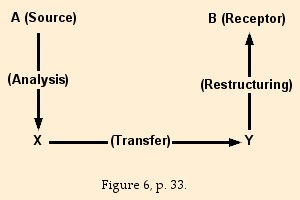
This same theory about kernels and transformations is found in Mildred Larson’s Meaning-Based Translation, where it is explained with different terms. Larson calls the kernels “propositions,” and says that (in the mind, somehow) these propositions are first associated in a “deep structure” or “semantic structure.” This “deep structure,” as described by Larson, consists of “a network of semantic units,” but she represents it as merely a list of propositions, and says that “in semantic structure the only ordering is chronological.” The “propositions” included in the “deep structure” are then transformed and linked together somehow on their way to the form in which sentences are actually spoken or written, which she calls the “surface structure.” Larson describes this theory as an “assumption” of her book. 13
Again, this account of language was invented by Chomsky, and it is known as “generative” or “transformational” linguistics. He and his followers have presented it as being in some sense scientific, but it is not based on empirical observations. It is speculative. The elementary “kernels” to which everything is reduced, and upon which everything is based, are only figments of the kind of grammatical analysis peculiar to generative grammar. And despite the use of the “kernel” metaphor, in which these postulated entities are compared to physical objects, they are not at all like physical objects, whose existence can be observed or demonstrated. They refer to unobservable processes of the subconscious mind. The existence of these kernels can no more be proven by empirical methods than can the æons of gnosticism. So here we are in the realm of unverifiable speculations, not empirical science. Nor does this theory have much explanatory power. The reductionistic account of language put forth here is quite incapable of explaining how human language works to create and convey complex thoughts and feelings. It brings to mind the lines in Goethe’s Faust about logicians who have tried to analyze human thought by reducing it to a few mechanical processes.
|
In truth the subtle web of thought
Is like the weaver’s fabric wrought:
One treadle moves a thousand lines,
Swift dart the shuttles to and fro,
Unseen the threads together flow,
A thousand knots one stroke combines.
Then forward steps your sage to show,
And prove to you, it must be so;
The first being so, and so the second,
The third and fourth deduced we see;
And if there were no first and second,
Nor third nor fourth would ever be.
This, scholars of all countries prize, —
Yet ‘mong themselves no weavers rise.
He who would know and treat of aught alive,
Seeks first the living spirit thence to drive:
Then are the lifeless fragments in his hand,
There only fails, alas! the spirit-band. 14
|
What Goethe calls the spirit-band (geistige Band) of the original web of thought (Gedankenfabrik) cannot survive all the methodical dismemberment it must suffer when reduced to a series of syllogisms, nor can it survive the similar treatment it receives in Nida’s “science of translation.”
As a theorist Nida was eclectic. He has been described as a basically Bloomfieldian linguist, but as we have seen above, he also borrowed from Chomsky, whose ideas were not compatible with Bloomfield’s. And I have found that the treatment of fundamental issues is perfunctory and shallow in the works of Nida. His assumptions are not clearly presented as assumptions — that is, they are not distinguished from findings or conclusions based on facts and analysis. His terms are not adequately defined. The process of thought is fast and loose, without a satisfactory analysis or discussion of basic concepts. There is a quality of cavalier spontaneity to his work, and one gets the impression that he is often “winging it.”
Nida’s statement, “Anything that can be said in one language can be said in another” is often quoted, sometimes without its continuation “unless the form is an essential element of the message.” 1 Obviously it is a theoretical statement with far-reaching implications. But if one goes to the source, in the first chapter of The Theory and Practice of Translation, one finds that this statement is made very arbitrarily, without any attempt to support it. It appears to have no more substance than a slogan. In the discussion that follows it, Nida also seems to have little regard for theoretical clarity or even the requirements of logic. I will reproduce the section and offer some comments on it.
Anything that can be said in one language can be said in another, unless the form is an essential element of the message.
For the average person the potential and actual equivalence of languages is perhaps the most debated point about translation. He does not see how people who have no snow can understand a passage in the Bible that speaks about “white as snow.” If the people do not know snow, how can they have a word for it? And if they do not have a word for it, then how can the Bible be translated? The answer to this question is both complex and varied. In the first place, many people have a word for snow, even if they have not themselves experienced it, for they have heard about the phenomenon. Second, in other instances, people do not know snow, but they do have “frost” and they speak about the two with the same term. Third, many languages have equivalent idioms, e.g., “white as egret feathers,” or “white as fungus” (if there is an especially white form of fungus); or they may use a nonmetaphor to express the concept “white as snow,” such as “very, very white.” The point is that snow as an object is not crucial to the message.
Some persons may object, however, and insist that unless one has a word for snow, the translation is not adequate, for anything which does not communicate the precise meaning of the original is a distortion. Of course no communication, even within a single language, is ever absolute (for no two people ever understand words in exactly the same manner), and we certainly cannot expect a perfect match between languages. In fact, we do not have such a match even in translating from Hebrew or Greek into English, with all its wealth of vocabulary (more than a million words if one includes all the technical terminology). When the Hebrew word hesed is translated into English as “loving-kindness,” or as “covenant love,” there is much left unsaid, for this Hebrew term implies a whole social structure of mutual loyalty and support between the tribal chief and his followers, a relationship quite strange to us and almost unthinkable to many people. Similarly, when the Gospel of John uses the Greek word logos, “Word,” in the prologue, there simply is no English word (and certainly not Word itself) which can do justice to the variety and richness of meaning of this Greek term.
It must be said, however, that if the form in which a message is expressed is an essential element of its significance, there is a very distinct limitation in communicating this significance from one language to another. It is usually impossible to reproduce this type of “meaning.” For example, in the third chapter of John, Jesus speaks of the “wind” and of the “Spirit.” In Greek a single word, pneuma, is used with both meanings. This results in a very significant play on words, but it cannot be reproduced in English. The best we can do under such circumstances is to use a marginal note to call the attention of the reader to the fact that in the source language one and the same word has both meanings.
In a similar way, we cannot reproduce the rhythm of Hebrew poetry, the acrostic features of many poems, and the frequent intentional alliteration. At this point, languages just do not correspond, and so we must be prepared to sacrifice certain formal niceties for the sake of the content.
To preserve the content of the message the form must be changed.
If all languages differ in form (and this is the essence of their being different languages), then quite naturally the forms must be altered if one is to preserve the content. For example, in Mark 1:4, the Greek employs a nominal construction, “baptism of repentance,” but translated literally into English the resulting phrase really does not convey the meaning of the original. The average person is simply unable to describe clearly what is the relationship between “baptism” and “repentance.” Moreover, in a high percentage of languages, terms which express events (and both “baptism” and “repentance” are events, not objects) are expressed more naturally as verbs, rather than as nouns. Even this Greek noun expression is really only a nominalization (or adaptation) of what occurs in Acts 2:38 in verbal form, namely, “repent and be baptized.” In languages which either require that such events be expressed as verbs or normally use verb rather than noun phrases, it is not only right, but essential, that the nominal form of this Greek phrase be changed into a corresponding verbal expression.
My purpose now is to observe the manner in which ideas are laid out and developed, and to contrast this with what a scholar would ordinarily expect to see in a theoretical treatise.
First we observe that the passage is obviously not intended to be a contribution to theoretical linguistics. It is written for translators, as a work of practical guidance, and it assumes that the reader is ignorant of some basic concepts. Nida begins with a comment about the views of the “average person,” as if his purpose were merely to correct a common layman’s mistake. Readers who are not linguists will get the impression that the “actual equivalence of languages” is not an issue debated by linguists, but an academic linguist would certainly notice the word anything in the clause, “anything that can be said in one language can be said in another,” and would know that among linguists this is controversial, to say the least. Most would reject it as an exaggeration, if by “another” Nida means an idiomatic translation into any dialect of any language whatsoever, without the aid of explanations. 2 A more defensible idea is expressed by Edward Sapir when he asserts that as far as the grammar is concerned, any given language has such a “formal completeness” that “no matter what any speaker of it may desire to communicate … the language is prepared to do his work,” but that improvements must sometimes be made in the vocabulary to give adequate expression to some thoughts. 3 Certainly no biblical scholar would agree that a translation can by itself convey the full meaning of a poetic and religious text from one language to another, without the need for commentary. If every exception to the anything in the first clause is supposed to be included in the category of exceptions where “form is an essential element,” then we must ask, what is meant by “form” here ?
As we read on, we find in the second paragraph that he seems to retreat from the extreme position that he appeared to take at first, by conceding that some words cannot be adequately translated. (The examples he gives can hardly be placed in the category where “form” is somehow responsible for the untranslatable semantic content.) And so it appears that by “anything” he might mean nothing more than what is called “crucial to the message” at the end of the first paragraph. Understood thus, however, the statement becomes empirically vacuous, and untestable. It expresses nothing more than a presumption that whatever is really important in the Bible can be conveyed in the translation somehow. So then everything depends upon what we decide is important, and apparently Nida does not think the meaning of chesed or logos is really important or “crucial to the message.”
He then goes on to discuss cases where he attributes meaning to “form,” and in his discussion of pneuma we learn that this includes the “significance” of a metaphorical comparison when it happens to exploit the ambiguity of a word. But in what sense can this be called a contribution of the “form”? And why does he put scare quotes around the word “meaning” in this context, as if to imply that the “significance” of the comparison could not properly be spoken of as being part of the “meaning” of the text? Again, we raise theoretical questions that would interest linguists, but he is not really addressing such theoretical issues. We begin to suspect that attributing meaning to “form” is just his hasty way of dealing with anything that cannot be expressed in translation. But if this is the case, then his sentence “Anything that can be said in one language can be said in another, unless the form is an essential element of the message” amounts to the tautological, “Anything that can be said in one language can be said in another, unless it can’t.”
Then we have the sentence, “If all languages differ in form (and this is the essence of their being different languages), then quite naturally the forms must be altered if one is to preserve the content,” in which we must infer that “content” is another way of referring to what he has called the “message” or the “meaning.” Or perhaps not. Why the shift in terminology? It seems we are being asked to make a distinction between “form” and “meaning” now. But as a linguist Nida knew that linguistic forms are themselves meaningful, and cannot be contrasted with meaning. In Toward a Science of Translating he gives an entire chapter to the discussion of the meaning that belongs to grammatical constructions or linguistic “forms,” a kind of grammatical meaning that he calls “Linguistic Meaning.” On the other hand, in chapter 8 of the same work he tried to make this distinction between “form” and “content”:
Messages differ primarily in the degree to which content or form is the dominant consideration. Of course, the content of a message can never be completely abstracted from the form, and form is nothing apart from content; but in some messages the content is of primary consideration, and in others the form must be given a higher priority. For example, in the Sermon on the Mount, despite certain important stylistic qualities, the importance of the message far exceeds considerations of form. (p. 156.)
With regard to “messages” he insists upon making a distinction between “form” and “content” even after saying that they cannot ultimately be separated. Apparently he concedes that the “message” is inseparable from the “meaning” of the text, and because form is always meaningful, we cannot say that the message is unaffected by the form. Nevertheless, he wants to suggest that there is a distinction between “form” and “content” that somehow acquires legitimacy under “considerations” that increase with the “importance of the message.” So it seems that the word “message” is now equated with “content,” and refers to something less than the full meaning of the text … or perhaps something more. But we cannot quite put our finger on what difference Nida has in mind, because he is not defining his key terms.
We observe also that the use of the terms “content” and “form” suggests an analogy, in which linguistic units are likened to containers of meaningful substance. There is a kind of implicit metaphor at work when we speak of language in this way. Analogies like this are often very helpful in teaching and learning, and so we are ready to entertain them, and they gain a certain plausibility on that account alone. But when doing intellectual work of this kind, one must be wary of arguments based upon analogies and metaphors, because they are often deceptive. As Sapir said: “Of all students of human behavior, the linguist should by the very nature of his subject matter be … the least taken in by the forms of his own speech.” 4
As an illustration of the “form” vs. “content” distinction he wants to draw, Nida begins to discuss the meaning of the Greek phrase normally rendered “baptism of repentance.” He claims that this rendering does not convey the meaning of the original, but that “repent and be baptized” does. But for those who know Greek this does not seem to be a reasonable statement, and so we require a strong argument. Obviously there is a difference in meaning between “preached, Repent and be baptized” and καὶ κηρύσσων βάπτισμα μετανοίας (“and preaching a baptism of repentance”). Are we to infer that according to Nida this difference in meaning does not involve a difference in “content”? If so, what makes “content” differ from “meaning”?
As a way out of these conundrums one might suggest that “content” be defined only as the “general idea” and not necessarily the precise meaning, but he does not say this. Later, on page 9, he says that “baptism of repentance” is “a transform of ‘repent and be baptized,’” and on page 52 he says that it reduces to a “set of kernels” that is “equivalent to the expression ‘repent and be baptized.’” So perhaps by “content” here he means the sum of the “kernels,” as an uncoordinated heap of little concepts. But he does not say that either. If he does not want to make any distinction between his terms “meaning” and “content,” then shall we say that the semantic difference is due to a difference in “form”? If so, what becomes of the distinction between “form” and “content”? These questions must be answered before Nida’s discussion can make sense on a theoretical level, but he does not address them at all.
Regarding the claim that “‘baptism’ and ‘repentance’ are events, not objects,” and that therefore it is somehow “essential” to transform the nouns into verbs to express the meaning, we observe that it involves a sort of fallacy in which nouns are associated only with objects—ignoring the fact that in addition to referring to “objects,” nouns also may refer to places, ideas, and conditions. “Repentance” and “baptism” are obviously not physical objects, but that does not mean that it is somehow wrong to refer to them with nouns. The word “baptism” in itself does not refer to a specific one-time event experienced by a single person, but to a religious rite or ordinance, and it is necessary to use the noun “baptism” if we want to talk about the rite or ordinance. It is also necessary to use the noun if we want to qualify the whole class of events that it denotes, with an adjective or other modifying phrase. That is what is going on in the phrase “baptism of repentance”—it is not just any baptism, it is a baptism that especially pertains to repentance. As for the word “repentance,” it is not merely a “nominalization” of an “event,” it refers to a condition which is not reducible to an event, hence the use of a noun instead of a verb. All of this meaning falls away in the transformation that Nida proposes. The meaning cannot really be separated from the syntactic form, because the nominal form enables us to express a concept that the corresponding verbs cannot express in themselves. To a linguist, the importance of the form to the meaning here should be obvious enough. Yet Nida is using this as an example of how unimportant the form is to the “content.” 5
In this same paragraph, we also notice that in Nida’s opinion a translation “does not convey the meaning of the original” if the reader is “unable to describe clearly what is the relationship” between the two nouns in the genitive phrase. But obviously the original text itself does not make this clear, because it is not the purpose of the author to make it clear just now. So Nida is really faulting the author, not merely the translation. We also notice the rhetorical stridency of his last sentence, where he declares that it is “not only right, but essential” to abide by whatever is thought to be “normal” in a language. This pulpit-pounding is out of place in a scientific treatise.
As a work of linguistic theory, therefore, we must say that this discussion is very inadequate, especially if it is supposed to be received as authoritative. The author imposes very much on his readers with an air of authority, but his ideas are half-baked. He seeks to make a strong impression with exaggerations, but neglects to define his terms in such a way that his statements become fully clear, testable and falsifiable, or even logically coherent. He eludes theoretical problems through vagueness, verbal shifts and other rhetorical devices, and fails to interact appropriately with scholarly literature. He surreptitiously introduces false dichotomies by implication. On close examination his examples backfire and cast doubt upon his analysis. The casual presentation of ideas here is more like an informal essay than a serious work of theoretical scholarship. If the book purported to be a serious theoretical treatise, its author would not be allowed to get away with such a careless discussion without having dealt more adequately with the same issues elsewhere. But I have not been able to find a more careful and rigorous treatment of the same issues in other works of Nida and his school.
I do notice that in an article published many years later, in 1995, Nida seems to have given up his earlier attempts to draw distinctions between linguistic “form” and “content.” He writes: “One thing is clear: the old distinctions about form versus content and literal versus free are no longer valid since they imply quite false dichotomies.” 6 But even this is problematic. He speaks of “the old distinctions” without mentioning that the “form versus content” distinction was his distinction, and we have good reason to doubt that he was ever really serious about it. And although we must agree that Nida’s attempt to associate “meaning” with “content” while distinguishing “form” and “content” is untenable, because it does amount to a false dichotomy, in which “meaning” is set against “form,” we do not agree that “literal versus free” involves any illicit dichotomization, because “free” and “literal” have always been understood as relative terms that indicate the positions of translations on an unbroken continuum. There is no dichotomization in this, only a gradation. It does not take much thought to see this difference. But once again, Nida is seen to be a careless thinker.
His attempt to make a distinction between “form” and “content” in language is really nothing more than an attempt to insinuate the idea that “form” is not important to the meaning, without saying it so plainly that the idea will be rejected immediately by informed readers. He needs this idea for his argument, because he must somehow associate “formal equivalence” with meaninglessness in order to set it over against “dynamic equivalence” or “functional equivalence.” But the attempt fails, because despite all his theorizing it remains only too plain that a formal equivalence is often needed to preserve the meaning which belongs to the form, and thus a true “functional equivalence” actually requires a formal equivalence. If the “receptor” language into which we are translating lacks grammatical forms which correspond closely to those of the original language, we are faced with the same problem that presents itself when the vocabulary is inadequate: it may not be possible to bring the meaning across without distortion. If a language is incapable of using nouns to talk about events and conditions, it may not be possible to express the meaning of “baptism of repentance” accurately and concisely in that language, because a successful transfer depends upon both lexical and grammatical equivalence.
The history of theoretical linguistics does not inspire much confidence in the field as a “science.” The field is highly speculative, and intellectually turbulent. There have been many conflicts about basic theoretical problems between 1920 and the present day. At present it seems that the basic ways of thinking about language that Nida and his followers had taken for granted are coming to be seen as obsolete.
In his writings on translation Nida liked to represent language as a kind of vessel or code which somehow carried thoughts from one mind to another. Hence the “form” versus “content” dichotomy, and his frequent use of the terms “coding” and “decoding” in connection with “messages.” The model served well enough to describe what happens in some very simple linguistic events, in a culturally sterile laboratory of theory. But it cannot serve very well as a model of language in general.
The trouble with the “code” analogy is, it implies that the whole meaning intended by a speaker or writer is “encoded” and “decoded” without relying much upon a shared body of knowledge, beliefs, presuppositions, expectations, and so forth. Language does not normally convey culturally-disembodied “messages” from one mind to another. It is more like a system of activating signals that invoke, vivify, combine, and modify various elements of a pre-existing and shared body of knowledge. It is not possible to “encode” the elaborately ramified “message” of the Bible in such a way that it might be “decoded” by those who lack the cultural knowledge that it presupposes. Trying to accomplish this in a translation is like trying to transplant a full-grown tree by cutting it off at the roots and sticking it into the ground in another place.
It is strange that such obvious things need to be stated. But this is the result of the abstract approach to language that Nida represents, which focuses on universal theories and models. As I point out in another essay, 1 after 1940 the trajectory of American linguistics has followed this path, after sharply separating itself from anthropological, psychological, historical, and literary studies. Edward Sapir had resisted efforts along this line, and at Yale he opposed the creation of a Department of Linguistics because saw the study of language as an activity which should be pursued by scholars with extensive training in other disciplines. Sapir had emphasized the particularity of languages and the need to study them in their cultural contexts. “Language is primarily a cultural or social product and must be understood as such.” 2 Verbal communication within the context of a developed culture takes much for granted, and is highly efficient: “Generally speaking, the smaller the circle and the more complex the understandings already arrived at within it, the more economical can the act of communication afford to become. A single word passed between members of an intimate group, in spite of its apparent vagueness and ambiguity, may constitute a far more precise communication than volumes of carefully prepared correspondence interchanged between two governments.” 3 Of some relevance here is Edward T. Hall’s distinction between “high context” and “low context” cultures, and the communication styles that pertain to each. 4 Public communication in our culturally shallow and deracinated society tends to be “low context,” requiring little cultural conditioning to be understood. But the Bible has the communication style of a very “high context” culture. Nida, as a follower of Bloomfield and Chomsky, tried to analyze linguistic communication as if it were all “low context,” and his program of translation is an attempt to transform the Bible into a “low context” document.
Outside of America, linguists have never been very supportive of the approach taken by Nida. European linguists have always placed much more emphasis on the connection of language to culture. And some linguists who have written in English on the subject of Bible translation in recent years have begun to show some awareness of what is really involved in Biblical interpretation. Ernst-August Gutt, for instance, has written several articles on this subject, in which he takes advantage of a new development in linguistics known as “relevance theory” to promote more adequate ideas about translation.
We all know from everyday experience that reading literature not written especially for us or eavesdropping on conversations between people whose background we do not share usually causes comprehension problems. This, then, being the case, how can one overcome these problems in Bible translation?
No doubt, the first and possibly most important step is that we, as Bible translators, fully acknowledge the existence of this problem. We need to lay aside the misconception that the meaning of biblical texts can be successfully communicated regardless of the receptors’ background knowledge. As I have tried to point out in my book Translation and Relevance (2000) and other writings, this idea is rooted in the code model paradigm, which lacks an adequate understanding of the inferential nature of communication and of the crucial role played by contextual information.
Secondly, Bible translators need to understand the true extent of contextual difference between original and target audiences and the magnitude of the communication problems they cause. Though context is referred to in translation literature, the vast amount of information it often involves has generally been seriously underestimated. For example, the opening verse of the epistle to the Hebrews (1,1) in the Revised Standard Version reads: “In many and various ways God spoke of old to our fathers by the prophets (polymeroos kai polytropoos palai ho theos lalesas tois patrasin en tois prophetais) …”
With the original readers, the Greek word prophetais (“by the prophets”) would access presumably large encyclopedic entries, full of information about the events of the history of Israel and of the prophets, such as Moses, Elijah, Isaiah, Jeremiah, and others. With all this information accessible in the minds of the audience, the expressions polymeroos (“on many occasions”) and polytropos (“in many ways”) would encourage the readers to recall a range of events from different times that illustrated the different ways in which God spoke through the prophets. Thus with a very few words, the author evoked in his readers’ minds a wealth of information spanning Old Testament history, for example, the giving of the law at Mount Sinai, God’s communications with Israel during the wanderings through the wilderness, the miracle of the fire coming down on Mount Horeb, and the visions God gave through Ezekiel.
At the same time, the author here leaves much to the audience: he gives no guidance as to any particular incidents they should consider. In relevance-theoretic terms, this is a clear example of weak communication: the author activates a wide range of information, but leaves to the readers which particular instances to recall — Moses, Elijah, and Samuel, for example, or Abraham, Daniel, Amos and Jeremiah — any selection satisfying the terms polymeroos and polytropos would do. Thus there would be a rich set of weakly implicated assumptions, that is, weak implicatures. Typically, code-model based accounts of and approaches to Bible translation have little, if any, recognition of weaker implicatures. Bible translation literature dealing with this particular passage, for example, does not usually address the existence of all this information nor how the translator might succeed in conveying it to the receptors. 5
I ought to mention that although Gutt writes in English, he is a German, who received his degrees at the University of London, and perhaps it says something about the present situation that we quote a person of this background to indicate the existence of serious intellectual opposition to theories of “dynamic equivalence.” But the cultural emphasis of Gutt is quickly gaining ground among American linguists. “Relevance Theory” in itself will not bring any improvement, because it is just another abstract theory of how language works, and its ideas might even be used to support the worst abuses of “dynamic equivalence.” But it does firmly set aside the “code” model.
Biblical scholars have always emphasized the importance of background knowledge, and have never felt a need for any formal theory of communication to justify this emphasis. To them it is perfectly obvious that the biblical text cannot be fully understood by those who have not studied the language and religious culture of the authors. A theory of translation that pretends to make exegetical comment unnecessary would be seen as simply foolish and irrelevant. But a formal linguistic theory that recognizes this fact is at least a welcome corrective to the more naive ideas that have been promoted in the field of translation theory after Nida. One biblical scholar, C. John Collins, has therefore criticized Nida’s simplistic code model of communication along the same lines as Gutt:
Consider what place a text has in an act of communication. It is far too simple to say that we have a speaker, an audience, and a message that connects them. Rather, we should see that the speaker and audience have a picture of the world that to some extent they share between them: that picture includes, for example, knowledge, beliefs, values, experiences, language, and rhetorical conventions. For example, I am writing this essay in English, and I assume that you know what I mean by “the Hebrew Bible.” A text is a means by which the speaker (or author) operates on that shared picture of the world to produce some effect (the message) in the audience; perhaps by adding new things for them to know, or by correcting things that they thought they knew; or by drawing on some part of it (such as their experience of God’s love) in order for them to act upon it; or by evoking some aspect of it for celebration or mourning; or even by radically revising their orientation to the world (their worldview). The authors and their audiences also share linguistic and literary conventions, which indicate how to interpret the text; for example, everyone who is competent in American English knows what to expect when a narrative begins with “once upon a time.” For an audience to interpret a text properly, they must cooperate with the author as he has expressed himself in his text. (In terms used by the linguists, the “message” includes such things as illocutionary force, implicatures, and so on.) 6
Evidently Collins has been reading about the recent contributions of “relevance theory” to theoretical linguistics, which emphasizes the wealth of “implicatures” (things implied or taken for granted by the author, which must be understood by the reader to get the meaning) in almost any communicative act.
Not everyone in the wide field of linguistics appreciates this new emphasis on the importance of “shared background” in communication. Translation theorists who have always sat at the feet of Nida can be expected to resist any fundamental change in their theoretical orientation. But we hope it will eventually dawn upon them that a translator can never succeed in conveying what the author of the epistle to the Hebrews meant by “the prophets” if the reader is not acquainted with the prophetic writings. Nor can a translation make readers understand why the New Testament begins with a genealogy, in which our Lord is introduced as a son of Abraham, if they are ignorant of the Old Testament. There is no magical science of translation that can make this historical and cultural preparation for the gospel unnecessary.
There are innumerable small inaccuracies in modern translations that appear to have arisen by a general lack of carefulness. But I suspect that, as translators are pushed out of the habit of giving literal renderings, and are expected to give more attention to stylistic matters, the work just becomes too complex and difficult for many of them to handle. There is certainly an increase in the demands put upon translators when they are expected to make everything not only accurate but also fluent and clear to every reader. Probably many of them are not skillful enough in English, or are not given enough time to do the job well. It is like a business owner asking his accountant to answer the phone, which rings every 30 seconds. We should not be surprised to find a number of errors in the account books at the end of the day.
In Hebrews 3:12 the Greek reads, Βλέπετε, ἀδελφοί, μήποτε ἔσται ἔν τινι ὑμῶν καρδία πονηρὰ ἀπιστίας ἐν τῷ ἀποστῆναι ἀπὸ θεοῦ ζῶντος. Literally this says, “Take care, brethren, that there will not be in any one of you an evil heart of unbelief, in apostasy from the Living God.” We would expect a careful scholar to notice here the emphatic expression “in any one of you” (ἔν τινι ὑμῶν). This is not the same as saying “in you” (ἐν ὑμῖν). The readers are urged, collectively, to take care that no one in their congregation, insofar as they can prevent it, should have such an unbelieving heart as to apostatize. And so in the following verse it continues, “encourage one another … lest any of you be hardened.” Evidently the purpose here is not to urge self-examination, but to enjoin the brethren to care for one another’s souls. 1 But the NLT says “Be careful then, dear brothers and sisters. Make sure that your own hearts are not evil and unbelieving, turning you away from the living God.” Thus the focus is turned inward, with each caring for himself. The RSV and ESV also distort the sense in this direction by adding “you” in the last clause: “Take care, brethren, lest there be in any of you an evil, unbelieving heart, leading you to fall away from the living God.” This is an error.
I do not doubt that the RSV translators knew the difference between ἔν τινι ὑμῶν and ἐν ὑμῖν. It only goes to show that even the most competent scholars will produce slipshod work when they are distracted and burdened by stylistic requirements. It is sometimes not easy, even for the most expert scholar, to give an accurate translation while making sure the style is fluent and clear. In the present case, the problem originated with a feeling that the last phrase must be made more fluent in English than a literal rendering would permit. The literal rendering in the ASV (“in falling away …”) was thought to be too awkward. 2 Therefore the translators made a limited use of the “dynamic” approach to translation, recasting the phrase and adding “you,” mainly for the sake of a fluent and clear expression; but in the process of making this little stylistic adjustment at the end, it escaped their notice that the meaning of the whole sentence was retroactively altered by it. The ESV revisers have in many places improved the accuracy of the RSV, but they failed to correct the inaccuracy here.
One of the editors of the New Revised Standard Version has said that the peculiar stylistic requirement under which they labored, of “insuring that the language was properly inclusive,” involved the translators in problems which were “often extremely difficult” and “very time-consuming, since the resulting text had to sound like normal English.” 3 The basic problem was, they were being required to produce a translation in a style which is not normal in English, and which seriously interfered with their ability to produce an accurate translation of the Hebrew and Greek. He reports that “three members of the committee, representing both the Old Testament and New Testament sections, resigned with the complaint that an inordinate amount of time was being spent on matters that seemed to them essentially trivial rather than on issues of substantial scholarly concern.” 4 Another editor of the version reports that the Old Testament committee “worked hours on” their attempt to produce a stylistically acceptable translation of a single verse, Genesis 9:6, without using the word “man.” 5 The result of their hours of work on this verse was, “Whoever sheds the blood of a human, by a human shall that person’s blood be shed; for in his own image God made humankind.” Yet even this awkward rendering was condemned as “sexist” by one constituency that the editors had hoped to please, because of its use of the pronoun “his” in reference to God. 6 In order to achieve the degree of “inclusiveness” that was desired by the editors, it was finally necessary for a small committee of “inclusive language” commissars to go over the whole version before its publication. Afterwards one of the translators reported that “when members of the full committee became aware of the extent of these changes, many were outraged, feeling that much of their own work on the translation over the years had been irresponsibly gutted.” 7 Needless to say, we are more inclined to sympathize with the translators who were trying to make an accurate translation, than with the editors who imposed such vexatious and essentially political requirements of English style. This unfortunate episode may also be seen as another instance of the “Criterion of Acceptability” at work, whose theoretical problems we have fully examined in a previous chapter. Here we simply note that the stylistic requirements imposed by the editors created such difficulties for the committee of scholars that some of them were not even willing to continue the work.
In the case of stylist-scholar teams, the usual process of translating should be reversed. Rather than having a scholar prepare a somewhat literal translation which is then revised by a stylist, it is the stylist who should prepare the first draft, but only on the basis of extensive preliminary discussions with the biblical scholar. Only later is the text gone over carefully by the scholar and various options discussed. —Eugene Nida, From One Language to Another (Nashville: Thomas Nelson, 1986), p. 192.
An old saying goes, “Laws are like sausages — it is best not to see them being made.” The same thing could be said about some versions of the Bible. People who know how they were made are not likely to have much respect for them.
It should be made known to readers of some modern versions that not everything in them can be attributed to the biblical scholars who are employed by the publisher as members of the “translation team.” People tend to assume that the scholars were the actual translators of the version, and that they are responsible for whatever is finally published. We have this picture of several expert scholars sitting around a table and hammering out the version together, over a period of years, with very learned discussions, followed by voting. And when all is finished, people imagine that the manuscript goes straight from the scholars’ conference table to the printer. This is a substantially true picture of how some versions in the past came into being. The King James Version, the English Revised Version, and the Revised Standard Version were created by such a confidence-inspiring process. But in the case of many modern versions, the picture is substantially false. The more usual procedure now is for a publisher to enlist various scholars as “reviewers” or “consultants” who send suggestions for portions of a version that is being revised by the publisher’s editorial staff. The scholars never sit down at a table together, and there is no voting. It is really the editors who create the version, although they are usually not scholars of any great reputation.
The rationale for this way of doing things was provided by Nida in his book The Theory and Practice of Translation (Leiden: Brill, 1969), in which he states that “too much knowledge of the subject matter” of the Bible is undesirable in a translator (p. 99), because “theologically trained persons have special problems in learning how to translate for a level other than the one on which they habitually operate” (p. 100). So it is better for the first draft to be produced by a “stylist” who “has some grasp of the source language but is not a scholar in it,” and afterwards a real scholar can review it, “bringing to the attention of the stylist errors of various kinds” (p. 103). He claims that “experience has shown that it is much easier to achieve the proper combination of accuracy and adequate style in this manner than in the more traditional approach in which the scholar translated and the stylist corrected” (p. 103). The stylist “should not have too much acquaintance with the traditional forms of the Scriptures.” If he “knows the Bible too well, he is likely to be deceived by his very familiarity with the text and thus let many things slip past which really do not make sense” (p. 157). Moreover, the final draft should be submitted to “a stylist who is not a Christian, or at least who is not familiar with the Bible” (p. 104). In an appendix to the same book, Nida admits that “not all reviewers will give as much time to this work as they should” (p. 185), but he seems more interested in emphasizing that their role should be limited: “From time to time the reviewers may be called together to discuss a specific agenda covering points on which the translators need guidance, but they should not meet as a committee to discuss in detail all that the translators have done. It should be emphasized that their function is supplementary and advisory. They do not constitute a committee of censors.” (pp. 179-80.) And again: “In some projects the reviewers have insisted on meeting together as a committee and going over the whole draft verse by verse. This is rarely a desirable approach. Not only can such a committee spend endless hours debating over details, but the end results are rarely as good as the work of the translators which was the basis of the discussion. The reviewers and the consultative group 1 should remember that it is not their work to be censors.” (p. 186.)
Now, it is certainly true that a committee of scholars is likely to produce a more literal version, and one that requires more from the reader. But we observe here, how the corrections that might have been made by a committee of careful scholars are disparaged as “censorship,” and how their deliberations are dismissed as nitpicking — “endless hours debating over details.”
Under this kind of arrangement, where scholars are merely asked to make suggestions by mail, one can never be sure whether at any given point the translation really represents the consensus of scholarly opinion, or even the opinion of anyone who was paid to “review” the version for accuracy. The first draft and the final decisions are made not by scholars, but by people who do not have “too much knowledge” of the Bible to produce the kind of “dynamic equivalence” that is desired by the publisher.
English versions that have been produced by such a process include some well-known ones, including the New Living Translation, the Good News Bible, the Contemporary English Version, and the New Century Version. The publishers of these versions have been less than frank about it in their prefaces and in their advertising, and for obvious reasons. They would not want the public to see their sausage-factory in operation. The Bible version that emerges from this process is not even primarily the work of professional scholars. The publishers have even rejected the whole concept that a Bible translation should be made by professional scholars.
In another passage of Faust, Goethe gives us a scene full of irony, as Faust sits down to translate a passage of the New Testament.
|
Our spirits yearn toward revelation
That nowhere glows more fair, more excellent,
Than here in the New Testament.
To open the fundamental text I’m moved,
With honest feeling, once for all,
To turn the sacred, blest original
Into my German well-beloved.
He opens a volume and applies himself to it.
‘Tis written: “In the beginning was the Word!”
Here now I’m balked! Who’ll put me in accord?
It is impossible, the Word so high to prize,
I must translate it otherwise
If I am rightly by the Spirit taught.
‘Tis written: In the beginning was the Thought!
Consider well that line, the first you see,
That your pen may not write too hastily!
Is it then Thought that works, creative, hour by hour?
Thus should it stand: In the beginning was the Power!
Yet even while I write this word, I falter,
For something warns me, this too I shall alter.
The Spirit’s helping me! I see now what I need
And write assured: In the beginning was the Deed! 1
|
As we noted above, the word λογος in the prologue of John’s Gospel presents a problem for translators. Faust begins to tackle the problem sincerely enough, but in the end he wanders far from the meaning of the Greek word, and sees in it only a reflection of his own ruminations on the need to turn away from mere words to the essence of things, and to deeds. The irony is that he imagines the Spirit is helping him, but what spirit is really present? In the room with him is Mephistopheles, the demon to whom he will turn for help at the peril of his soul.
A translator must indeed be careful. Weighty theological lessons sometimes depend upon having a strictly accurate translation of the Bible. A good example of this may be seen when we compare Bible versions at Genesis 50:20. Here as Joseph comforts his brethren he makes a statement full of theological implications. The ESV gives us a literal rendering of the verse: “As for you, you meant evil against me, but God meant it for good, to bring it about that many people should be kept alive, as they are today.” This is truly an interesting statement, often quoted by theologians in the context of explaining the sovereignty and providence of God behind even those events which seem to be evil. As John Calvin explains in his Genesis commentary here,
The selling of Joseph was a crime detestable for its cruelty and perfidy; yet he was not sold except by the decree of heaven. For neither did God merely remain at rest, and by conniving for a time, let loose the reins of human malice, in order that afterwards he might make use of this occasion; but, at his own will, he appointed the order of acting which he intended to be fixed and certain. Thus we may say with truth and propriety, that Joseph was sold by the wicked consent of his brethren, and by the secret providence of God.
Yet what does the user of the New Living Translation read here? “As far as I am concerned, God turned into good what you meant for evil. He brought me to the high position I have today so I could save the lives of many people.” Here there are several things that might be pointed out which vitiate the theology implicit in Joseph’s words. We wonder how the phrase “As far as I am concerned” can be justified here, because it corresponds to nothing in the Hebrew text and it makes the statement merely an opinion rather than a statement of fact. This in itself is an important change in the meaning of the verse. We notice that the phrase “He brought me to the high position I have today” has been inserted. So instead of the bald statement that God planned the harmful action of the brothers for the good of many (this is even clearer in the Hebrew than in the literal English), a good thing is inserted, namely Joseph’s prosperity, as the thing that God used as the means of saving people. We see that “so I could save the lives of many people” attributes the good outcome to the will of Joseph rather than attributing it to the will of God alone, as in the Hebrew. But we notice especially the paraphrastic rendering “God turned.” Gone from the verse is the mysterious secret providence of God, expressed in the words “God meant it,” which required Calvin’s explanation, and in its place we see that the New Living Translation has substituted the idea that God afterwards “turned” evil actions to his use. So in at least four ways in this one little verse the use of “dynamic equivalence” has obscured an important theological lesson which shines through in the literal rendering. Probably the NLT translator believed that he was helping the reader to understand the verse with these adjustments, but for all the good intentions we may attribute to the translator we perceive in this officious meddling with the text the hand of someone who is attempting to change not only the verbal form but the very teaching of the verse into something that is easier to understand and accept. 2
It is often said by advocates of dynamic equivalence that “all translation is interpretation” or “all good translation involves interpretation.” 3 This statement is true; yet it is dishonest, if it is designed to distract attention from the fact that some translations are more interpretive than others. Like most things in life, it is a matter of degree, and the difference in degree can be important. If a doctor who wanted to do elective surgery on a patient knew that the patient’s health would probably be ruined by it, he could not escape responsibility by shrugging his shoulders and saying “well, all surgery involves risks.” Some surgery carries little risk, some is very risky. Some is absolutely necessary to save the patient’s life; some is purely optional, and does not improve the health of the patient at all. And the same is true of translations. Some interpretation is necessary, and some is not. Take for instance Philippians 2:13, which in the Greek reads, θεὸς γάρ ἐστιν ὁ ἐνεργῶν ἐν ὑμῖν καὶ τὸ θέλειν καὶ τὸ ἐνεργεῖν ὑπὲρ τῆς εὐδοκίας. A translation that involves very little interpretation is, “for it is God who works in you, both to will and to work for his good pleasure” (ESV). The interpretation here is so obvious and so minimal that probably the translator was not even aware of having interpreted the verse, but it does involve some assumptions and some obligatory interpretation: for instance, it assumes that by θεὸς Paul means “God” and not “a god,” and that by ἐν he means “in” rather than “among.” But now compare this with the much more interpretive and riskier translation of the Common English Bible: “God is the one who enables you both to want and to actually live out his good purposes.” Here ἐνεργῶν ἐν ὑμῖν has been interpreted, “who enables you.” This is certainly more interpretive, and it is also highly qestionable, because the verb ἐνεργέω does not mean “enable.” It means “be operative, be at work, put forth power” (Thayer), “be at work, operate, be effective” (BAGD). H.C.G. Moule observes that “the Greek word has a certain intensity about it, ‘worketh effectually.’” 4 The translation neglects to convey what the text actually says (“who works effectually”) and offers instead a notion of how God might be said to work in the heart and life of the believer if his working were not really effectual. Evidently the translator reasoned that God must be at work in the believer indirectly and non-effectually by “enabling” him to want and to do this or that, rather than simply causing him to want or do these things, although that is by no means what the text says. The interpretation injected here goes beyond what is necessary for a grammatical and understandable English sentence.
In connection with this interpretation we note what Calvin writes on the verse:
It is God that worketh. This is the true engine for bringing down all haughtiness — this the sword for putting an end to all pride, when we are taught that we are utterly nothing, and can do nothing, except through the grace of God alone. I mean supernatural grace, which comes forth from the spirit of regeneration. For, considered as men, we already are, and live and move in God. (Acts 17:28.) But Paul reasons here as to a kind of movement different from that universal one. Let us now observe how much he ascribes to God, and how much he leaves to us. There are, in any action, two principal departments — the inclination, and the power to carry it into effect. Both of these he ascribes wholly to God; what more remains to us as a ground of glorying? Nor is there any reason to doubt that this division has the same force as if Paul had expressed the whole in a single word; for the inclination is the groundwork; the accomplishment of it is the summit of the building brought to a completion. He has also expressed much more than if he had said that God is the Author of the beginning and of the end. For in that case sophists would have alleged, by way of cavil, that something between the two was left to men. But as it is, what will they find that is in any degree peculiar to us? They toil hard in their schools to reconcile with the grace of God free-will — of such a nature, I mean, as they conceive of — which might be capable of turning itself by its own movement, and might have a peculiar and separate power, by which it might co-operate with the grace of God. I do not dispute as to the name, but as to the thing itself. In order, therefore, that free-will may harmonize with grace, they divide in such a manner, that God restores in us a free choice, that we may have it in our power to will aright. Thus they acknowledge to have received from God the power of willing aright, but assign to man a good inclination. Paul, however, declares this to be a work of God, without any reservation. For he does not say that our hearts are simply turned or stirred up, or that the infirmity of a good will is helped, but that a good inclination is wholly the work of God.
Perhaps not everyone will agree with all that Calvin says here. But it must be admitted that it requires no torturing of the text. The same cannot be said for the Arminian gloss of the Common English Bible, which pointedly excludes Calvin’s thoughts, by playing fast and loose with the words of the Apostle. This manipulation of the text in translation is not excusable on the grounds that “all translation is interpretation.”
Someone might object to our criticism by saying that the method of dynamic equivalence itself cannot be blamed for misinterpretations. It is the fault of the translator, not the theory, because the translator must understand the original text before he can recast it in equivalent English expressions. Yet does it surprise anyone that when so much emphasis is placed upon the ease of the reader, we find not only easy language but also easy theology? Moreover, it is an impractical theory which requires the translator to interpret the text so thoroughly while avoiding interpretations that flow naturally from his own intellectual presuppositions. It expects something that we cannot reasonably expect from a human being. In his book The Text of the Old Testament, Ernst Würthwein emphasizes the importance of taking a psychologically realistic view of Bible versions:
For a long period the versions were approached rather naively and used directly for textual criticism on the uncritical assumption that the base from which they were translated could be readily determined. But the matter is not that simple. Anyone who translates also interprets: the translation is not simply a rendering of the underlying text but also an expression of the translator’s understanding of it. And every translator is a child of his own time and of his own culture. Consequently every translation must be understood and appreciated as an intellectual achievement in its own right. This is especially true of the versions of the Bible which were produced to meet the practical needs of a community. Most versions of the Bible have been the work of anonymous translators (usually of many translators) who have given concrete expression in their work to the intellectual assumptions of their age and their culture, the religious and other opinions which they adhere to or respect, the prejudices and concerns which they adopt consciously or unconsciously, their education, their ability to express themselves, the conceptual range of the language they are translating into, and many other factors. We must therefore distinguish between what comes from the original text and what is added by the translator—a formidable task to accomplish before we can use the versions for purposes of textual criticism. 5
Here Würthwein is speaking of ancient versions of the Old Testament, such as the Greek Septuagint, the Aramaic Targums, and the Latin Vulgate; but what he says concerning these ancient versions must also be said about modern English versions. And if it is “especially true of the versions of the Bible which were produced to meet the practical needs of a community” — i.e., versions like the Targums, which have their contemporary readers very much in mind, and which aim to make the text highly accessible and pertinent to them — then it is also especially true of modern English versions that are of this same character. This warning about the use of highly interpretive versions does not lose its relevance when the versions are modern, and it pertains just as much to simple questions about the meaning of the Greek and Hebrew words as it does to the specialized text-critical research of scholars like Würthwein.
Scholars never trust ‘dynamic’ translations, because they know from experience the strength of the tendencies which lead even learned men to accommodate any admired author to their own mentality. At one time the prestige of Aristotle was such that philosophers, at least, could hardly be trusted to quote him accurately! In 1813 one complained “how easy it is for a translator of Aristotle (in consequence of the unparalleled brevity which he sometimes effects) to accommodate the sense of the original, by the help of paraphrastical clauses, expressed in the phraseology of modern science, to every progressive step in the history of human knowledge. In truth, there is not one philosopher of antiquity, whose opinions, when they are stated in any terms but his own, are to be received with so great distrust.” 6 This is even more true of St. Paul, whose rapid style gives many occasions to interpreters.
We might as well notice here the role that Nida’s theories have played in recent controversies about missionary “contextualization” of the Christian religion, reconceptualizations of biblical theology according to the worldview and thought-forms of various cultures. In the 1970’s Charles Kraft of Fuller Theological Seminary even used the phrase “dynamic equivalence” in reference to this, urging the creation of “dynamic equivalence churches” in which principles of “dynamic theology” would allow the development of indigenous “ethnotheologies.” 7 Various things which are being done under the banner of contextualization and “ethnotheology” are clearly syncretistic. For example, missionaries may explain the efficacy of prayer in line with Voodoo concepts about magical utterances, or Jesus could be described as being the son of the most powerful deity already being worshiped by a tribe. “Contextualizations” like this are now common on the mission field, even among missionaries associated with reputedly conservative mission agencies such as the Wycliffe Bible Translators. 8
This kind of thinking is not confined to missionary theorists and translators in primitive places. Recently one of Nida’s disciples wrote:
I have studied how a number of theologians and preachers discuss the move from time-bound text to timeless theological truths. I have noticed that a model that has not been as widely used or influential in hermeneutical circles as I think it should be is the process of Bible translation known as dynamic equivalence (or functional equivalence). The heart of dynamic equivalence translation theory is the attempt to create the same impact in the receptor language of those who are hearing the text now as was created in the original audience of the text. In order to do this, Eugene Nida and others have developed a complex model of translational theory. I recognize that this theory has both shortcomings and strengths, and that it is the subject of considerable debate, in which I have been a participant. The intricacies of that debate are not my concern here, though I will say that virtually all debate over Bible translation theory today takes as its starting point Nida’s dynamic equivalence, which tries to move from one language and context—an ancient and sacred one—to a modern language and context. My contention is that this is the task not only of translation, but also of theology itself, and that the procedure of one may well be essentially the procedure of the other.
I will try to summarize the theory. The notion is that one must first determine the kernel or heart of what is being said in the original text. In translation theory this is applied to the sentence, but I think that the notion can be and often is extended to larger units, including larger theological units. This requires a process of differentiating the essential from the ephemeral, the enduring from the contingent, the pertinent from the impertinent. Then one must put this kernel into the equivalent form of expression in the receptor language—today’s theological language—so that it has the same effect on the present receiver as it did on the first hearer.… We may have to return to how we formulate our theology in each day and age, and with various receptor groups in mind, but that seems consistent with how the original gospel message was presented; within a context, but without losing its christological center. 9
It might be argued that this goes beyond what Nida himself had in mind for Bible versions, but there are many programmatic statements in favor of cultural contextualization in Nida’s published works, with extensive discussion of examples, and it is difficult to say where he might draw the line between dynamic equivalence and contextualization. In his books he mixes these things together so much that it is sometimes hard to tell which of the two subjects is under discussion. In any case Nida himself clearly wished to convey the idea that dynamic equivalence and contextualization are intrinsically related, being two aspects of the same principle of immediate “equivalent effect” in communication, and so it is not unfair for us to connect these things also. At bottom they are related, and our attitude toward contextualization will have implications for our evaluation of dynamic equivalence. The root of both is the idea that everything important in the Bible can be so thoroughly naturalized that it does not seem to be foreign to the language and culture into which it is introduced, and that if there is anything that cannot be so naturalized, it must not be “essential” to the message or “pertinent” to modern readers of the Bible.
In the pursuit of contemporary relevance, the Bible translator had better beware of what spirit is helping him.
 Much of the support for paraphrastic Bible versions has been due to the desire of some to provide a version which children might be able to understand. This is well-meant, but I think it should be obvious to anyone who is really familiar with the Bible that it was not written for children. Let us be realistic. We have always had catechisms and Bible story books for the children, and anyone who has been involved in teaching the children knows very well that these supply more than enough material for young minds; and they are far better suited for the education of children than any simplified version of the Bible can be. There is only so much one can do with the Bible to make it clear or interesting to children, and in the end a selection of passages is going to be made anyway—which, if it is a good selection, will differ little from the selection in the old Bible Story books. I remember that when I was a child in Sunday school we did have copies of the “Good News for Modern Man” New Testament on hand (I still have the copy that was presented to me one “promotion Sunday”), but I also remember that we did not use it. The catechism took up all of our time. The truth is, there is no good reason why the Bible should be adapted for this purpose. And there is a danger in it. The danger is, the Bible simplified for children will become the Bible of adults. I have seen “Good News” Bibles in the pews of mainline churches. The American Bible Society had removed the cartoons for this “pew bible” edition. And then there is the case of the Living Bible, which Ken Taylor originally meant for children, and yet Billy Graham quickly made it into one of the most popular versions for adults. 1 This was bound to happen, given the mental laziness of so many people, both in the pew and in the pulpit.
The publishers of the “dynamic equivalence” versions have at any rate been very aggressive in promoting these versions as if they were suitable for everyone, young and old, Christian or non-Christian. The New Living Translation now is making much headway in our churches as a version for the whole congregation, being used in the pulpit and in Bible study classes. I wonder how superficial the preaching and teaching must be in such churches, where this simplified version is thought to be adequate or necessary. What if a man who has been under such a steady diet of pablum happens to open an exegetical commentary and read there the comments of a scholar, or visits a church where the Bible is explained in some detail? He will not be long in seeing what a false impression has been given by his easy-reading version. It is not at all as he was led to suppose. The main ideas of the Bible are indeed simple enough, in any version; but it is very far from being true that every verse of the Bible is simple. Moreover, if he reads any moderately detailed treatise of theology he will find that the great theologians of Protestantism habitually call attention to linguistic details that are simply absent from his Bible version. If a man knows the Bible only through such a version, and has been encouraged to think that it is just as accurate as any other, how well has he been served? He has been treated like a child or a simpleton. Is it any wonder that many educated people scoff at Christianity when even our Bibles have been so dumbed down that they offer nothing above the level of a ten-year-old child? Is it any wonder that we have such problems getting the interest of the men (who ought to be the spiritual leaders of their households) when everything is designed for children? In regards to this, perhaps the words of the old Scottish preacher, James Stalker, bear repeating.
Not unfrequently ministers are exhorted to cultivate extreme simplicity in their preaching. Everything ought, we are told, to be brought down to the comprehension of the most ignorant hearer, and even of children. Far be it from me to depreciate the place of the simplest in the congregation; it is one of the best features of the Church in the present day that it cares for the lambs. I dealt with this subject, not unsympathetically I hope, in a former lecture. But do not ask us to be always speaking to children or to beginners. Is the Bible always simple? Is Job simple, or Isaiah? Is the Epistle to the Romans simple, or Galatians? This cry for simplicity is three-fourths intellectual laziness; and that Church is doomed in which there is not supplied meat for men as well as milk for babes. We owe the Gospel not only to the barbarian but also to the Greek. Not only to the unwise but also to the wise. 2
Stalker’s counsel here is to preachers, who in their sermons must engage the attention of grown men and educated people as well as the simple. He takes it for granted that the reader will agree with him that the Bible itself is not always simple, and is itself “meat for men.”
|
For then will I restore to the peoples a pure language,
That they may all call upon the name of the Lord,
To serve him with one accord. (Zephaniah 3:9)
|
In the late 1950’s F.F. Bruce wrote a book on the history of English Bible versions in which he expressed some appreciation of versions in modern English that had appeared up to that time, saying, “may their number go on increasing!” 1 And increase they did! This was before the great proliferation of versions that began in the 1960’s, and before the appearance of any of the modern versions that are now to be found on the shelves of Christian bookstores. In an enlarged edition of his book published in 1978 we detect a note of concern, however, when Bruce complains that the number of new translations of the Bible “keeps on increasing to a point where it becomes more and more difficult to keep up with them all.” 2 In 1991 D.A. Carson observed that “from the publication of the RSV Bible [in 1952] to the present, twenty-nine English versions of the entire Bible have appeared, plus an additional twenty-six English renderings of the New Testament.” 3 And yet they continue to increase. Turning out new versions and revisions of the Bible has become an established industry, with interests of its own, and we can no longer extend a magnanimous welcome to everything that the Bible publishing industry churns out.
The problem lies not only the number of versions, but also in their mutability. Publishers are continually making changes in their versions, so that they do not remain the same for more than a dozen years or so. The situation with the NIV is typical. Its New Testament was originally published in 1973. Changes were made in 1978, and in 1984. By 1997 the people who control the NIV were revising it with “inclusive language.” Apparently they thought this revision would be accepted in the same way that the previous revisions had been. As it turned out, however, many church leaders objected to this last revision as frivolous, and as a capitulation to “political correctness.” The NIV is not really owned by a publisher. It is owned by a non-profit organization called Biblica, formerly called the International Bible Society. But this organization has a very close relationship with Zondervan Publishers, and it was reported that Zondervan executives had requested the revision. 4 The pressure brought against the project by ministry leaders prevented the revision from replacing the 1984 NIV immediately, but Zondervan got what it asked for anyway, because the revision was published under another name: Today’s New International Version (published in 2002). The version was marketed as being one that was adapted to the language of “consumers” between eighteen and thirty-four years old. Prior to this, Zondervan had also caused the International Bible Society to produce a New International Reader’s Version (1995) adapted to the language of children. Then in 2011 the 1984 NIV was superceded by a new edition which was really a revision of the TNIV. So one generation has seen at least five different “New International” versions being published in America. But there is more: if we include the British editions (which are not identical to the American editions), there are at least seven “New International” versions.
This instability and variety within the NIV brand itself is not in line with the intentions of the original NIV committee. When they began work on the version in 1967 they stated their goals in a document which emphasized the importance of having “one version in common use.”
Only with one version in common use in our churches will Bible memorization flourish, will those in the pew follow in their own Bibles the reading of Scripture and comments on individual Scriptures from the pulpit, will unison readings be possible, will Bible Teachers be able to interpret with maximum success the Biblical text word by word and phrase by phrase to their students, and will the Word be implanted indelibly upon the minds of Christians as they hear and read again and again the words of the Bible in the same phraseology. We acknowledge freely that there are benefits to be derived by the individual as he refers to other translations in his study of the Bible, but this could still be done in situations in which a common Bible was in general use. 5
The prospects for “one version in common use” are not good. Although the NIV brand has become the best-selling one in America (according to statistics compiled by the Christian Booksellers Association), it has never been the one most often read by people who do much Bible-reading. That honor still belongs to the King James Version—a version which has not changed in hundreds of years. In 1998 the Barna Research Group found that among Americans who “read the Bible during a typical week, not including when they are at church … the King James Version is more likely to be the Bible read during the week than is the NIV by a 5:1 ratio.” 6 This might seem incredible to some people in the Bible business, but it agrees with my own observations over the years. For whatever reason, people who use the KJV tend to know their Bibles much better than those who use the NIV, despite the fact that the NIV (in any of its forms) is much easier to understand. I have also met people who say that although they sometimes use the NIV for casual reading, they prefer to use the KJV for memorization. And I do not know anyone who uses the NIV for “word by word and phrase by phrase” exposition. People who study the Bible closely have generally preferred the New American Standard or the New King James Version over the NIV. For those who do not care so much about literal accuracy, the New Living Translation is now being used by many congregations that had formerly used the NIV.
In 1998 the Sunday School Board of the Southern Baptist Convention launched a translation project of its own. At that time Paige Patterson, the President of the SBC, was asked to comment on the situation. His reply indicated the failure of the NIV translators’ hopes: “If the Sunday School Board did something really good, there’s enough dissatisfaction with the NIV that it might sell,” and he added, “We have over-translated and we have ruined Bible memorization and congregational reading. We have translation pandemonium out there. How it’s going to work out, I don’t know.” 7 When the New Testament of this new version (the Holman Christian Standard Bible) appeared in 2001, its preface explained that there was a need for the version because “Each generation needs a fresh translation of the Bible in its own language.” By “fresh” they mean something completely new, as opposed to “revisions of translations from previous generations.” If the editors believe this, then thirty years from now they will have to say that their own version is obsolete. By then it will have reached its generational expiration date.
Also in 2001 the English Standard Version (a revision of the RSV) appeared, under the marketing rubric “Truth. Unchanged.” Six years later a revised edition appeared, with 360 changes.
The situation reached a high point of absurdity in 2003 when the New Century Version (the least accurate one of all) soared to the top of the sales charts in an edition called Revolve, “bringing the Bible to teen girls in a format they’re comfortable with.” Designed to resemble the celebrity gossip magazines sold at supermarket checkouts, this edition “shows them that the Bible is fun and applicable to life today.”
In the meantime—what has happened to the Holy Bible? It has become a piece of merchandise. Bible publishing has become like the popular music industry, in which the songs are given only so much air time before they are replaced by newer ones. The Bible racks at the Christian bookstore have become like the toothpaste aisle at the grocery store—ten brand names, with several “new and improved” formulas, available in four varieties each. The resemblance is not accidental. In both cases the same principles of product development and brand marketing are in operation.
Regarding the contribution of “dynamic equivalence” to this situation, we will not say that Nida is responsible for the Revolve edition. We might connect it with the emphasis on cultural relevance and formal accommodation that figure so prominently in his theories, but even if the publisher of such an edition presented it as an application of “dynamic equivalence,” we should rather see it as something wholly inspired by commercial interests. Nevertheless, the philosophy of “dynamic equivalence” has obviously contributed to the current flood of popular versions and editions, not only by directly inspiring many of them, but also by subverting the traditional view that continuity and uniformity are important in the ministry of the Word. Under the new regime of dynamic equivalence, there can be no continuity or uniformity in Bible versions, and no “standard” translation. Only a succession of versions erected on the shifting sand of what “each generation” seems to want.
The theory of dynamic equivalence actually demands multiple versions and frequent revisions. Nida has said, “because languages are constantly changing, no translation can retain its value for very long.” 8 And because people differ so much in their linguistic preferences and capacities, Nida maintained that every language ought to have several different Bible versions designed for different constituencies. In Toward a Science of Translating (1964) he wrote:
The ability to decode a particular type of message is constantly in process of change, not only as the result of an increase in general education, but especially through specific acquaintance with the particular type of message. For example, at first a new reader of the Scriptures is obviously confronted with a very heavy communication load, but as he becomes familiar with certain words and combinations of words, the communication load is reduced. Obviously, then, the communication load is not a fixed characteristic of a message in and of itself, but is always relative to the specific receptors who are in the process of decoding it.
Because of this shift in communication load, we are faced with two alternatives: (1) changing the receptors, i.e. giving them more experience, and (2) changing the form of the message, i.e. providing different forms of the message for different grades of receptors. In the past the tendency was to insist on educating the receptors to the level of being able to decode the message. At present, however, in the production of all literature aimed at the masses the usual practice is to prepare different grades of the same message, so that people at different levels of experience may be able to decode at a rate acceptable to them. The American Bible Society, for example, is sponsoring three translations of the Bible into Spanish: one is of a traditional type, aimed at the present Evangelical constituency; another is of a more contemporary and sophisticated character, directed to the well-educated but nonchurch constituency; and a third is in very simple Spanish, intended especially for the new literate, who has usually had a minimum of contact with Protestant churches. Communist propagandists, it may be noted, have engaged in a similar scaling of translations of Lenin and Marx, making important adaptations for various grades of background and educational experience.
If the communication load is generally too low for the receptor, both in style and content, the message will appear insipid and boring. The failure of Laubach’s The Inspired Letters (a translation of the New Testament Epistles from Romans through Jude) is largely due to this fact. It is possible, of course, to combine a low formal communication load with a relatively high semantic load (especially by the inclusion of allusions) and to produce thus a very acceptable piece of literature or translation. The Kingsley-Williams translation of the New Testament in Plain English is an example of a translation which purposely employs a limited vocabulary and simple grammatical constructions, but in which the semantic content is not watered down or artificially restricted. In the field of literature, Alice in Wonderland and Winnie the Poo, and, in contemporary cartoon strips, Pogo and Peanuts, provide examples of quite low formal communication loads combined with high semantic loads. On the highest level, the power of Jesus’ teaching by means of parables exemplifies this combination of low formal communication load with superbly challenging semantic content.
It is possible to produce a very acceptable translation while combining high formal and semantic communication loads, as has been done in the New Testament of the New English Bible—an outstanding work of translation. From time to time any good literary production must of necessity pierce the upper limit of ready decodability; but again it must also drop below this limit in order to adjust to the periodicity which is a part of all normal human activity.
A really successful translation, judged in terms of the response of the audience for which it is designed, must provide a challenge as well as information. This challenge must lie not merely in difficulty in decoding, but in newness of form—new ways of rendering old truths, new insights into traditional interpretations, and new words in fresh combinations. (pp. 143-4.)
Decoding ability in any language involves at least four principal levels: (1) the capacity of children, whose vocabulary and cultural experience are limited; (2) the double-standard capacity of new literates, who can decode oral messages with facility but whose ability to decode written messages is limited; (3) the capacity of the average literate adult, who can handle both oral and written messages with relative ease; and (4) the unusually high capacity of specialists (doctors, theologians, philosophers, scientists, etc.), when they are decoding messages within their own area of specialization. Obviously a translation designed for children cannot be the same as one prepared for specialists, nor can a translation for children be the same as one for a newly literate adult.
Prospective audiences differ not only in decoding ability, but perhaps even more in their interests. For example, a translation designed to stimulate reading for pleasure will be quite different from one intended for a person anxious to learn how to assemble a complicated machine. (p. 158.)
Likewise in The Theory and Practice of Translation (1969) he wrote:
The priority of the audience over the forms of the language means essentially that one must attach greater importance to the forms understood and accepted by the audience for which a translation is designed than to the forms which may possess a longer linguistic tradition or have greater literary prestige.
In applying this principle of priority it is necessary to distinguish between two different sets of situations: (1) those in which the language in question has a long literary tradition and in which the Scriptures have existed for some time and (2) those in which the language has no literary tradition and in which the Scriptures have either not been translated or are not so set in their form as to pose serious problems for revisers.
As will be seen in Chapter 7, in which the basic problems of style are considered for languages with a long literary tradition and a well-established traditional text of the Bible, it is usually necessary to have three types of Scriptures: (1) a translation which will reflect the traditional usage and be used in the churches, largely for liturgical purposes (this may be called an “ecclesiastical translation”), (2) a translation in the present-day literary language, so as to communicate to the well-educated constituency, and (3) a translation in the “common” or “popular” language, which is known to and used by the common people, and which is at the same time acceptable as a standard for published materials. (p. 31)
I have quoted so extensively from Toward a Science of Translating here because I want the reader to notice not only what is said but also what is not said by Nida in his discussion of the subject. The thing missing is any admission of the fact that meaning is lost in the versions that have a low “communication load.” By “communication load” Nida does not mean the total amount of information conveyed by the translation, but rather the rate at which information is conveyed, as he explains very carefully in the same chapter. To put it very simply and in my own terms, he maintains that the amount of information can be made equivalent by paraphrastic expansion of the translation. A low communication load conveys the same information at a low rate by extending its length. The only downside is, a version that does this “will appear insipid and boring” to educated people. In the passage quoted from The Theory and Practice of Translation he sends us to chapter 7 for an explanation of the need for “three types of Scriptures.” But there we find that the only reason for this is that different classes of people tend to prefer different styles of writing. It is only a matter of taste. (No explanation is given for the threefold division, but this seems rather arbitrary. Human beings do not just naturally fall into three classes. Why not four or five?) The reason for a traditional “ecclesiastical translation” is not explained, and we get the impression that it is merely a concession to the benighted people who insist upon having one. Another theorist of Nida’s school, William Wonderly, sees no good reason why “common language” versions like the Good News Bible should not completely displace the more literal “Church” translations. He attributes the preference for more literal versions within the Church to a spirit of mindless traditionalism: “common language translations are indeed excellent for church use,” he says, “wherever there is not a heavy pressure for the use of a version which is hallowed by church tradition.” 9 Of course the “Church” translation is the one that causes “serious problems for revisers,” as Nida complains, because people will not allow it to be changed lightly; but by the same token it is the one most diligently read and studied by Christians. Nida never acknowledges any legitimate place for tradition, gives no attention to the question of exegetical accuracy, sees no value in theological terms, and, indeed, he completely ignores all of the considerations I have raised in this book. Even the “literary” translations are to be judged purely “in terms of the response of the audience.”
Nida constantly focuses on the need for versions in “common” or “popular” language. The very notion of a “common” language becomes rather problematic, however, when we find that Nida believes that “no word ever has precisely the same meaning twice.”
If the problem of describing the area covered by a particular linguistic symbol is difficult, the assigning of boundaries is even more so. The basic reason is that no word ever has precisely the same meaning twice, for each speech event is in a sense unique, involving participants who are constantly changing and referents which are never fixed. Bloomfield (1933, p. 407) describes this problem by saying that “every utterance of a speech form involves a minute semantic innovation.” If this is so—and from both a theoretical and a practical point of view we must admit this to be a fact—it means that, in some measure at least, the boundaries of a term are being altered constantly. At the same time, of course, no two persons have exactly the same boundaries to words. That is to say, for precisely the same referent one person my use one linguistic symbol and another person a different symbol. The interminable arguments about terminology provide ample evidence that the boundaries of terms are not identical for all members of a speech community. Of course, there is a wide measure of agreement in the use of words; otherwise, human society could not function. Nevertheless, there are significant differences of word boundaries between semantic areas. (Toward a Science of Translating, p. 48)
He further states that “no two persons ever mean exactly the same thing by the use of the same language symbols.”
In any discussion of communication and meaning, one must recognize at the start, each source and each receptor differs from all others, not only in the way the formal aspects of the language are handled, but also in the manner in which symbols are used to designate certain referents. If, as is obviously true, each person employs language on the basis of his background and no two individuals ever have precisely the same background, then it is also obvious that no two persons ever mean exactly the same thing by the use of the same language symbols. (ibid., p. 51)
Here we see the foundations of our modern Bible Babel. For there is almost nothing that cannot be defended in one way or another, on the grounds that it may be convenient or pleasing to some hypothetical group of people—whose limitations are just accepted, rather than challenged and expanded by teaching.
There is something plausible about Nida’s idea that different versions are appropriate for different sociological groups and also for different levels of knowledge within each group. It puts us in mind of the textbooks designed for different grades in school. Obviously a second-grade text should be much simpler than a sixth-grade text. But in an educational setting like this, the texts are not “translations” of the same material in some other language, nor are they ever presented as such. (We note that Nida must go to the “Communist propagandists” to find a precedent for this questionable practice.) It is not just the verbal form of the material that changes from grade to grade, but also the content. There is no pretense of equality or “equivalence.” The subject matter becomes more challenging and complex. So the situation is not really comparable. And in fact a gradation of translations is not a viable option for congregational ministry. We do have Sunday-school grades, youth ministries, small-group Bible studies, and “new member” classes; but the adult members of the congregation cannot be divided into grades, like students in a school, and given different versions of the Bible that are adapted to their level of biblical knowledge. Although their knowledge is unequal, they must be treated as one body—a sociological unit—and the teachers must help everyone to understand the Bible through an accurate translation, “rightly dividing the word of Truth.”
Nida never did acknowledge the need for such a painstaking ministry of the Word. We even find in his books such disparaging remarks concerning the role of teachers as this:
… in some instances Christian scholars have a certain professionalism about their task and feel that to make the Bible too clear would be to eliminate their distinctive function as chief expositors and explainers of the message. In fact, when one committee was asked to adopt some translations which were in perfectly clear, understandable language, the reactions of its members were, “But if all the laymen can understand the Bible, what will the preachers have to do?” (The Theory and Practice of Translation, p. 101.)
An ecclesiastical setting is in view here, but Nida goes out of his way to deny any place for an “ecclesiastical translation” in it. Instead, he explains that some teachers do not want to use the new paraphrastic versions for teaching purposes in the church because they are selfish obscurantists, who do not want their jobs eliminated by translators who “make the Bible too clear.” He tries to establish this slander with an anecdote (which he no doubt heard from one of the translators he had trained) in which certain “perfectly clear” and “understandable” renderings were rejected by a church committee. We have no way of knowing what the “perfectly clear” and “understandable” renderings were in this case, but considering all the problems we have seen in English versions produced according to Nida’s recommendations, we can well imagine what sort of renderings were being rejected. Frankly, we find it hard to believe that any Christian could have said “But if all the laymen can understand the Bible, what will the preachers have to do?”—unless perhaps it were a joke, designed to make the translator of the rejected version feel better. But again, Nida presents it in all seriousness as the real reason why so many teachers prefer to use a more literal “ecclesiastical” version in ministry.
Regarding the use of an ecclesiastical translation for “liturgical purposes,” we find that Nida does not understand why it should be so. Elsewhere he argues that a version used for such a purpose must not be traditional, but should instead be especially “dynamic” and easy to understand:
The priority of the heard form of language over the purely written forms is particularly important for translations of the Bible. In the first place, the Holy Scriptures are often used liturgically, and this means that many more people will hear the Scriptures read than will read them for themselves. Second, the Scriptures are often read aloud to groups as means of group instruction …
If a translation is relatively literal (i.e.. a formal correspondence translation), it is likely to be overloaded to the point that the listener cannot understand as rapidly as the reader speaks. This is particularly true in the case of expository materials. For this reason it is not only legitimate, but also necessary, to see that the rate at which new information is communicated in the translation will not be too fast for the average listener. (Theory and Practice of Translation, pp. 28-30.)
Now as for the use of the Bible in study groups, it will not be necessary for me to describe to those who have much experience of it the problems which arise from different people having different versions in front of them. We all know what happens. Someone reads a passage out loud, and others follow along in their own Bibles, in whatever version they may be, and the differences between the versions sometimes give rise to difficult questions. This problem is not severe when the different versions are all essentially literal, having only minor differences which are easily taken in stride. But I have often had to explain to people why so many “dynamic” renderings are incorrect. I have been involved for many years in group Bible studies, at which various versions were being used, among them the King James, the New American Standard, the New International, the English Standard Version, and others, all of which can be read together without much trouble. But when such a version as the New Living Translation is read, it is quite impossible for people to follow along in other versions. They soon lose track and look up from their Bibles in confusion. I have seen this several times in recent Bible study meetings. A “dynamic equivalence” version can only be used very extensively if everyone uses it. But this is out of the question. Nor is it even possible, because these versions come and go, and keep changing. The people who use them also come and go. They will buy their own Bibles, of course, and they will choose between versions for their own private reading; but a teacher must use a version that is not always going its own peculiar way. Even if I enjoyed some paraphrastic version, and wanted to use it in ministry, I know it would not be practical to use it much in the context of a Bible study. There is no way around it: a version that is used in common must be a relatively literal one.
There is really no need for dumbing down the Bible in the context of the worship service, where a sermon is delivered for the very purpose of explaining the Word of God. Nor is there any reason for it in the context of a Sunday school or Bible study group, in which someone who is able to teach is doing it, as a “workman who does not need to be ashamed.”
In the circumstances of our society, where so many Bible versions are competing, it is not enough for us evaluate them only according to the individual effect each may have in isolation from the others, because they do not really exist in isolation. They must also be evaluated according to the total effect produced by their presence together in society. If one effect of adding yet another “dynamic” version to the mix is to worsen the confusion experienced by laymen, then we cannot just ignore this problem. The confusion is in fact one of the effects of the version. But as a theorist Nida does ignore the problem, because in his theory the individual readers and the versions appear not in their real-world social context but only in an unreal theoretical state of isolation. Thus, the practical realities of ministry, and indeed social realities in general, are left out of account.
Although our problem is not acknowledged by Nida, it is a real problem that arises every day for many people who are trying to teach or learn what the Bible says about all sorts of things. Recently I happened to read the daily “Billy Graham” column that appears in my local newspaper, which gives brief answers to questions about Christian teachings. The question today was, Did people in Old Testament times go to heaven when they died? In his answer Graham says yes, and to prove it he quotes “the familiar words of King David in Psalm 23 — words of hope and confidence in God’s promise of eternal life. He wrote, ‘Even though I walk through the valley of the shadow of death, I will fear no evil, for you are with me … and I will dwell in the house of the Lord forever’ (Psalm 23:4,6).” This precious Psalm should be stored in the heart of every Christian. But what I have in mind here is a situation where the reader of Graham’s column turns to the passage in the Bible he has at home. If that happens to be an edition of the New American Bible (NAB) published between 1970 and 2011, he will find: “Even though I walk in the dark valley I fear no evil, for you are at my side … And I shall dwell in the house of the Lord for years to come.” Likewise in the Revised English Bible he will read, “Even were I to walk through a valley of deepest darkness I should fear no harm … and I shall dwell in the house of the Lord throughout years to come.” And now in the 2011 revision of the NIV we find in verse 4 “the darkest valley.” It will be noticed that in this rendering there is no reference to death or the life beyond. So what will the reader make of this? The very words which Graham depends upon for his point are altered so that the point cannot be made. It appears now that even the final words of the twenty-third Psalm cannot be quoted without fear of contradiction. In verse 4 the translators have interpreted the Hebrew word צלמות (vocalized tsalmaveth in the Masoretic text) in a weakened sense, so that “valley of the shadow of death” becomes only a “dark valley.” This is defensible if we accept a different vocalization of the word (tsalmuth), but the opinion of the translators here was certainly influenced by the common liberal view that the writers of the Old Testament did not look forward to any life beyond the grave, in stark contradiction to Graham’s view of the matter. 10 And it is for the same reason that they have interpreted the final phrase לארך ימים (lit. “to length of days”) rather minimally as “for years to come” instead of “forever more.” 11 On the other hand, the traditional translation cited by Graham assumes that the Psalmist has in view not only this life but also the life to come.
Although I believe the traditional rendering of these words is better, that is not my point just now. The point is, the newspaper readers who want to know which representation of the meaning is more correct have no way of settling the matter independently. The difference cannot even be explained without reference to the Hebrew and without bringing in some important hermeneutical questions as well. In the end the layman will have to rely upon a teacher or commentator to explain the options and recommend one or the other. So Nida’s attempt to eliminate the role of the teacher must ultimately fail, not only in the context of the Church but also in society at large. A really adequate theory of translation would not be blind to this.
In addition to breaking society up and dissolving it into individuals, even the stages of the average person’s education are isolated from one another in Nida’s theory. Superficially this does not appear to be the case, because in one paragraph quoted above, Nida states that “The ability to decode a particular type of message is constantly in process of change, not only as the result of an increase in general education, but especially through specific acquaintance with the particular type of message.” He then speaks of the desirability of having “different grades of the same message” (Toward a Science of Translating, p. 143). Further on he acknowledges the fact that “Obviously a translation designed for children cannot be the same as one prepared for specialists, nor can a translation for children be the same as one for a newly literate adult” (p. 158). We have compared this to educational methods. But we find in his works no recognition of the need to move from one grade to the next, nor any explanation of why a literate adult should not be using a version prepared for children. He even avoids saying this outright in his discussion of “grades.” The reason is, he will not admit on a theoretical level that there must be a loss of meaning in any “dynamic equivalence” version. Obviously there can be no “equivalence” if the different “grades” of versions are not even theoretically equivalent, and so they must be regarded as equivalent. But how can that be? Only if “equivalence” is defined purely “in terms of the response of the audience,” so that “one is not so concerned with matching the receptor-language message with the source-language message, but with the dynamic relationship” (p. 159). I would emphasize this point because I think most people looking at this range of versions from a common-sense standpoint will assume that in Nida’s scheme of things the different “grades” are provided so that people can begin with something easy and progress to something more accurate. But that is precisely what he cannot say, and does not say. He cannot admit a difference in accuracy. Indeed he is compelled to redefine accuracy, so that it means nothing other than a Nidaesque equivalence:
Actually, one cannot speak of “accuracy” apart from comprehension by the receptor, for there is no way of treating accuracy except in terms of the extent to which the message gets across (or should presumably get across) to the intended receptor. “Accuracy” is meaningless, if treated in isolation from actual decoding by individuals for which the message is intended. Accordingly, what may be “accurate” for one set of receptors may be “inaccurate” for another, for the level and manner of comprehension may be different for the two groups. Furthermore, comprehension itself must be analyzed in terms of comprehending the significance of a message as related to its possible settings, i.e. the original setting of the communication and the setting in which the receptors themselves exist. (p. 183)
Thus the whole concept of accuracy becomes as slippery and subjective as everything else in this body of theory. It may be thought that Nida has a point here, in saying that the accuracy of a translation must be measured by the receptors’ comprehension of it. But his point has validity only after we have accepted the assumption implicit in the phrase “decoding by individuals for which the message is intended.” The thing in view here is not translation into languages, such as German, French, English, etc., but translation into the infinitely variable idiolects of “individuals.” If this is the goal of translation, then it follows that accuracy can only be defined with reference to “decoding by individuals,” as Nida says. But if the goal of the translation is to transfer the meaning from one language to another, and the language of the receptor is defined not as his personal idiolect but as the language of his country, then we are able to speak of accuracy in a more objective way. The national language is everywhere a matter of public record. It is taught in schools, and described in dictionaries and grammars. It is embodied in the literature of the nation. When judged by that fixed standard, accuracy is not a subjective and personal matter. If an English version uses the word grace as an equivalent for the Greek χαρις, and someone does not understand the meaning of the word grace, he might after all look it up in the dictionary. It is in fact an accurate English translation of χαρις whether he understands it or not. This is how accuracy has always been understood in the past. Within the framework of Nida’s theory, from the standpoint of his individualized view of language, it might indeed be said that if a man does not understand the word grace, then the word is not part of his language. But we would insist that it is part of his language, if his language is English.
We note also that Nida propounds a rather novel view of “comprehension” when he states that “comprehension itself must be analyzed in terms of comprehending the significance of a message as related to its possible settings.” A related assertion is made in The Theory and Practice of Translation, where he says concerning “intelligibility” that it is “not … to be measured merely in terms of whether the words are understandable and the sentences grammatically constructed, but in terms of the total impact the message has on the one who receives it.” (p. 22.) By these statements he apparently means that the receptor’s “comprehension” includes his understanding of the contemporary relevance of the text, or what may be called its “significance” for modern times, and even the intelligibility of the translation cannot be measured without somehow factoring in such intangible and invisible effects as “the total impact” on the receptors, both ancient and modern. The translator is thus made responsible for knowing what is really unknowable, and presenting the text so that its (divinely intended?) transcultural applications may be “comprehended” by everyone straight off the page of the version. According to Nida, any talk of “accuracy” is “meaningless” apart from this definition of comprehension.
Is it necessary for us to point out that these definitions are outlandish, and that they place impossible demands upon the translation? For what version has ever done this, or ever could do such things? There is something fantastic and even megalomaniacal about Nida’s vision of the role of translators and translations, in which the whole process of religious education and spiritual development is taken up into versions produced by omni-competent translators.
Nida’s refusal to admit the need for education is not strange when the theory is really understood. Linguistic education, at least, must be excluded on a theoretical level if all languages, dialects and idiolects are to be regarded as equal. In chapter 16 of this book I traced the origin of this concept, pointed out its unscientific nature, and emphasized the fact that among the more careful linguists it is nothing more than an assertion of potential equality. But Nida’s theory depends upon the idea of an absolute and actual equality, not only between different languages, but also between different dialects and registers of the same language. This concept arose as an absolutist development of the “linguistic equality” notion, and it gained currency among American linguists around 1930. An early example is in Leonard Bloomfield’s Language (New York, 1933), an introduction to linguistics which was used as the standard textbook on the subject in American universities for many years. Bloomfield writes:
For the native speaker of sub-standard or dialectical English, the acquisition of standard English is a real problem, akin to that of speaking a foreign language. To be told that one’s habits are due to “ignorance” or “carelessness” and are “not English,” is by no means helpful. Our schools sin greatly in this regard. The non-standard speaker has the task of replacing some of his forms (e.g. I seen it) by others (I saw it) which are current among people who enjoy greater privilege. An unrealistic attitude—say, of humility—is bound to impede his progress. The unequal distribution of privilege which injured him in childhood, is a fault of the society in which he lives. Without embarrassment, he should try to substitute standard forms which he knows from actual hearing, for those which he knows to be sub-standard. In the beginning he runs a risk of using hyper-urbanisms; such as I have saw it (arising from the proportion I seen it : I saw it = I have seen it : x). At a later stage, he is likely to climb into a region of stilted verbiage and over-involved syntax, in his effort to escape from plain dialect; he should rather take pride in simplicity of speech and view it as an advantage that he gains from his non-standard background. (p. 499)
The presence of an ideology here is plain to see. We find value judgments about several things. Instead of just stating the fact that in English we have a formal and traditional variety called “standard” English, and describing its history, features and purposes in an objective way, Bloomfield rather dismissively characterizes it as a form of language “current among people who enjoy greater privilege,” and expresses disapproval of this whole socio-linguistic system of things, on ideological and even moral grounds. He would like to encourage the sub-standard speaker to “take pride” in his non-standard colloquial language, while actually pitying him for his linguistic disability. He expresses the view that we cannot expect people to become proficient in standard English, and he even compares “acquisition of standard English” to “speaking a foreign language.” People will only make themselves ridiculous, like incompetent foreigners, by trying too hard. The whole situation is somehow a “a fault of the society,” in which educators “sin greatly,” and so forth.
This may appear very noble and democratic in spirit, but the alleged problem is certainly overstated, and we are left with the impression that “Standard English” serves no other purpose than to make uneducated people feel inferior. Bloomfield should have explained that traditional standards of language serve important cultural and linguistic purposes. We might compare Standard English with a uniform system of federal law which makes it possible for people of different states to make enforceable contracts across state lines. Without such a code of law, the welfare of the whole country will suffer. Likewise the promotion of a common language will have cultural benefits, and there can be no common language without traditional standards. Even when we recognize that the established forms of a language are purely and simply a matter of custom, and ultimately arbitrary, that should not lead us to think that formal standards are dispensable. They are both arbitrary and indispensable. “Law and order” is as necessary in language as it is in the political and economic realms. It promotes continuity and community. When there are no standards held in common, the linguistic community deteriorates, and everything that depends upon our ability to communicate ideas declines. 12
The decomposition of the national language not only separates contemporaries from one another, but also the generations. If we might use again the analogy between language and law, the point is well made by Edmund Burke in his Reflections on the Revolution in France (1790):
But one of the first and most leading principles on which the commonwealth and the laws are consecrated, is lest the temporary possessors and life-renters in it, unmindful of what they have received from their ancestors, or of what is due to their posterity, should act as if they were the entire masters; that they should not think it amongst their rights to cut off the entail, or commit waste on the inheritance, by destroying at their pleasure the whole original fabric of their society; hazarding to leave to those who come after them, a ruin instead of a habitation—and teaching these successors as little to respect their contrivances, as they had themselves respected the institutions of their forefathers. By this unprincipled facility of changing the State as often, and as much, and in as many ways as there are floating fancies or fashions, the whole chain and continuity of the commonwealth would be broken. No one generation could link with the other. Men would become little better than the flies of a summer.
We have only to change one word to make the application: substitute “Language” for “State.” And it brings to mind the claim made in one Bible version’s preface quoted above, that “Each generation needs a fresh translation of the Bible in its own language.” The “language” referred to here is presumably a form of colloquial English that lasts only one generation. But it took centuries for the words “grace,” “righteousness,” “repent,” “faith,” “blessed,” and “Christ” to accumulate all the connotations that make them so meaningful to Christians. Will these words now be unceremoniously ditched and forgotten by a vain generation that prefers the “common language” of the moment? That would be to “cut off the entail,” and “commit waste on the inheritance” of our Christian language. The only Common Language that is adequate for speaking of these things is the one we have in common with our fathers.
Until recently most people who attend church were not even aware of the existence of most of these new versions. But in the past ten years, many preachers in the evangelical churches have been using canned sermon series that come with Power Point slides, and these slides often use “dynamic equivalence” versions for Scripture quotations. In this they are following the example of Rick Warren, author of the wildly popular Purpose Driven™ line of commercial products. I have seen some renderings on these slides which almost make me despair, they are so bad. (Some of the examples I have used in this book first came to my attention in this way.) But people in the congregation who are not very familiar with the Bible will have no idea how inaccurate those renderings are.
Just twenty years ago it was normal for people in most evangelical churches to bring their Bibles to church. Their pastors would ask them to open their Bibles to the passages quoted in the sermon, and would even wait for them to find the place. It might have been unnecessary when the point being made was very simple, but there are several good reasons for it. First, as Tyndale observed, “I had perceived by experience, how that it was impossible to stablish the lay people in any truth, except the scripture were plainly laid before their eyes in their mother tongue, that they might see the process, order, and meaning of the text.” 1 People are much more likely to understand a verse if they look at the context of the verse in their Bibles. Second, it keeps their attention from wandering. Third, many people learn better when they both hear and see the words. Fourth, it encourages them to make use of their own Bibles. And last but not least, it keeps the preacher honest. But unfortunately it seems that the Power Point slides are bringing an end to this “excellent Scottish fashion, of keeping a Bible in hand during the sermon,” as John Broadus called it. 2 Recently I was listening to a sermon in which the preacher wanted to quote a verse from a paraphrastic translation to make his point, but, not having a slide for it, he felt the need to say, Don’t turn to it in your Bibles, just listen to this ! Whatever his reason was for saying this, I think we are in trouble when people are being told not to open their Bibles.
In another sermon I recently heard, the preacher put the following passage from the New Living Translation on the screen:
At that time the Roman emperor, Augustus, decreed that a census should be taken throughout the Roman Empire. (This was the first census taken when Quirinius was governor of Syria.) All returned to their own towns to register for this census. And because Joseph was a descendant of King David, he had to go to Bethlehem in Judea, David’s ancient home. He traveled there from the village of Nazareth in Galilee. He took with him Mary, his fiancée, who was obviously pregnant by this time. And while they were there, the time came for her baby to be born. She gave birth to her first child, a son. She wrapped him snugly in strips of cloth and laid him in a manger, because there was no room for them in the village inn. (Luke 2:1-7)
Now, of all the things that might be said about this passage, the preacher chose to focus on the supposed lack of hospitality shown by the innkeeper—a person not mentioned in the narrative. The preacher introduced this character by referring to the melodramatic form the narrative usually assumes in a Christmas pageant, in which the innkeeper behaves rudely; but he pointed out that there is a scriptural basis for it in the word “obviously” before “pregnant.” The innkeeper must have noticed Mary’s condition, he said, because it was “obvious.” The rest of the sermon was a lesson on the obligation to show hospitality to those in need, especially now during the Christmas season. It was a good sermon on that subject. However, I noticed that the one word that the preacher used as the basis of his whole exposition was a word that had been added gratuitously by the translation, without any warrant in the original. And in fact the sermon removed attention from the narrative’s focus on Christ, whose lowly birth in a stable represents the amazing condescension of our God. Blaming it on the innkeeper misses the point.
This method of handling Scripture resembles the ancient midrash of Jewish expositors, in which the biblical narrative is embellished by the invention of characters and incidents that are more convenient for the expositor’s moralizing than the narrative itself. Usually some verbal detail of the text is exploited to provide an ostensible basis for the midrash, but, as this example illustrates, the midrashic “interpretation” was often tangential or even irrelevant to the purpose of the biblical passage that was used as a springboard. In late antiquity, the Aramaic translations of the Bible commonly used in the synagogues (called Targums) tended to reflect and facilitate the most popular midrashic treatments of Scripture, by adding words that gave the traditional midrash a stronger basis in the text.
This is precisely what the editors of the New Living Translation have done in this case. Or rather, this is what Ken Taylor did in the Living Bible, and his rendering was retained by the editors of the NLT revision. Taylor inserted “obviously” here to suggest that someone’s observation of Mary’s condition was pertinent, as in the Christmas pageant version of the story. So the preacher’s inferences from the translation were natural enough.
Would a more literal version have prevented this? Perhaps not. I think true exposition of the Scriptures depends almost entirely upon the wisdom of the preacher, and a competent preacher does not depend upon any Bible version. He ought to be in the habit of applying himself to the original. But if he does depend upon versions, he would not be wise to put his trust in “dynamic equivalence.”
In one respect the example just cited is unusual, in that seven consecutive verses were put on the screen. It is more usual to see only one at a time, and I think the “dynamic” versions are often used because they lend themselves to this kind of atomistic quotation. The modern expositor, instead of having to quote a complex thirty-word sentence for the sake of just one phrase, can now find a “dynamic” version that chops the sentence up into three bite-sized pieces of only ten words each. The fragmentation of the original sentence can do wonders for the interpretation and application of its pieces. There is no more messy context to get bogged down in. One can even search in a variety of paraphrastic translations for favorite words and phrases one would like to emphasize, using a computer to find them, as Warren did for his Purpose Driven™ books. The beauty of using a computer program for this kind of work is that the search-results window will even rip the verses out of their contexts for you. Just select, copy and paste the pieces you need on a slide, and you are ready to “prove” anything. This atomistic treatment of the words of Scripture is also very much in the spirit of ancient Jewish midrash. People who do not compare the preacher’s remarks with a decent Bible translation, and have only the verses of a Targum dangled before their eyes, will be none the wiser.
How can you say that … the Law of the Lord is with us? (Jeremiah 8:8)
It was no coincidence that the first English Bible was produced in a time of crisis, the period known as the Great Schism (1378-1417) during which rival “popes” strove for supremacy over Western Christendom. There was a pope in Rome, and one in Avignon. In 1409 a third pope was elected by cardinals meeting at Pisa. Christians everywhere began to wonder how the Pope could be seen as the ultimate authority in the Catholic Church when there are three of them, all duly elected by cardinals, excommunicating one another. In the midst of this crisis of authority, John Wycliffe stepped forward with a Bible, and declared that Scripture alone should be regarded as the ultimate authority, and the standard against which all teachings and practices were to be judged. He translated the Bible into English so that even laymen might be able to read what is written in “God’s Law,” as opposed to the canon law of the Roman hierarchy.
A century later Martin Luther renewed this teaching of Wycliffe, and ever since, evangelical Protestants have emphasized the supreme authority of the Bible. In 1849 one prominent evangelical minister in the Church of England wrote:
I would to God the eyes of the laity of this country were more open on this subject. I would to God they would learn to weigh sermons, books, opinions, and ministers, in the scales of the Bible, and to value all according to their conformity to the word. I would to God they would see that it matters little who says a thing, whether he be Father or Reformer, Bishop or Arch-bishop, Priest or Deacon, Archdeacon or Dean. The only question is, Is the thing said Scriptural? If it is, it ought to be received and believed. If it is not, it ought to be refused and cast aside. I fear the consequences of that servile acceptance of everything which the parson says, which is so common among many English laymen. I fear lest they be led they know not whither, like the blinded Syrians, and awake some day to find themselves in the power of Rome. Oh! That men in England would only remember for what the Bible was given them! I tell English laymen that it is nonsense to say, as some do, that it is presumptuous to judge a minister’s teaching by the word. When one doctrine is proclaimed in one parish, and another in another, people must read and judge for themselves. Both doctrines cannot be right, and both ought to be tried by the word. I charge them above all things, never to suppose that any true minister of the Gospel will dislike his people measuring all he teaches by the Bible. 1
The minister was J.C. Ryle, who went on to become a bishop himself. Unfortunately, his views were not shared by many bishops in the Anglican church, but I wish to point out that when Ryle thinks of “for what the Bible was given” he thinks of an authoritative standard by which all things are weighed, judged, and tried. I wonder how many evangelicals today think of their English versions in these terms.
Today we are in the midst of a crisis of authority that goes deeper than the Great Schism of the Papacy. Now we have a schism of the Bible itself. The clash of versions has provided more than enough excuse for unstable modern people to reject teachings of the Bible here and there. As one liberal scholar observed long ago, the multiplication of versions in itself tends to subvert, in the popular mind, the idea that the text is verbally inspired.
The work which a translation does unconsciously is often the most far-reaching. We wish to emphasize the importance of these considerations. The partisans of a verbal inspiration are right in maintaining that their view has been shaken in the public confidence by no other argument so much as by the appearance of the Revised Version in other words. It called the attention of all patently to the fact that no version was “authorized” by canons either of the human or the divine. How significant a step this new insight was in the swift forward movement of the last twenty years we have failed to appreciate. It was really a popular emancipation from that literalism which could hold its ground only where there was but one translation of the Bible. Yet this result was no purpose of the English revisers. In a like unconsciousness these recent translators are surely achieving. 2
It is becoming a real problem for pastors and teachers. One college course I took in English literature dealt with the translations of the Bible, and a woman in the class gave a presentation on the subject, in which she observed: “My husband keeps saying the Bible teaches this and that, but now that I know how many different versions there have been, I can say, which Bible?” She rather liked the idea that the versions disagree. That was in a secular academic setting thirty years ago, but the attitude may now be found in the churches. Not long ago in one Bible study meeting at a Presbyterian church I had occasion to mention the authority of the Bible, and one woman there immediately piped up: “Yes, but what version? And whose interpretation?” It was a very good question, but, like Pilate when he asked “what is truth?” she did not want an answer. She asked the question because she thought it was unanswerable. Many people who profess to be Christians today do not want an authoritative text, or indeed any authority over them.
In evangelical churches the decline of the Bible’s authority is not signaled by direct challenges like this, but there has been a real decline of interest in the Bible as an authoritative text. The emphasis is now shifted from what the Bible teaches to how it makes people feel.
 Probably everyone who has been raised in an evangelical church has heard at one time or another the encouragement to read the Bible that goes something like this: “Why do you not read your Bible? If someone sent you a love letter, would you leave it unread? Well, the Bible is God’s love letter to you,” and so on. I have not used this exhortation myself because, aside from the fact that it is off-putting to men and appeals only to women, it is simply false. Anyone who begins to read the Bible from the first page will find out soon enough that it is anything but a “love letter.” It is more like a combination history book and code of law; and even the prophetic books which do contain some few passages which might be compared to love letters (e.g. Hosea 2:19) are in general much more like a reading of the Riot Act than a Valentine. There is a good reason for this. The canon of Scripture was shaped by the purpose of providing an authoritative Torah and Diatheke for the people of God. The overarching purpose is to disclose the will of God, and to provide instruction in righteousness, as indicated by Paul: “whatever was written in former days was written for our instruction” (Romans 15:4) and “All scripture is given by inspiration of God, and is profitable for doctrine, for reproof, for correction, for instruction in righteousness, that the man of God may be complete … ” (2 Tim. 3:16).
This is obvious enough to those who have studied it. The Bible is mostly an anthology of books that are designed to instruct, warn and exhort. The whole idea of the canon was to set apart a collection of authoritative books. Many edifying books have been written, and continue to be written; but the canonical books of the New Testament were first separated from the general run of Christian literature and identified as Scripture so that they might serve as a touchstone for judging doctrine. They were not selected with any other “effect” in mind. But evidently most people do not care much for authority, doctrine, or instruction in righteousness; they cannot be induced to read the Bible if it is presented in those terms. Most people would much rather enjoy a narcissistic emotional experience of the kind provided by romantic movies and sentimental songs, and so the Bible is presented as something which might also provide such an experience.
This has certainly had an effect on how the Bible is translated in some recent versions. It may be seen most clearly in the gushing language of the Living Bible and New Living Translation (e.g. Romans 1:7, “dear friends … God loves you dearly, and he has called you to be his very own people”). One suspects also that the heavy emphasis on the supposed need for “common language” is largely caused by a desire to make the whole tone of the biblical text less formal and more intimate, let us say, if not exactly sentimental. The idea here seems to be that, if Jesus is not precisely your lover, he might at least talk like your familiar friend. I hope it is clear from what I have written earlier that I am not insensitive to emotional effects of style. My main point in chapter 15 was that the “common language” versions avoid the poetic diction of Scripture that “sets the mind in a flame, and makes our hearts burn within us,” as Addison describes it. The noble “thoughts that breathe, and words that burn” are very important to the purposes of the Bible. However, one cannot make up for the loss of truly noble and impressive language by an application of cheap semantic perfume, sprinkling words like “marvelous” and “dearly” here and there to sweeten the style. I do not think I am alone in saying that the effect of this upon me is not too pleasant: I find it smarmy and somewhat nauseating. In any case, the Bible is not a “love letter.” It is intended to be received as authoritative Torah (instruction). It is God who speaks. A generation which tries to translate the voice of the Almighty into the casual talk of friends and neighbors has lost all sense of this Book’s authority.
The tendency of our times is to magnify the value of spontaneous feelings and subjective impressions, while belittling the need for careful study and learning. The triumph of this subjective approach to everything is nearly complete. The text has become just another medium to be used for stimulating emotions, and the whole question of its objective accuracy and authority does not even arise.
Knowledge and even rational thought become less and less important in this atmosphere, and so language as a vehicle of thinking and instruction degenerates. Robert Nisbet in his book Twilight of Authority has described the linguistic tendencies of our age very well:
As there are ages of growth in language, so are there ages of decline and sterility. Twilight ages have a number of linguistic traits in common. There is a kind of retreat from the disciplines and complexities of language. Often it is more than retreat; it is actual repudiation of language and of the modes of thought which are inseparable from language of high order. Corruptions abound, along with cultivations of feeling and emotion in which language, as such, is regarded with disdain, as a positive barrier to expression of what is important. The discipline of language comes to seem little more than sterile coercion. Under the guise of search for the simple and the universal, or the colloquial, there is almost a sabotage of language’s authority. I do not question that something akin to sabotage of the old is to be found in the linguistically creative ages, for language grows and prospers on what it casts aside as well as on what is added. But escape from the old or sterile in the creative ages is invariably set in the larger pattern of quest for new structures, words, phrases, metaphors, and other meanings. In the twilight periods, casting-aside becomes its own justification. In such ages there is commonly a turning to the child, to the “noble savage,” to the barbarian, to the demented, to all those for whom language in any rich sense is yet to be achieved or to whom it is in some manner denied. An emphasis grows, even in literature and philosophy, upon the special kinds of wisdom which are thought to lie in the preliterate or semiliterate. 3
The growing use of dynamic equivalence versions in “common language,” along with the whole body of theory that seeks to legitimize it, may be seen as just another manifestation of these tendencies. Indeed Nisbet’s paragraph here might even serve as a summary of all that I have said about dynamic equivalence in this book. There is the “retreat from the disciplines and complexities of language,” there is a “repudiation of … modes of thought which are inseparable from language of high order,” along with “cultivations of feeling and emotion.” There is the “search for the simple and the universal, or the colloquial.” The “casting-aside” of the old “becomes its own justification.” There is a “turning to the child” and to the “semiliterate.” Nida’s theoretical writings begin to look like a mere epiphenomenon of the anti-authoritarian Zeitgeist described by Nisbet. This is what the Bible begins to look like when it is stripped of its authority.
One follower of Nida exemplifies the “turning to the child” in a most explicit way. On his blog he argues that Bible versions must be done in our “mother tongue English,” which he defines as the kind of “English that uses the linguistic forms and expressions … that you learned at your mother’s knee.” “Bible versions which are not written in our mother tongue English typically impact us cognitively, and not emotively nor volitionally,” he claims. So nothing but “mother tongue English” will do, because when “we” speak or write to someone else for the purpose of “trying to get them to feel” something or “change their attitude or behavior” or “worship God more intimately,” we use “natural (mother tongue) English syntax, lexicon, discourse flow, and rhetoric to impact one another with more than just our cognitive faculties.” 4 He maintains that “you will have to do something about what you read if your Bible is in English that uses the linguistic forms and expressions of your mother tongue, the English that you learned at your mother’s knee,” because this is “your English, your heart language,” and you must get “your heart warmed by hearing God’s Word written in language that speaks most directly to your mind and heart, since it was your first language.” 5
Although this writer describes himself as a “linguist,” his argument is much more sentimental than scientific, and his assertions do not square with my own observations about language, feelings, and behavior. I have observed that even children (especially boys) tend to ignore their “mother’s tongue.” A real change of attitude and behavior is generally brought about by other means (Prov. 22:15). And grown men do not change their behavior by getting their “heart warmed.” Far more important to reformation of life and spiritual growth is a belief in the authority of the speaker, feelings of respect and admiration, an awakened sense of duty, fear of shame, and so forth. And it is not even true that people are touched by banal forms of language, or that “we” use such language when trying to motivate people. Ordinary language goes in one ear and out the other. 6 But attention is gained and emotions are stirred up by eloquent speakers (like the prophets) when they use language that is unusually formal and verges on the poetic, as Aristotle in his Art of Rhetoric observes, 7 because impressiveness depends largely on deviations from the idiom of ordinary talk. As an illustration of this, I give below one of my favorite passages from the Old Testament, Deuteronomy 26:5-10, in two versions, and I invite the reader to judge which is more impressive.
| Literal version (ESV) | “Mother’s Knee” version (CEV) |
A wandering Aramean was my father. And he went down into Egypt and sojourned there, few in number, and there he became a nation, great, mighty, and populous.
And the Egyptians treated us harshly and humiliated us and laid on us hard labor.
Then we cried to the Lord, the God of our fathers, and the Lord heard our voice and saw our affliction, our toil, and our oppression.
And the Lord brought us out of Egypt with a mighty hand and an outstretched arm, with great deeds of terror, with signs and wonders.
And he brought us into this place and gave us this land, a land flowing with milk and honey.
And behold, now I bring the first of the fruit of the ground, which you, O Lord, have given me.
|
My ancestor was homeless, an Aramean who went to live in Egypt. There were only a few in his family then, but they became great and powerful, a nation of many people.
6 The Egyptians were cruel and had no pity on us. They mistreated our people and forced us into slavery.
7 We called out for help to you, the Lord God of our ancestors. You heard our cries; you knew we were in trouble and abused.
8 Then you terrified the Egyptians with your mighty miracles and rescued us from Egypt.
9 You brought us here and gave us this land rich with milk and honey.
10 Now, Lord, I bring to you the best of the crops that you have given me.
|
We are not evaluating these according to the criterion of easy intelligibility just now. If that were the main issue, the CEV clearly has some advantages, because the main purpose of its translators was to make it easy. Rather, we are asking which of the two is most impressive. And I do not think anyone could say that the CEV is more impressive or “heart warming” than the ESV here. Is the phrase “my ancestor was homeless, an Aramean” more emotive than “a wandering Aramean was my father”? I think not. I would point out in particular the difference between “you terrified the Egyptians with your mighty miracles and rescued us from Egypt” and “the Lord brought us out of Egypt with a mighty hand and an outstretched arm, with great deeds of terror, with signs and wonders.” The latter is certainly more impressive. In fact every sentence of the ESV is more impressive. Why is that? Because it has poetic qualities. In the ESV, the first sentence acquires poetic force by the use of inverted syntax. A stately rhythmic quality runs through the whole passage. The diction is in a register definitely higher than ordinary talk. It has imagery and metaphors. For instance, there is the striking imagery of the “mighty hand” and “outstretched arm.” This is the rhetorical high point of the passage. Anyone reading it aloud would certainly slow down and raise his voice at this point. It has real impact. It stirs up a feeling of overwhelming triumph and admiration. Then we have the words “with great deeds of terror, with signs and wonders.” These words have the cumulative force of hammer blows. But the effect of it is entirely eliminated in the weak and prosaic rendering of the CEV. There are several other things we could mention also, such as the CEV’s prosaic “rich” instead of “flowing,” and “crops” instead of “fruit of the ground.” Any literary critic would notice these differences, and pronounce in favor of the ESV. Presumably the CEV translators thought their own paraphrastic rendering would be easier to understand. Perhaps they believed that the intelligibility of the sentence in the eighth verse was improved by recasting it in two clauses with the verbs “terrified” and “rescued.” This would also be in keeping with Nida’s rule that it is grammatically more “natural” to express actions with verbs. But the effect is much weaker than the literal rendering of the ESV. I find the same kind of thing over and over again, in every chapter, and in nearly every verse of this version. Emotional impact is the very thing it lacks most conspicuously.
We have turned aside here from the main point I wished to make in this chapter, however, which is that a loss of authority happens when the Bible is presented mainly as an instrument for emotional stimulation. The “emotive” qualities of the Bible can take care of themselves quite well in a literal translation, without being the focus of a translator’s misguided efforts. And they will not be the center of a translator’s attention if he is properly focused on the main purpose of the Bible, which is to provide the people of God with a translation of a divine revelation and an authoritative canon of teachings. The “cognitive” function of language observed in traditional criteria of accuracy cannot take a back seat while subjective “emotive” considerations drive the translation, if indeed this Book is being taken seriously as the Word of God. Emotional stimulation (if that is what the reader really needs) can always be supplied by devotional books and sermons. But this Book alone can serve as the ultimate authority for all things in the church. It should be translated with that principal objective in view, with especial care for accuracy. And we should especially disapprove of any loss or distortion of meaning that can be defended only by unsubstantial and sentimental notions about “heart language,” or any such thing.
Tough-minded demands for precision and accuracy will prevail whenever the Bible is seen primarily as an authority. Regarding the work of John Wycliffe and his followers, F.F. Bruce says:
The earlier Wycliffite version is an extremely literal rendering of the Latin original. … Professor Margaret Deanesly suggests that this version was made in accordance with Wycliffe’s conception of the Bible as the codification of God’s law, something that ought to take the place of contemporary canon law as the basis of church order and authority. In the formulation of law verbal accuracy is of the utmost importance. While men of learning could still use the Latin Bible as their law-book, the less learned clerics and the lay leaders of John of Gaunt’s anti-clerical party would have at their disposal a strictly literal rendering of that law-book. Besides, if recourse were had to the standard glosses or commentaries on the biblical text, in which each individual word was annotated, the relevance of these glosses to the English translation would be more apparent if the translation corresponded to the Vulgate word for word. 8
“In the formulation of law verbal accuracy is of the utmost importance” goes to the heart of the matter here. The Bible regarded as a canonical book has the force of law, even in its non-legal portions, because it is regarded as normative—not only for church order and authority, but for all matters pertaining to Christian teaching, faith and practice. A translation to be used for proof, in accordance with this normative purpose of the Bible, cannot be a paraphrastic translation; it must be a version that faithfully represents every word of the original. One eighteenth-century scholar, James Macknight, expressed it thus:
The author is sensible that a literal translation of the scriptures, such as he hath attempted, cannot be so elegant as one in which more liberty is taken. But, as a free translation is in reality a paraphrase, rather than a translation, a version of the scriptures, formed on that plan, never can have the authority in determining matters of faith and practice, which a translation of writings, acknowledged to be inspired, ought to have; and this seems to be the reason, why most of the learned men, who have translated the scriptures, have preferred the literal, to the free method. In endeavouring, therefore, to make this translation as literal as possible, consistently with the genius of the English language, the author is sufficiently justified by the nature of the writings translated, and by the example of those who have gone before him in the like undertaking. 9
Theologians like to emphasize that the authority and inspiration of Scripture pertain only to the original text in Hebrew and Greek, and not to any translation. An English version of the Bible cannot be canonized and treated as fully equivalent to the originals. But as a practical matter, there is really no use talking about the Bible’s authority if you are not going to give your people a reliable translation. If the versions disagree sharply, how is anyone to know what the Word of God really says?
One of Nida’s favorite concepts is “functional equivalence.” The translation, he says, must use expressions that have the same communicative function in the receptor language as the original words did, although they may be quite different in form. But Nida’s focus is myopic and narrowly linguistic, dealing only with isolated phrases. He does not apply the concept of “functional equivalence” to the version as a whole. We should ask what sort of translation is really “functionally equivalent” to the canonical books of the Bible in the original languages, for persons with a high view of Scripture. Can a modernistic “dynamic” version that remains in print for less than twenty years ever serve the canonical and dogmatic functions of an absolutely authoritative book? What are we to say about a whole group of such ephemeral translations, which not only disappear within a generation, but also compete and disagree with one another while they are in print? Obviously none of them can really function as the Word of God. They all fail miserably of “the venerableness which appropriately belongs to a book of God.” 10 It should not be necessary to point out that a translation that has been revised five times in the space of forty years has practically disqualified itself. We require something more sacred than that. What we have in mind is something like the ancient version celebrated in the Letter of Aristeas (second century b.c.), in which the following account is given of the version’s reception:
When the work was completed, Demetrius collected together the Jewish population in the place where the translation had been made, and read it over to all, in the presence of the translators … After the books had been read, the priests and the elders of the translators and the Jewish community and the leaders of the people stood up and said, that since so excellent and sacred and accurate a translation had been made [καλῶς καὶ ὁσίως διηρμήνευται καὶ κατὰ πᾶν ἠκριβωμένως], it was only right that it should remain as it was and no alteration should be made in it. And when the whole company expressed their approval, they bade them pronounce a curse in accordance with their custom upon any one who should make any alteration either by adding anything or changing in any way whatever any of the words which had been written or making any omission. This was a very wise precaution to ensure that the book might be preserved for all the future time unchanged. 11
Now we grant that Aristeas probably gives more legend than history here, but we must credit the author with knowing what it means to have an authoritative book! And we notice that he correlates authority with ακριβεια, “exactness.” The aura of canonicity is gained by the translation by virtue of its literal accuracy. Likewise Philo of Alexandria explains in his treatise On the Life of Moses (first century a.d.) that only such a literal translation, in which there is an exact and consistent word-for-word correspondence, could truly represent the sacred text:
And yet who is there who does not know that every language, and the Greek language above all others, is rich in a variety of words, and that it is possible to vary a sentence and to paraphrase the same idea, so as to set it forth in a great variety of manners, adapting many different forms of expression to it at different times. But this, they say, did not happen at all in the case of this translation of the Law, but that, in every case, exactly corresponding Greek words were employed to translate literally the appropriate Chaldaic words [συνενεχθῆναι δ' εἰς ταὐτὸν κύρια κυρίοις ὀνόμασι, τὰ Ἑλληνικὰ τοῖς Χαλδαϊκοῖς], being adapted with exceeding propriety to the matters which were to be explained; for just as I suppose the things which are proved in geometry and logic do not admit any variety of explanation, but the proposition which was set forth from the beginning remains unaltered, in like manner I conceive did these men find words precisely and literally corresponding to the things, which words were alone, or in the greatest possible degree, destined to explain with clearness and force the matters which it was desired to reveal. 12
If these statements overestimate the literal accuracy of the Septuagint, the exaggeration only underlines the fact that in ancient times a version would be seen as reliable and authoritative only if it were thought to be a literal translation. We have here the most ancient “theory of translation,” in which the ideal version is described. It is true that in the first century some rather paraphrastic Aramaic renderings of the biblical books also began to develop by a process of oral tradition, but these had to be memorized, because the Aramaic-speaking rabbis would not even allow such inferior substitutes for the original to exist as written texts. Eventually they were written down, and the least paraphrastic of them (Targum Onkelos) acquired authoritative status among the Jews of later times, but only after the rabbis began to say that this particular version of the Torah had been given to Moses by God himself on mount Sinai. I do not say that anyone should accept such extravagant claims, but the perennial tendency to invest approved versions with near-canonical authority arises from an urgent theological need to present in other languages the Word of God in all its authority; and I will venture to say that it is justifiable to “authorize” a version for most practical purposes, when the version is sufficiently literal. When an English translation is so servile to the original Hebrew and Greek that its readers must learn a “biblical” dialect of English—in which the meanings of English words are enriched or modified by the Hebrew and Greek words that they represent—it may even be said that the readers are on the verge of learning the original language.
People today who have a high view of Scripture quite naturally think along the same lines as those who so venerated the Scriptures in ancient times. It is generally recognized that linguistic learning is indispensable for understanding the Scriptures, and despite the claims of our modern Targumists, the most “understandable” translations are usually deemed the least accurate. So people are quite willing to put up with difficulties, for the sake of accuracy, and they will put considerable effort into understanding a really accurate form of the text. They accept the fact that ministers are appointed to help them understand and apply the text correctly; but it is far better in their eyes to have a reliable translation that requires study, than to have an easy paraphrase that is not reliable. This is the attitude expressed by Leland Ryken:
Having had a quarter of a century to ponder the matter, I have concluded that the criterion of readability, when offered as a criterion by itself, should be met with the utmost resistance. To put it bluntly, what good is readability if a translation does not accurately render what the Bible actually says? If a translation gains readability by departing from the original, readability is harmful. It is, after all, the truth of the Bible that we want. 13
I do not see how anyone with a high view of Scripture can disagree with that statement, in principle. But there is a need for the principled and deliberate “resistance” that Ryken enjoins, because we are continually bombarded with the marketing propaganda issued by publishers who promise to make bible-reading easier for the beginner. “There is no wonder if ease and pleasure have found their advocates,” as Samuel Johnson observed, in an effete age when “paraphrastic liberties have been almost universally admitted.” Our age does not need more of the same. What we need is an attempt “to justify or revive the ancient severity.” 14
We might mollify this by granting that the most literal rendering is not always the best one for all readers. But people who use the most readily understandable versions must also understand that many accommodations have been made for their sake in these versions, and they cannot have it both ways. Most people understand this intuitively. In any case, the new “dynamic equivalence” versions will never be accepted as authoritative by educated people. Any intelligent person who takes even an hour to compare versions will realize soon enough that the text has been simplified and extensively processed in these new versions, and will also notice that their interpretations frequently disagree with one another — which is really fatal to any claims of accuracy that have been made for them. Although they are easy to understand, they are just as easily dismissed as illegitimate. In short, they lack authority. They were not even translated with the authority of the Bible in view. Even in matters of style they seem to avoid giving people the impression that the Bible is an authoritative book, by avoiding the kind of formal and dignified style that everyone associates with authority.
Consequently, these version cannot be used effectively in ministries that emphasize the authority of the Bible. If a minister is going to use the Bible as an authority, by quoting it to prove his assertions in the pulpit, he had better see to it that the version he quotes is not some fun but easily-dismissed paraphrase. If he feels a need to say, “Don’t turn to it in your Bibles, just listen to this,” he had better not be trying to prove something that requires biblical support.
Biblical authority is closely connected with the concept of plenary inspiration. History shows that these things cannot be separated. Those who believe that the text is fully inspired will insist upon its authority, as the very Word of God. Those who think it is only partly inspired have already put themselves above it. So we need to ask what view of inspiration (if any) is implied in “dynamic equivalence.”
Nida himself addressed this question in one place, and he observed that the ideology of “dynamic equivalence” is especially congenial to the so-called “neo-orthodox” view of inspiration and authority.
One must recognize, however, that neo-orthodox theology has given a new perspective to the doctrine of divine inspiration. For the most part, it conceives of inspiration primarily in terms of the response of the receptor, and places less emphasis on what happened to the source at the time of writing. An oversimplified statement of this new view is reflected in the often quoted expression, “The Scriptures are inspired because they inspire me.” Such a concept of inspiration means, however, that attention is inevitably shifted from the details of wording in the original to the means by which the same message can be effectively communicated to present-day readers. Those who espouse the traditional, orthodox view of inspiration quite naturally focus attention on the presumed readings of the “autographs.” The result is that, directly or indirectly, they often tend to favor quite close, literal renderings as the best way of preserving the inspiration of the writer by the Holy Spirit. On the other hand, those who hold the neo-orthodox view, or who have been influenced by it, tend to be freer in their translating; as they see it, since the original document inspired its readers because it spoke meaningfully to them, only an equally meaningful translation can have this same power to inspire present-day receptors. 1
The truth of this can be illustrated with statements from several translators. James Moffatt, for instance, says that his attempts to give the meaning in modern English were made easier by the fact that he is "freed from the influence of the theory of verbal inspiration" (Preface to the New Testament, 1913). J.B. Phillips writes:
But before I begin my testimony as a translator I must make a few reservations. First, although I believe in the true inspiration of the New Testament and its obvious power to change human lives in this or any other century, I should like to make it quite clear that I could not possibly hold to the extreme “fundamentalist” position of so-called verbal inspiration. This theory is bound to break down sooner or later in the world of translation. There are over 1,100 known human languages, and it was during a brief spell of work for the British and Foreign Bible Society that I learned of the attempts to translate the Bible, or at least parts of it, into nearly all of these different tongues. I learned of the extreme ingenuity which the translator must use to convey sense and truth where word-for-word transmission is out of the question. You cannot talk to tribes who live without ever seeing navigable water of our possessing “an anchor for the soul.” You cannot speak to the Eskimos of “the Lamb of God which taketh away the sin of the world,” or of Christ being “the true Vine” and of us, his disciples, being “the branches”! Such examples could, literally, be multiplied many thousands of times. Yet I have found, when addressing meetings in this country and in America, that there still survives a minority who passionately believe in verbal inspiration. It appears that they have never seriously thought that there are millions for whom Christ died who would find a word-for-word translation of the New Testament, even if it were possible, frequently meaningless. Any man who has sense as well as faith is bound to conclude that it is the truths which are inspired and not the words, which are merely the vehicles of truth. 2
The logic of this argument is not entirely clear to us. But evidently Phillips takes it for granted that anyone who believes in verbal inspiration must be in favor of literal translation. Strangely, he seems to think that God could not have inspired anything that is not immediately intelligible to Eskimos.
Robert Bratcher—who was Nida’s protégé at the American Bible Society, and the principal translator of the Good News Bible—has some bitter words for those who think that the words of the Bible are inspired:
Only willful ignorance or intellectual dishonesty can account for the claim that the Bible is inerrant and infallible. To qualify this absurd claim by adding “with respect to the autographs” is a bit of sophistry, a specious attempt to justify a patent error … No truth-loving, God-respecting, Christ-honoring believer should be guilty of such heresy. To invest the Bible with the qualities of inerrancy and infallibility is to idolatrize it, to transform it into a false God … No one seriously claims that all the words of the Bible are the very words of God. If someone does so it is only because that person is not willing thoroughly to explore its implications … Even words spoken by Jesus in Aramaic in the thirties of the first century and preserved in writing in Greek 35 to 50 years later do not necessarily wield compelling or authentic authority over us today. The locus of scriptural authority is not the words themselves. It is Jesus Christ as THE Word of God who is the authority for us to be and to do. 3
It does not surprise us that Bratcher thinks “no one seriously claims that all the words of the Bible are the very words of God.” His work as a researcher and translator at the liberal-dominated American Bible Society would not have brought him into regular contact with anyone who espouses this view.
Dr. William Hull, who was a professor and Dean of the graduate school at Southern Baptist Seminary in Louisville, Kentucky, noticed the theological implications of “dynamic equivalence” in remarks delivered to a meeting of the Association of Baptist Professors of Religion (of which he was President) on February 23, 1968:
… with the passing of the torch to younger hands, one notes a growing impatience to go beyond the tired cautions of an earlier era … We cannot worry forever with the millennium, or verbal inspiration, or the Scofield Bible. For an increasing number of restless spirits, it is time to move on … What are the implications of widespread SBC [Southern Baptist Convention] acceptance of the TEV [Today’s English Version]? To begin with, we have here the employment of a much more daring translation theory than that adopted by the RSV … Of course, Southern Baptists do not yet realize all of this … Shout it not from the housetops, but the TEV is clearly incompatible with traditional notions of verbal inspiration, and the theologies built thereon. It could be that Southern Baptists will embrace the TEV with their hearts before they grasp the implications with their heads. 4
Hull seems to relish the thought that old views of inspiration will be overthrown by gradual subversion, as the implications of Nida’s new theories of translation secretly undermine the “tired cautions of an earlier era.” In his view, not only the “traditional notions of verbal inspiration,” but also “the theologies built thereon” are made obsolete by dynamic equivalence.
What could be plainer? I could add other examples. But I think this is enough to establish the point. And I think it throws some light on the question of why the translators of the Contemporary English Version found the Bible’s way of talking about inspiration so “extremely difficult” that it could not be translated literally. 5
Nida protests that “It would be quite wrong … to assume that all those who emphasize fully meaningful translations necessarily hold to a neo-orthodox view of inspiration; for those who have combined orthodox theology with deep evangelistic or missionary convictions have been equally concerned with the need for making translations entirely meaningful.” 6 Nida’s use of the word “meaningful” here is very misleading, because our main objection to “dynamic” versions is that they fail to represent the meaning. But leaving that main point on one side for the moment, we gather that he means that some persons who have advocated the use of “idiomatic” or “modern English” versions have also held to the orthodox view of inspiration. That we freely concede. We think of William F. Beck, for example, whose version of the New Testament is paraphrastic but whose opinions on inspiration seem impeccable. But Beck’s version swarms with errors of interpretation, and we can only suppose that he was unable to distinguish between his interpretations and the actual words of Truth. The same is true of Kenneth Taylor, whose Living Bible is a monument of “evangelical” audacity. We also observe that not everyone who has favored literal translation believes in verbal inspiration. Some of the translators of the exceedingly literal American Standard Version (1901) did not believe in verbal inspiration. 7 Even a non-Christian might favor a literal translation of the New Testament simply because he needs an accurate translation of it for academic purposes. Nevertheless, it remains true that “those who espouse the traditional, orthodox view of inspiration … tend to favor quite close, literal renderings as the best way of preserving the inspiration of the writer by the Holy Spirit,” as Nida says, and it is surely significant that he described the neo-orthodox opinion in terms that link it with his own theory (“the response of the receptor” being the really important thing). The ideological affinities are clear enough, the connection is enthusiastically asserted by people who are promoting the theory, and the widespread rejection of orthodox views of inspiration does help explain why so many translators and editors in our generation have cared so little about accuracy or traditional exegesis, while professing to make the real meaning of the Bible clear to “the masses.”
In this work I have interacted chiefly with the writings of Nida and his co-authors. It may be said that in focusing on them I am behind the times, and criticizing ideas which have already lost their ascendancy in the field of academic translation theory. A catalogue of “Books on Translation Theory and Practice” presented online by the United Bible Societies describes The Theory and Practice of Translation by Nida and Taber as a book “Of historical interest, as a reflection of an influential perspective on Bible translation from the 1950’s-80’s, and with many insights of contemporary pertinence.” 1 A recent book about Nida’s influence published by the American Bible Society says that “Nida’s theory and model of translation relied on several related assumptions. First, all languages have equal value … Second, Nida assumes that ‘anything that can be said in one language can be said in another …” 2 So it is recognized that he relied upon questionable assumptions, as I have argued above. Theorists have moved on, and much of the literature of the field in the past twenty years really amounts to a reaction against Nida, especially his universalist assumptions about language. It is not hard to find theoretical linguists who sharply disagree with important elements of “dynamic equivalence” theory. I have myself emphasized this in the chapter on “Recent Developments in Linguistics.” But the influence of this theory continues to be very strong in popular-level works, whose authors seem to be unaware of what is happening in the field — and usually it is the most questionable aspects of the theory that are being invoked to defend renderings found in modern Bible versions. Recent developments in translation theory go in several directions, and some only amplify the worst ideas in Nida.
It would be an understatement to describe Nida as “influential” in the training of missionary translators at the Summer Institute of Linguistics (SIL). For four decades, instructors there have been True Believers. SIL officials continue to cite the works of Nida, chapter-and-verse, as their ultimate authority. 3 SIL authors John Beekman and John Callow, in their Translating the Word of God (1974), followed Nida very closely. They wanted a translation that “faithfully transmits the message of the original,” 4 but the goal of clarity and ease of understanding was so emphasized that it became an overriding concern. Beekman even endorsed the idea that The Living Bible should serve as a model for translation projects around the world. 5 We get an idea of what applications of the method Beekman recommended from the companion volume prepared by one of his students, Mildred Larson. In this book, A Manual for Problem Solving in Bible Translation (Dallas: Summer Institute of Linguistics, 1975) translators are taught to refashion James 2:24 “a man is justified by works and not by faith alone” as “a man is justified by faith shown by his works and he is not justified by faith alone.” (p. 34) This of course represents an attempt to explain James’ statement in such a way that it does not seem to be contradicting the teaching of Paul, in his epistles to the Romans and Galatians. As a teacher I approve of the effort to explain James and Paul in ways that show their essential agreement; but I think most people would agree that this is the duty of teachers with formal training in theology, not of translators, and I am not at all satisfied with the solution proposed by Larson. “Justified by faith shown by his works” does not really harmonize with Paul’s teaching. A better solution would be “justified by the kind of genuine faith that produces good works,” or something similar. But an explanatory paraphrase like this belongs in the margin, not the text. The Geneva Bible note in this place explains that by “faith only” James means a false, “barren and dead faith.” This, by the way, is not really an exception to the rule that in the New Testament πίστις denotes more than a mere intellectual assent, because James is speaking of an empty pretension of faith, and thus modifies the word: “What doth it profit, my brethren, if a man say he hath faith, but have not works? can that faith save him?” (2:14, in which we understand the definite article preceding πίστις as having the demonstrative force of “that.”) The old saying, “Faith alone justifies, but the faith which justifies is not alone” is one that every Protestant teacher should know; 6 and we must also teach that in the epistles of Paul, πίστις does not refer to an idle “faith” that bears no fruit. Such explanations are probably best given not only in the margin but also in introductions to the epistles. It is a great mistake on the part of Nida’s followers to think that such explanations can be made unnecessary, in versions designed for the uneducated, “without doctrinal note or comment.” 7
One has to wonder what sort of things the missionary translators have presented as the Word of God in the many tribal languages of Africa. A single heretic armed with this theory could do much damage. I once received a letter from an Ethiopian minister about “the Bible translated for most common Ethiopians languages by an organization called UBS” which had created “an issue which troubles and become night mare for my people with me.” 8 He did not describe the problem in detail, but I have seen enough of modern translation theory to know what is possible. Even well-meaning people who are apparently orthodox in their theology will make mistakes that tend to support heterodox teachings at times. One must have an education in historical theology to be aware of the implications that have been drawn from different interpretations of phrases here and there in the Bible. The crash course in “communication theory” that people receive at places like SIL does not make them competent interpreters of the Bible.
Larson’s Meaning-Based Translation has been used as an introductory textbook at SIL since 1984. 9 This book is not as technical and theoretical as Nida’s writings, and it uses terminology preferred by Beekman and Callow, but it largely takes for granted the rightness of Nida’s ideas, and their appropriateness for Bible translation. 10 The book often relies on the Chomskian concept that a covert “deep structure” or “semantic structure” exists somewhere beneath the overt “surface structure” of language. Larson describes the building up of the surface structure as a process in which there is a “skewing” of the constituent “deep” elements, which the translator must disassemble and set right again before attempting to translate. Reversal of the “skewing” results in a disintegration of complex sentences into a series of very short and simple sentences, in which all passive verbs are converted to active forms, all nouns which do not refer to physical objects are converted to verbs, and so on. This is said to be an intermediate phase of the translation process. The translator is supposed to go on to recombine the parts in ways that are “natural” for the receptors. But if the receptor language does not have syntactic and lexical resources comparable to those used in the “surface structure” of the original, or if the use of comparable constructions and words in that language is not “natural” enough for the intended readers, the parts are never “re-skewed” and reassembled. Like Nida, Larson focuses almost exclusively upon methods of making the text easily understood by people who have little education and little experience of language outside the habits of daily speech. She does express in two or three places the idea that the translator should keep in mind the educational level of the intended audience, but she only does this to emphasize the importance of making the Bible easy for “newly literate” people to understand. For example:
One of the main concerns of the translator who is translating for indigenous minority cultures is the educational level of the audience for whom he is translating. If the translation is to be read by people with the level of primary education, the vocabulary chosen must be vocabulary which would be understood by those people. If, however, the translation will be used primarily by people who have a secondary education there will be a great deal of additional vocabulary which might be used. For example, more educated persons tend to have borrowed more words from other languages and use these as part of their own language. Persons with less education would probably not understand many of these borrowed words. (p. 148)
Technical terminology may also have special connotative value for those who use them. [sic] Sometimes people will use more technical or more formal vocabulary in order to impress the audience with their own level of education or status in the community. The use of technical terms can be a way of speaking which will eliminate some people from understanding because they are not acquainted with the technical terminology. The translator must carefully keep in mind who the audience is for whom he is translating and not use vocabulary which is so technical that it will not be understood. A medical bulletin translated for doctors might use words like incision, lesion, tonsillectomy, and optometrist. The same information translated for rural people with less education might use cut, wound, have tonsils out, and eye doctor, respectively. (p. 149)
Here it is said that the translator “must” use simple vocabulary for people with little education, but “might” use more advanced vocabulary for the better educated. There is no suggestion that the translator should take full advantage of the readers’ linguistic abilities. Common sense tells us that this should be done, because it makes for greater accuracy. Obviously the richer and more precise vocabulary of educated people has its advantages. But this is never mentioned by Larson, probably because it is incompatible with the notion of linguistic equality. After Nida’s example, she explains the use of “technical” terms only by the elitist motives that might lead someone to use them, and shows no awareness of what communicative purposes they are designed to serve among educated people. She is committed to the idea that “Anything which can be said in one language can be said in another” (p. 12), and, like Nida, she presses this idea beyond reasonable limits by adding that the language of the translation must not only be intelligible but also perfectly natural and ordinary for the readers. She does notice a fundamental problem:
If the source language text originates from a highly technical society, it may be much more difficult to translate it into the language of a nontechnical society. For example, to translate the Hebrew Scriptures into the languages of Papua New Guinea or the languages of the Amazon of South America, there will be many problems in vocabulary having to do with such things as priest, temple, sacrifice, and synagogue. … When the cultures are similar, there is less difficulty in translating. This is because both languages will probably have terms that are more or less equivalent for the various aspects of the culture. When the cultures are very different, it is often very difficult to find equivalent lexical items. (p. 150)
But this downplays the problem that confronts the missionary translator. For jungle languages, it is more than difficult, it is often impossible to find words that can be called equivalent to the words of the original texts, because the words do not exist in the jungle languages. How can we translate a text that often mentions “wine” into the language of a people that is unfamiliar with intoxicating beverages? Before the arrival of European explorers in the eighteenth century, many indigenous cultures knew nothing about such drinks. I do not see how the word “wine” could be translated into the language of such a culture with any reasonable expectation of semantic equivalence. One must have at least a second-hand knowledge of the substance. Actually, one needs first-hand knowledge of it to fully understand any talk about this particular substance, but such knowledge has practically destroyed many indigenous cultures. In the more elaborate languages of civilized countries we are not so constrained by culture and personal experience, because we have acquired specific words for many things that are quite foreign to us, on account of our education. We are able to talk about shamans, komodo dragons, and cannibals without ever having encountered them. But the jungle languages are disadvantaged in this respect, because they cannot talk about things from other cultures with such precision. Sometimes they lack words that are necessary to talk about them even in the vaguest terms. In the face of such problems, clinging to some politically correct fantasy about how “anything which can be said in one language can be said in another” is useless. One must recognize at some point the need for education, and the development of a vocabulary that is suitable for the subjects of the foreign text.
Larson ignores the fact that for bookless “indigenous minority cultures” any kind of education necessarily involves a transition to a more advanced state of culture, with corresponding linguistic developments. No doubt she shares Nida’s sectarian vision of an “indigenous” Christianity that will “fit” in the jungle. But this vision is unbiblical and unrealistic. Christianity is emphatically not indigenous to the jungle culture. It is itself a kind of culture, which must be introduced from outside. If it is well and truly planted, it does not seek to “fit in,” it refashions and transforms everything around it. It is the very nature of the Church to be universal, transformative, and pointedly non-indigenous. Its purpose is to gather a holy people together into the one, indivisible body of Christ. So for any jungle culture, the arrival of Christian missionaries portends great cultural changes; and with the beginning of literacy these changes have already begun. The language will also be changed. Literacy by itself will either transform these languages or kill them. A language that cannot grow, develop, and adapt itself to the educational culture of the civilized world will only be abandoned by those who are being educated.
The languages of Papua New Guinea are often mentioned by Larson. This country, on an island just north of Australia, is said to have 830 languages. The territory covered by many of them is not much larger than an average township in America, and I am told that these are not dialects but separate languages, whose speakers cannot understand one another. A missionary informs me that the clannishness of many of these tribes is beyond measure, and the fact that neighboring tribes cannot understand their speech has been a point of savage pride. But it can hardly be doubted what the future holds for these 830 proud languages. The place is crawling with missionaries, and a Pidgin-English has already established itself as the lingua franca of the island. I wonder if Larson and her colleagues at SIL have considered this whole situation carefully enough. A broader and longer view might suggest that the goal of producing an “idiomatic” Bible translation for each of the 830 languages is ill-conceived.
Larson, like her teachers, is always assuming that difficulties of comprehension are due to an insensitive use of language, and can be solved by condescending linguistic adjustments on the part of the author or translator. I find in her chapter on “Information Load” a particularly clear example of the failure to see the true nature of communication problems. She writes:
Notice the following example. Two texts about the turbine are given. The second is easier to read than the first. The information load is not as "heavy" in the second. (Example from Barnwell 1980: 123):
A. The steam turbine obtains its motive power from the change of momentum of a jet of steam flowing over a curved vane. The steam jet, in moving over the curved surface of the blade, exerts a pressure on the blade owing to its centrifugal force. This centrifugal pressure is exerted normal to the blade surface and acts along the whole length of the blade. The resultant combination of these centrifugal pressures, plus the effect of changes of velocity, is the motive force on the blade. (from E. H. Lewitt: Thermodynamics Applied to Heat Engines)
B. The principle of the turbine is extremely simple. If the lid of a kettle is wedged down, when the water boils, a jet of steam will issue from the spout. If this jet is projected against the blades of a fan or any sort of wheel shaped like the old-fashioned water-wheel, it will, obviously, drive it round. In the power station, steam is generated in huge boilers, and very often a temperature as high as 850 degrees Fahrenheit at a pressure of sometimes 1,000 lbs. per sq. in. is built up before the steam is released from the boiler to the turbine jets.
The turbine comprises two parts, the rotor or moving part, and the stator or fixed portion. Instead of a single nozzle with one jet, there are a large number of nozzles ... (from: How and Why it Works, published by Odhams)
As can be seen by studying the above examples, highly technical words make understanding more difficult. Relating the new information to something familiar makes it easier to understand. Long sentences and complicated grammatical constructions make it harder for the reader to follow what is being said. There are many factors which are involved in the information load of a particular text. The translator needs to be familiar with these in order to make a translation which will be easily understood by the receptor language audience. (p. 478)
These two texts are obviously intended for different kinds of readers, and are giving different information. The first, in which “technical words make understanding more difficult,” is written for people who have some education in physics, and it is trying to explain one aspect of the physics of a machine. For this purpose the technical terms are really indispensable, and in fact these terms are “relating the new information to something familiar” for the intended readers. It is not the technical terms themselves, but the ignorance of their meaning, which will prevent uneducated readers from understanding what is being said. It would be pointless to try to explain the physics of this machine to someone who has no background in physics, and there is no reason for us to think that the “information load” is “heavier” for the intended readers of the first text than it is for the intended readers of the second. The second contains much information; but it is written for people who have no education in physics, and nothing in it is comparable to the information in the first. The author does not try to explain why the fan moves, which is the whole subject of the first text; he only says that the steam jet will “obviously drive it round,” without offering any explanation of how that happens. Larson says that the examples illustrate how “long sentences and complicated grammatical constructions make it harder for the reader,” but in fact the second text has, on average, longer sentences than the first, and it also has the more complex sentences. This is not hard to see.
How did Larson’s analysis of the differences here go so completely wrong? It was her hasty assumption, in line with theories of dynamic equivalence, that the difficulties are attributable to the linguistic form. Her theoretical prepossessions have so distorted her perception of the facts that she even mentions “long sentences” as being one reason for the difficulty of the first text. But it is really the subject of the first text that makes it hard for laymen, not any of the things that she mentions. And I think the same is true for most problems that uneducated people encounter while reading the Bible. The usual problem is a lack of the kind of preparation that the original text assumes.
In the same chapter, we are pleased to find the following paragraph, which points the way to the only practical method of dealing with most problems of comprehension:
All meaning is culturally conditioned. The receptor language readers will interpret the message in terms of their own culture. They cannot draw on the experiences of the source text writer, but only on their own. The translator must make it possible for the reader to understand the message in light of the source text background. To do this he must supply, at some point, the information needed. Some can be woven into the translation, when appropriate, but much of this background will need to be given in introductions, notes, or glossaries. (p. 480, emphasis added.)
Nearly all the difficulties that Nida and his followers try to resolve with paraphrastic renderings can be dealt with more effectively and more safely in this traditional fashion. We suspect that Larson mentions it here as a last resort, to be avoided as much as possible; but it should be the primary method. A well-written introduction can supply the needs of the reader far better than any theory of translation.
Theories can be very helpful. They serve as tools for thinking and enable us to organize knowledge. But the excessive love of theories is dangerous, especially when they are new. It is not unusual to see highly intellectual people enthralled by them. When we notice how it distorts their perception of things, we say their minds are “captive to a theory.” This is what I see in works written by adherents of this school. They are long on theory, and short of common sense. For the sake of the theory, they magnify the importance of things that do not even exist (“deep structures” and “kernels,” Bible-readers who are baffled by the words “grace” and “righteousness”) and ignore obvious facts of language, culture, and education. A theory designed under the assumption that the readers are extremely ignorant and can receive no help from teachers may of course be useful where that assumption is true. But it is rarely true, and so this cannot be accepted as a comprehensive theory, or one that is adequate for guiding the work of translation in civilized countries.
This work uses many examples, in which I criticize specific renderings of the so-called “dynamic equivalence” versions, but my argument has not merely been that a theory that generates so many bad renderings must be wrong. I aimed to deal with the theory itself, on a deep theoretical level, not merely to criticize its practical results. The examples are intended to illustrate aspects of the theory and the methods that it prescribes. I would emphasize this here, because a naive defense of the theory might claim that the bad renderings I have brought under discussion are only a consequence of misapplications of the theory. I contend that they are not random misapplications of the theory, they are illustrations of the theory in action. When renderings like this have been pointed out in the past, the theory has been invoked to justify them ex post facto. They are quite in keeping with the theory. My task, therefore, has been to criticize the theory itself, by examining the theoretical statements upon which everything depends.
Under close examination the theory is found to be an organon of interrelated fallacies. It acquires the appearance of science by its use of linguists’ jargon, and by its technical treatment of superficial and minor questions, but it is not really based upon linguistic science. It is based upon a reductionistic “bible alone” orientation to missionary work, and upon ideas that are fundamental to modern liberalism—chiefly individualism and egalitarianism. It is modernistic in spirit, explicitly anti-traditional, and anti-clerical to the core. Borrowing the words of Hymes, we might say that the predominance of ideas associated with “dynamic equivalence” in the field of translation theory is mostly due to the fact that they are “simply consistent with, elaborations of, an insurgent and triumphant world view.” It comes as no surprise, therefore, that support for this theory is strongest in the most liberal circles, and weakest among conservative Christians. In Europe the theory has been associated with American “evangelicals,” and in chapter two I also drew a connection between it and modern American evangelicalism; but it is deeply contrary to conservative principles and instincts.
Here and there I have indicated on what grounds a theoretically-minded person might “justify the ancient severity” of literal translation. I do not aspire to build up any grand theory of translation that would receive respect from professional linguists. That is a task for one of their own. But in this area no progress will be made by those who do not move well beyond the sort of elementary speech-centered linguistics that one finds in Nida, which is totally incapable of dealing with the issues raised in this book. Progress will depend upon the development of a sophisticated literary linguistics that is able to account for linguistic effects pertaining to a body of canonical literature.
The traditional, essentially literal Bible translation is surely one of the best established genres of world literature, and it does not require any theoretical defense. Descriptive linguists might spend some time trying to understand how such versions function in Christianity, by observing how they are used by preachers, teachers, and authors. But scientific linguistics is not now in any position to be prescribing methods of biblical translation for the Church, and probably never will be.
Even if all this is granted, we may still be asked to accept simplified versions as being useful for various purposes. I have made arguments against this in chapters 22 and 23, but I do not deny that paraphrases can be useful if they are presented with modesty, and used in full awareness of their typical inadequacies. For example, in their exegetical commentary on the Epistle to the Romans, Sanday and Headlam give a loose paraphrase of the text to explicate some aspects of it. In my opinion their paraphrase is often wrong, but I do not object to their use of this method, as long as everyone understands that it is merely a convenient way of presenting interpretations. If someone were to extract this paraphrase from their commentary and set it forth as an authoritative translation, it would not be acceptable. The paraphrase of Paul’s Epistles done by F.F. Bruce is acceptable because in his introduction he clearly explains its purpose and its limitations:
It is of course difficult to say where translation ends and paraphrase begins; much depends on one’s definition of the two words. But frequently the criticism has been urged against certain recent versions of the New Testament that in places they are not translations but paraphrases. Well, this one is a paraphrase. One feature of such a work probably is that the paraphrast includes much more of his own interpretation and exposition than a translator would deem proper. Where my own interpretation and exposition are incorporated in this paraphrase, they are based on careful consideration of the text; and I have tried not to represent Paul as saying anything which he did not intend to say. 1
Such a disarming caveat makes most criticism needless. Here we find no attempt to confuse the public with quibbles about “every translation is an interpretation,” no overblown claims of “equivalence,” no one-sided polemic against more literal translations. Bruce is far from claiming that his paraphrase is more accurate than a literal version. In fact he recommends the highly literal English Revised Version of 1881, as a version “which reproduces most accurately the nuances of Greek grammar and follows the idiom of the original as closely as possible without doing excessive violence to English literary usage,” 2 and he even prints it next to his paraphrase in parallel columns. The whole ideology of “dynamic equivalence” is absent here, and perhaps implicitly rejected. One only needs to quote Bruce’s Introduction to remind people that according to his own description it is an interpretive paraphrase, and not what we should call a translation. As for the Phillips paraphrase, I can remember sermons in the 1970’s when the preacher would quote some words from it, but this was always done more or less as a bit of fun, and it was perceived as somewhat rakish, without anyone thinking that the paraphrase was more accurate as a translation. If a preacher quoted from it too extensively or too seriously, that would not have gone over very well. 3
The situation is quite different now. Our generation has seen a general decline in standards of formality and seriousness. “Worship” services in the burgeoning mega-churches are like rock music concerts, where anything very formal, religious, or educational seems out of place. In this context, it was almost inevitable that paraphrastic versions like the New Living Translation would supplant the more accurate translations. The “seeker sensitive” movement is being pushed forward by people who care nothing about accuracy, and so claims of accuracy seem strangely irrelevant here—but the new versions are being recommended by persons who insist upon calling them “accurate,” “equivalent,” etc., according to the rhetoric of dynamic equivalence. When laymen hear such claims, they have no idea how the words “accuracy” and “equivalence” have been defined by Nida, and so these claims can only mislead and confuse people. Ernst-August Gutt makes this point in one article, although he believes that there is a place for the “low-resemblance” versions if they are called something other than “translations.” 4 The whole controversy about Bible versions would lose much of its urgency if the publishers and promoters of paraphrastic versions would stop trying to mislead people with claims of “accuracy,” and practice more truth in advertising. When the publishers of the Living Bible asserted that “Scholars, pastors and laymen have paid tribute to its accuracy and fluency,” 5 they could not expect such a misleading statement to go unchallenged. The same is true of other versions, whose publishers have been less than completely honest in their advertising. It is only too clear that Nida’s concepts are being used as a fig leaf to hide the real motives that are at work here.
For the publishing companies, the true motive is of course the profit motive. I was most impressed by this fact while reading publishing industry trade journals in the years following the publication of the TNIV, a revision of the NIV that appeared in 2002. In its press releases the publisher pretends to have evangelical motives, and describes itself as “the leading Christian communications company in the world.” 6 But these articles revealed an utterly shameless pursuit of filthy lucre. A common theme of the articles was their strategy of bypassing uncooperative church leaders, while appealing directly to the felt needs of “consumers in the 18- to 34-year-old age group” in youth-market venues, with innovative marketing techniques. In particular, I noticed the alarming contempt for pastoral leadership that came to light in the remarks of Zondervan’s Vice President of Bible Marketing, who was heartened by the thought that young people “are more sophisticated and understand the complexities of life, so when a leader of the previous generation comes out against the TNIV, they are more likely to think for themselves.” 7 One article explained that “Zondervan is hoping to do an end-run” around church leaders who disapprove of the version, and quoted its vice president of sales and marketing: “We’re targeting key gatekeepers such as the leaders of local chapters of campus Bible studies and parachurch organizations.” 8 Another officer of the same corporation dismissed all criticism with the remark, “These people who are making these judgments are not linguists.” 9 May God save us from men who would drive a wedge between the generations in the Church, so as to make “consumers” of our young people. But just as their ancient counterparts made the Court of the Gentiles a marketplace (John 2:14-16), these hustlers have found a ready market for their merchandise in the outer courts of the Church, where a brand of pop-evangelicalism that almost excludes discipleship or any serious learning prevails; and neither the sellers nor the buyers of the new versions have much interest in maintaining the level of accuracy that is appropriate for Scripture.
I began this book with the thesis that the Bible belongs to the Church. But a corrupted church will naturally lead to a corrupted Bible, because its leaders will not be faithful in the stewardship of the written Word. Conversely, a corrupted Bible is a sign of a corrupted church. 10 We see this all around us today. Yet I maintain that this stewardship cannot be delegated to another institution, and that a large part of the current problem about versions is due to the fact that, in the past fifty years, parachurch organizations and publishing companies have usurped this stewardship, and have taken control of the Bible. The translation of the Bible is now being controlled by interests and agendas that are far different from the original purposes of its authors, and the theory of dynamic “equivalence” is being used to justify all of this.
Which versions should we use? I have been asked that question many times. So I will offer some recommendations here. Obviously I am advocating the use of the more literal and traditional translations in ministry. First of all I must say that the King James Version is more accurate and hence a more reliable basis of teaching than most versions published in recent years. The greater accuracy made possible by scholarly research over the past four centuries is indeed considerable, and ought to have led to a generally higher level of accuracy in English versions; but this scholarly advantage has been so contravened by the paraphrastic tendencies of modern translators that the overall accuracy of their versions is really lower. Still, the problem of obsolete words cannot be overlooked. Some revisions of the KJV published during the nineteenth century replaced the most troublesome obsolete words with more modern language, without altering the meaning. The revision published by Noah Webster is one of these. The editors of the New Scofield Reference Bible (1967) did a good job of replacing obsolete words. This edition is available in most Christian bookstores, and although I have some reservations about its notes, I can recommend its revised text to anyone who wishes to use a minimal revision of the KJV. The New King James Version of 1982 is a much more thorough revision, and it often represents opinions of modern scholars about the meanings of Hebrew and Greek words, but it is rather cautious in this respect, usually retaining interpretations of the KJV that are supportable. The American Standard Version of 1901 is a highly literal revision of the KJV that represents the consensus of scholarly opinion about the meaning of the text and about the correct manuscript readings. Its language is somewhat archaic (without being obsolete), and its literal method sometimes makes for difficult reading, but in my opinion it continues to be the most reliable version available. The New American Standard Bible of 1971 is a mostly literal revision of the ASV that replaces its archaic language with more modern language, and represents more recent opinions about the meanings of words and expressions. I must say that it is less accurate than the ASV, but it is certainly good enough for most purposes, and easier to understand. The Revised Standard Version of 1952 is at a much lower level of accuracy, and presents interpretations that are associated with liberal hermeneutics. A revision of the RSV known as the English Standard Version, published in 2001, improves its accuracy and eliminates most of the liberal bias. It is generally acceptable for use in ministry, although it does require some correction. Much more could be said about these versions, but I would recommend any of them except the RSV for use in ministry. The New International Version, as I have indicated several times in this book, often falls below the level of accuracy that is necessary for serious teaching, and I would recommend it only for the most casual purposes. The New Living Translation of 1996 should not be used by ministers at all. The Message by Eugene Peterson is a mockery of Scripture that should not be used for any purpose, either at church or at home. Those who wish to learn more about these and many other versions can find detailed reviews that I have published on the internet. 11
Christians must stop listening to the siren song of “experts” who, with seductive promises and misrepresentations, have lured us into this confusion. “New and improved” Bible versions should be viewed with suspicion, especially when they promise to make things easier. None of the modern versions mentioned in the previous paragraph are as difficult for us as the King James Version was for our ancestors. Yet it seems that our forefathers were better off a hundred years ago, before all these new versions came along. Explaining an obscure expression here and there in the KJV was a small thing, compared to all the trouble and uncertainty that the new versions have brought upon us. It also seems that our forefathers were better people than we are. They did not expect everything to be so easy; but we, being lazy, have corrupted our way through love of ease and pleasure. If that does not change, there is no hope for us.
Church leaders must be more diligent in their guardianship of the Word. This means acquiring the ability to compare versions with the original text, and telling people what to receive and what not to receive under the name of Holy Scripture. Criticism may not be easy or pleasant, but at the present time it is necessary. Competence in this area will never be gained by people who continue to indulge egalitarian delusions and spurn “head knowledge.” I would not give any encouragement to the oafish and nasty criticism of modern versions that we have seen from “King James Only” fundamentalists, which does more harm than good; but it was no less foolish, or harmful, for evangelicals to think that the Bible could be entrusted to secular publishers or parachurch Bible Societies, and that we could accept one version after another from these sources without scrutiny. Discernment is always in order, and it is the responsibility of the Church—a divine institution established by Jesus Christ—to determine such matters. We are told to preserve knowledge (Malachi 2:7), prove all things (1 Thess. 5:21), hold fast the form of sound words (2 Tim. 1:13), the faithful word as it has been taught (Titus 1:9). We are not peddlers of God’s word (2 Cor. 2:17), but stewards of the mysteries of God, who will be held responsible for our stewardship (1 Cor. 4:1-2).
Michael Marlowe
January, 2012