New Revised Standard Version
Bible, 1990. Bruce M. Metzger et al., The New Revised Standard Version. New York: Oxford University Press, 1990.
This is a revision of the Revised Standard Version on the basis of the third edition of the UBS Greek Testament. It modernizes and simplifies the language of the RSV, and also revises it in the interest of “gender-inclusiveness.”
According to a publisher’s website, thirty people were active on the NRSV Bible Translation Committee at the time of publication:
William A. Beardslee
Phyllis A. Bird
George Coats
Demetrios J. Constantelos
Robert C. Dentan
Alexander A. DiLella
J. Cheryl Exum
Reginald H. Fuller
Paul D. Hanson
Walter Harrelson
|
William L. Holladay
Sherman E. Johnson
Robert A. Kraft
George M. Landes
Conrad E. L’Heureux
S. Dean McBride, Jr.
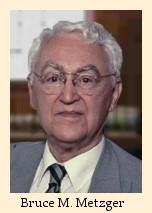
Bruce M. Metzger
Patrick D. Miller
Paul S. Minear
Lucetta Mowry
|
Roland E. Murphy
Harry S. Orlinsky
Marvin H. Pope
J. J. M. Roberts
Alfred v. Rohr Sauer
Katharine D. Sakenfeld
James A. Sanders
Gene M. Tucker
Eugene C. Ulrich
Allen Wikgren
|
In general, the translation is less literal than the RSV. The revisers aimed to make the English more idiomatic and easier to understand, but their changes often degrade the accuracy of the translation. For example, in Acts 1:1 the words πάντων … ὧν ἤρξατο ὁ Ἰησοῦς ποιεῖν τε καὶ διδάσκειν are rendered “all that Jesus did and taught from the beginning” (as in the REB) instead of “all that Jesus began to do and teach.” This is easier, but the literal rendering of the RSV indicates Luke’s idea better, because he means to imply that Christ’s actions and teachings are not finished, and intends to show how Christ after his Resurrection continues to teach many things to the apostles and to work through them. The NRSV revisers apparently found this difficult, or felt that it was too hard for readers. But Luke would certainly not use an expression like ἤρξατο … ποιεῖν if all he had meant was “did from the beginning.”
 The deliberately non-Christian interpretation of the Old Testament which made the RSV unacceptable to many Christians is continued in this revision. The most notorious verse of the RSV, Isaiah 7:14, “a young woman shall conceive,” is revised only to put the verb in the present tense and add the definite article: “the young woman is with child.” In some places the NRSV is worse than the RSV in this respect. For example, in Genesis 1:2 the RSV’s “and the Spirit of God was moving” has been changed to “a wind from God swept.” In Psalm 23 the RSV’s traditional renderings “valley of the shadow of death” and “dwell in the house of the Lord for ever” are changed to “the darkest valley” and “my whole life long.” We do however notice an improvement over the RSV in the NRSV’s translation of נברכו “be blessed” in Genesis 12:3, 18:18, and 28:14; and התברכו “gain blessing for themselves” in Genesis 22:18 and 26:4.
The inclusive language alterations are very thorough, involving thousands of alterations designed to completely erase the Bible’s generic masculine pronouns and other usages offensive to feminists. An attempt has been made to downplay the extent to which this policy was imposed upon the committee by the National Council of Churches (the copyright holder, which in 1980 also commissioned the Inclusive Language Lectionary as another revision of the RSV), but it is evident that it did not arise spontaneously from a consensus of the translators themselves. Barry Hoberman, writing in the Atlantic Monthly [1] near to the end of the work on the NRSV, reported the following comments from members of the committee:
“The basic principle that the RSV committee uses is that we will remove all masculine-dominated language that has been introduced by the translators,” says George MacRae, who serves on the New Testament panel. Thus, no attempt will be made to disguise the fact that every book of the Bible is the product of a thoroughly male-dominated society. To pretend that the ancient Near Eastern world of the Bible was not radically different from our own world would be to deprive Scripture of its historical context. “I think it’s part of God’s revelation in history that we take history, and we take the time-boundedness of a biblical writer, seriously,” says William Holladay, an Old Testament panel member who teaches at Andover Newton Theological School, in Massachusetts. “Then, it’s the teaching task of the church or the synagogue, it seems to me, to say, ‘Well, all right, Jeremiah said it this way. What God intends through those words may be something a little bit different, so let’s talk about that for a while.’”
These quotations would seem to indicate that McRae and Hollady, at least, were unaware of how thoroughly the gender-neutral language policy was about to be implemented.
In 1990 one member of the NRSV Committee wrote:
The variety of goals, the larger committee, and the gradual addition over fifteen years of new members to the RSV committee also meant that conflicts arose among members of the committee over how much weight to give to different aims. The original intention of the committee to be highly conservative in making changes began to give way to more radical change as the committee itself changed and progressed in its work. [2]
J.J.M. Roberts, another member of the NRSV translation committee, later published an article [3] in which he protested against the “tyrannical and arbitrary authority” assumed by the final editorial committee which had been elected to revise the translation for “stylistic consistency”:
“ … the members of this editorial committee understood their task as involving a far greater authority to revise the translation than the full committee ever intended. According to Dentan [one of the five members of the committee], ‘This editorial committee was given power to determine the final form of the text before publication.’ Such a formulation is dangerously ambiguous. What the full committee understood and intended as the task of the editorial committee was actually quite limited; while respecting the basic work of the full committee, the editorial committee was expected to make the relatively minor changes to the finished product that were necessary for the sake of stylistic consistency. At least in the case of the Old Testament editorial subcommittee, that is not what happened. Some hint of the far more intensive reworking carried out by this small committee … can be seen in Dentan’s account of non-scholarly consideration that colored their work … the editorial committee made thousands of changes, some quite substantive, to the translation of the Old Testament made by the full committee, and when members of the full committee became aware of the extent of these changes, many were outraged, feeling that much of their own work on the translation over the years had been irresponsibly gutted.”
Roberts allows that the “inclusivity” of the NRSV makes it well-suited “for liturgical public reading,” but he points out that this advantage has come at a real price. After discussing the loss of particularity, emphasis, concreteness, and vividness in two passages of the Old Testament (Psalms 1 and 41), he gives the following comment on “brothers and sisters” as a translation for adelphoi in the New Testament:
It is likely that Paul was using the Greek term “brothers” in an inclusive sense … Nonetheless, Paul did not highlight a concern for inclusivity by using the compound expression “brothers and sisters.” To articulate this concern in translation by expressing what Paul left unexpressed is to impose a twentieth century, western cultural agenda on a first century text. Such anachronistic glosses make sociological or cultural appraisal of the world of the original text more difficult and cast doubts on the reliability of such a translation for serious historical work.
Despite such hard feelings and complaints of the translators themselves, [4] the NRSV was quickly adopted as a replacement of the RSV in the liberal denominations associated with the National Council of Churches. It has also been favored by liberal university professors, for use as a text in “religion” courses. Two study editions have appeared: The New Oxford Annotated Bible (1991), edited by Bruce Metzger and Roland Murphy; and the HarperCollins Study Bible (1993) edited by Wayne Meeks and others. In both of these editions, the introductions and annotations are decidedly liberal.
Regarding its suitability “for liturgical public reading,” we observe that the version disagrees with traditional interpretations of the Bible that are incorporated in the liturgies of several mainline Protestant churches. The 1978 Book of Common Prayer, containing the liturgy of the Episcopal Church, assumes that the worshippers are familiar with the traditional rendering of Genesis 1:2. In its liturgy for baptism it says, “We thank you, Almighty God, for the gift of water. Over it the Holy Spirit moved in the beginning of creation.” The same is true of the Evangelical Lutheran Church in America’s Lutheran Book of Worship (1978), where it says, “We give you thanks, for in the beginning your Spirit moved over the waters and you created heaven and earth.” But when members of these churches hear Genesis 1:2 read from the NRSV, they will hear nothing about the Spirit of God moving over the waters. Although the Preface states that it is “intended for use in public reading and congregational worship,” the version seems strangely disconnected from the liturgy and life of the Church.
Obviously, there is little chance of this version becoming popular outside of the shrinking “mainline” churches for whom it was executed. Indeed it may be wondered whether any considerable attention will given to it even within these churches, in which the exposition and study of the Bible has practically ceased.
In a report on the National Council of Churches’ work of Bible translation to the NCC general assembly held in Oakland, California in November, 2001, General Secretary Robert Edgar “mentioned that the NCC is exploring various possibilities regarding the sale or license of the copyright to the Revised and Newly Revised Standard Versions of the Bible. The NCC owns the copyrights to both versions. Edgar noted that the NCC had already refused one offer to purchase the copyrights. He said that the NCC would not exist today if it did not receive $500,000 a year in royalties from the sale of the RSV and NRSV Bibles.” [5]
1. Barry Hoberman, “Translating the Bible” in The Atlantic Monthly Volume 255, No. 2 (February 1985), pages 43-58.
2. Patrick D. Miller, “Musings of a Translator,” Theology Today 47/3 (Oct. 1990), p. 234.
3. J.J.M. Roberts, “An Evaluation of the NRSV: Demystifying Bible translation.” Insights: A Journal of the Faculty of Austin Seminary 108/2 (1993), formerly the Austin Seminary Bulletin.
4. And for good measure we will note the remarks of Robert Jewett, professor of New Testament at Garrett-Northwestern Theological Seminary. Jewett is himself a liberal, and a supporter of the feminist cause, but he insists upon the obligation of liberal scholars to behave honestly in translating the Bible. Regarding the NRSV he says: “We’re facing, with the NRSV, liberal dishonesty in spades. The modern liberated perspective which imposes itself on the text is about as dishonest as you can be. All the way through the NRSV, implying that Paul has all these liberated concepts and so forth like the current politically correct person in an Ivy League school: I mean that’s just ridiculous. Here you have the imposition of liberal prejudice on the biblical text with the ridiculous assumption that our modern liberal views were Paul’s.” Against the specious arguments offered by apologists for these politically correct alterations, Jewett declares that a gender-neutral translation that claims to be accurate is “almost as bad as Stalin’s revisions of world history in which every 10 years he’d change all the history textbooks.” These remarks were published in WORLD magazine, vol. 16, no. 6 (Feb. 13, 1998).
5. Jerald Walz, listserve news report, Ecumenical Flagship Still Drifting, Taking on Water, dated 16 February 2002.
Literature
- Preface to the NRSV
- Bruce M. Metzger, Robert Claude Dentan, Walter Harrelson, The Making of the New Revised Standard Version of the Bible, Grand Rapids: Eerdmans, 1991.
- Robert C. Dentan, “The Story of the New Revised Standard Version,” Princeton Seminary Bulletin 11/3 (1990), pp. 211-23.
- Walter Harrelson, “Inclusive Language in the New Revised Standard Version,” Princeton Seminary Bulletin 11/3 (1990), pp. 224-31.
- J.J.M. [Jimmy Jack McBee] Roberts, “An Evaluation of the NRSV: Demystifying Bible translation.” Insights: A Journal of the Faculty of Austin Seminary 108/2 (1993), formerly the Austin Seminary Bulletin.
- Barry Hoberman, “Translating the Bible” in The Atlantic Monthly Volume 255, No. 2 (February 1985), pages 43-58.
- Robert L. Thomas, review article “Holy Bible, New Revised Standard Version,” in The Master’s Seminary Journal 2/1 (Spring 1991), pp. 111-115. A detailed review that focuses on problems of the version.