The Revised Standard Version (1946-1977)
New Testament, 1946. Luther Weigle, et al., The New Covenant, Commonly Called the New Testament of our Lord and Savior Jesus Christ, Revised Standard Version, Translated from the Greek, Being the Version Set Forth A.D. 1611, Revised A.D. 1881 and A.D. 1901, Compared with the Most Ancient Authorities and Revised A.D. 1946. New York: Thomas Nelson & Sons, 1946. Revised 1952, 1959, 1971. Roman Catholic edition, 1965.
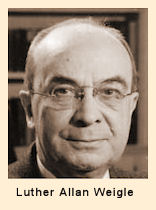 The Revised Standard Version of the New Testament purported to be a revision of the American Standard Version, although very little of the ASV remains in the RSV. In many passages it bears more resemblance to the version of James Moffatt than to the ASV. The Greek text usually followed was the 17th edition (1941) of the Nestle text, but this differs little from the Greek text followed by the ASV translators. The differences between the two versions are almost entirely due to a different approach to the translation of the text. The American Standard Version excelled in literal accuracy, and gave little consideration to the ease of the reader; while the RSV, like Moffatt’s version, tends to be much less accurate in its renderings, and more concerned with making the general meaning of the text clear to the common readers. In the process, however, as F.F. Bruce puts it, the RSV translators “blurred some of the finer distinctions in New Testament wording which ... have some significance for those who are concerned with the more accurate interpretation of the text.” 1
The difference between the two versions may be illustrated by their respective renderings of 1 Corinthians 10:1-12, which we will give now side-by-side, followed by some comments.
1 Corinthians 10:1-12
|
Οὐ θέλω γὰρ ὑμᾶς ἀγνοεῖν, ἀδελφοί, ὅτι οἱ πατέρες ἡμῶν πάντες ὑπὸ τὴν νεφέλην ἦσαν καὶ πάντες διὰ τῆς θαλάσσης διῆλθον 2 καὶ πάντες εἰς τὸν Μωϋσῆν ἐβαπτίσθησαν ἐν τῇ νεφέλῃ καὶ ἐν τῇ θαλάσσῃ 3 καὶ πάντες τὸ αὐτὸ πνευματικὸν βρῶμα ἔφαγον 4 καὶ πάντες τὸ αὐτὸ πνευματικὸν ἔπιον πόμα· ἔπινον γὰρ ἐκ πνευματικῆς ἀκολουθούσης πέτρας, ἡ πέτρα δὲ ἦν ὁ Χριστός. 5 Ἀλλ᾽ οὐκ ἐν τοῖς πλείοσιν αὐτῶν εὐδόκησεν ὁ θεός, κατεστρώθησαν γὰρ ἐν τῇ ἐρήμῳ. 6 Ταῦτα δὲ τύποι ἡμῶν ἐγενήθησαν, εἰς τὸ μὴ εἶναι ἡμᾶς ἐπιθυμητὰς κακῶν, καθὼς κἀκεῖνοι ἐπεθύμησαν. 7 μηδὲ εἰδωλολάτραι γίνεσθε καθώς τινες αὐτῶν, ὥσπερ γέγραπται· ἐκάθισεν ὁ λαὸς φαγεῖν καὶ πεῖν καὶ ἀνέστησαν παίζειν. 8 μηδὲ πορνεύωμεν, καθώς τινες αὐτῶν ἐπόρνευσαν καὶ ἔπεσαν μιᾷ ἡμέρᾳ εἴκοσι τρεῖς χιλιάδες. 9 μηδὲ ἐκπειράζωμεν τὸν κύριον, καθώς τινες αὐτῶν ἐπείρασαν καὶ ὑπὸ τῶν ὄφεων ἀπώλλυντο. 10 μηδὲ γογγύζετε, καθάπερ τινὲς αὐτῶν ἐγόγγυσαν καὶ ἀπώλοντο ὑπὸ τοῦ ὀλοθρευτοῦ. 11 ταῦτα δὲ τυπικῶς συνέβαινεν ἐκείνοις, ἐγράφη δὲ πρὸς νουθεσίαν ἡμῶν, εἰς οὓς τὰ τέλη τῶν αἰώνων κατήντηκεν. 12 Ὥστε ὁ δοκῶν ἑστάναι βλεπέτω μὴ πέσῃ.
|
| ASV (1901) | RSV (1946) |
|
1 For I would not, brethren, have you ignorant, that our fathers were all under the cloud, and all passed through the sea; 2 and were all baptized 1 unto Moses in the cloud and in the sea; 3 and did all eat the same spiritual food; 4 and did all drink the same spiritual drink: for they drank of a spiritual rock that followed them: and the rock was 2 Christ. 5 Howbeit with most of them God was not well pleased: for they were overthrown in the wilderness. 6 Now 3 these things were our examples, to the intent we should not lust after evil things, as they also lusted. 7 Neither be ye idolaters, as were some of them; as it is written, The people sat down to eat and drink, and rose up to play. 8 Neither let us commit fornication, as some of them committed, and fell in one day three and twenty thousand. 9 Neither let us make trial of the 4 Lord, as some of them made trial, and perished by the serpents. 10 Neither murmur ye, as some of them murmured, and perished by the destroyer. 11 Now these things happened unto them 5 by way of example; and they were written for our admonition, upon whom the ends of the ages are come. 12 Wherefore let him that thinketh he standeth take heed lest he fall.
1. Gr. into.
2. Or, the Christ. Comp. Heb. 11.26.
3. Or, in these things they became figures of us.
4. Some ancient authorities read Christ.
5. Gr. by way of figure.
|
1 I want you to know, brethren, that our fathers were all under the cloud, and all passed through the sea, 2 and all were baptized into Moses in the cloud and in the sea, 3 and all ate the same supernatural 1 food, 4 and all drank the same supernatural 1 drink. For they drank from the supernatural 1 Rock which followed them, and the Rock was Christ. 5 Nevertheless with most of them God was not pleased, for they were overthrown in the wilderness. 6 Now these things are warnings for us, not to desire evil as they did. 7 Do not be idolaters as some of them were; as it is written, “The people sat down to eat and drink and rose up to dance.” 8 We must not indulge in immorality as some of them did and twenty-three thousand fell in a single day. 9 We must not put the Lord 2 to the test, as some of them did and were destroyed by serpents; 10 nor grumble, as some of them did and were destroyed by the Destroyer. 11 Now these things happened to them as a warning, but they were written down for our instruction, upon whom the end of the ages has come. 12 Therefore let anyone who thinks that he stands take heed lest he fall.
1. Greek spiritual.
2. Other ancient authorities read Christ.
|
At the beginning of verse 1, the RSV lacks any English equivalent for the word γὰρ, “for.” We must suppose it is omitted because the translators thought that the word here has almost no logical force. This is in accordance with modern tendencies to minimize the meaning of conjunctions in the New Testament. But it is probably a mistake. The γὰρ is not meaningless: it expresses a logical connection between this paragraph and the foregoing one. We find also in verse 1 that the RSV translators have paraphrased Οὐ θέλω γὰρ ὑμᾶς ἀγνοεῖν as “I want you to know,” rather than give the literal rendering “For I do not want you to be ignorant.” This rendering is a variation of Moffatt’s “I would have you know,” and it was used to make the style more natural in English, but the Greek expression here is more emphatic than the RSV’s rendering.
In verses 3 and 4 the RSV does not translate the adjective πνευματικος literally as “spiritual,” as in the ASV, but interprets it to mean “supernatural.” This rendering (also from Moffatt) may be wrong. By πνευματικος Paul could very well mean that the food, drink, and rock had a spiritual effect, or a spiritual significance by typological interpretation.
In verse 6 the RSV’s translation of τύποι ἡμῶν ἐγενήθησαν is “are warnings for us,” which is again less adequate than the ASV’s “were our examples.” The word τύπος does not mean “warning” (another rendering borrowed from Moffatt) but “pattern” or “example,” as in the ASV. In the New Testament τύπος also has a specialized meaning of “prefigurement” (see the usage in Romans 5:14), and so Luther translated it zum Vorbilde. The ASV indicates this meaning with the marginal alternative “figures of us.” The verb ἐγενήθησαν should be translated more exactly as “became.” Paul is not just saying that the remembrance of these events may serve as a warning; the thought is rather that they happened for the purpose of being a prefigurement of the Church. 2 This will become more clear in verse 11.
In verse 7 the verb παίζειν does not specifically mean “to dance,” as in the RSV, but more generally “to play,” as in the ASV. The RSV translators have given a specific interpretation to the word rather than simply translating its sense.
In verse 8 πορνεύωμεν is in the RSV rather vaguely translated “indulge in immorality.” Probably the translators felt that the ASV’s more explicit and precise “commit fornication” was stylistically too archaic. But “immorality” does not convey the meaning as clearly.
At the beginning of verse 10 the ASV’s “Neither murmur ye” reflects a shift in the Greek from the first person plural to the second person plural. The RSV’s “nor grumble” conceals the shift, and will be understood as another first person plural after “We must not …” in verse 9. The meaning is not greatly affected, but the less exact rendering here does lose some of the urgency that belongs to the direct address in the second person, and it shows a certain amount of carelessness about such verbal details in the RSV.
In verse 11 the adverb τυπικῶς is wrongly translated “as a warning” in the RSV. This is really no translation of the word at all. It has gone untranslated, and the idea it expresses has been supplanted by the “warning” idea expressed by νουθεσίαν (“admonition,” not merely “instruction” as in the RSV) in the immediate context. 3 Then a disjunctive sense is given to the δὲ in the next clause; as if Paul meant that their punishment happened as a “warning” to them, but was recorded for our instruction. This involves some very questionable exegesis, and it is certainly not what the Greek appears to be saying. The only plausible interpretation of the Greek is that the events described happened τυπικῶς “figuratively” not for them, but for us. One might even use a technical term from biblical hermeneutics here and translate “typologically,” as suggested in Bauer’s lexicon.
Finally, we note that neither version indicates that τέλη τῶν αἰώνων at the end of verse 11 may mean “the purposes of the ages,” which seems to be more in accord with the context.
This passage shows how the RSV translators have injected more interpretation into their translation than the ASV translators did. And we see that some of their interpretation is rather questionable. The ASV is not perfect, and it is no substitute for the Greek, but it is more closely equivalent to the Greek, it refrains from interpretation when it is not absolutely necessary, and it gives more alternatives in the margin. The RSV is more fluent and easier to understand, but its easiness is purchased by limiting and obscuring interpretive possibilities. It is less interesting and less reliable than the ASV as a basis for close study. We see here not merely a modernization of the language, but a different conception of the task of the translator and of the capabilities of the reader. 4
Misadventures of Greek Philology
The RSV Preface of 1952 incorrectly refers to the scholars who produced the ASV as “revisers in the 1870’s,” and says that “they lacked the resources which discoveries within the past eighty years have afforded for understanding the vocabulary, grammar, and idioms of the Greek New Testament.” In fact, less than fifty years separated the publication of the ASV and the RSV New Testament, and there is little reason to think that the RSV committee members of 1946 understood Greek better than their predecessors of 1901. When we compare the works of the most learned scholars of the nineteenth century to those of the twentieth century, we come away with the impression that there has been a decline in the quality of scholarship. The study of Greek, in particular, has long ceased to attract the kind of academic talent and zeal that it did in the middle of the nineteenth century, and it is unlikely that American scholars of the 1940’s would have understood Greek better than the best scholars of previous generations. But the RSV revisers believed that they were in a better position to determine the meaning of words, after the discovery of numerous papyrus documents in Egypt from the Hellenistic period. The Oxyrhynchus Papyri were published in fifteen volumes between 1898 and 1922, and were applied to questions of New Testament philology in many books and articles that appeared in the first half of the twentieth century. At the time, some scholars believed that proper attention to the papyri would revolutionize the study of the New Testament, and so a mood of enthusiasm developed, and many scholars exaggerated the importance of the new linguistic evidence.
A number of RSV renderings are best understood as the product of this eagerness to accept new proposals, ostensibly based on the papyri, which now seem rather ill-supported. For example, the adjective ατακτος in 1 Thess. 5:14, the adverb ατακτως in 2 Thess 3:6 and 3:11, and the verb ατακτεω in 2 Thess. 3:7 were translated “the disorderly,” “disorderly,” and “behaved disorderly” in the ASV; but these are translated “idlers,” “in idleness,” and “were idle” in the RSV, because in 1908 George Milligan suggested that “idling” was the sort of behavior in view where the verb is used in two papyrus documents that he had examined 5 He claimed that “play truant” was the actual meaning in these documents, and this seems plausible enough, but his suggestion that this may be equated with “be idle” is rather weak. In both texts the more general sense “neglect to do his duty” seems to fit well enough, and Milligan himself translated it “not living a well-ordered life” in his commentary. The context does not really require such a meaning as “be idle.” At any rate, Milligan adduced this as a “striking” example of how much new light is thrown on the vocabulary of the New Testament by the recently discovered papyri (Vocabulary of the Greek New Testament, pp. xviii, xix). Soon afterwards Moffatt (1913) translated the words with “loafers,” “loafing” and “loaf,” and Goodspeed (1923) translated them “idlers,” “in idleness” and “idle.” The RSV followed the example of Goodspeed. (Both Moffatt and Goodspeed sat on the RSV committee.) It is to be noticed, however, that this does not adequately represent Milligan’s idea of the meaning of the word. It only picks up on his suggestion that the kind of irresponsible behavior referred to in his papyrus documents was idleness. This is not the same as claiming that the meaning of the adjective can be reduced to “idle” or the verb to “be idle.” Nevertheless, the meaning faulenzen appeared in the definition of the verb in Bauer’s Wörterbuch (fifth edition, 1958), and in the second English edition (BAGD, 1979) we find the statement “the context demands the meaning be idle, lazy.” Other scholars did not agree with this analysis. Gerhard Delling in his TDNT article (vol. 8, pp. 47-8) argued against it, and maintained that the well-attested broader meanings of “set oneself outside the order,” “evade one’s obligations,” “act irresponsibly” probably represent Paul’s meaning better, and this seems to be the opinion of most scholars today. If Paul had wanted to talk specifically about idleness, he would probably have used αργος and its derivatives, as in 1 Tim. 5:13. But he uses a broader word, ατακτος, to characterize the behavior of those who are neglecting their own proper duties. We note that the third English edition of Bauer’s lexicon (published in 2000) now says that ατακτεω means “to violate prescribed or recognized order, behave inappropriately,” and that “the trans. be idle, lazy does not take adequate account of Gr-Rom. social history,” in agreement with Delling. So we have come full circle.
In addition to the use of new lexical evidence, we also see in the RSV a new way of looking at all the evidence, both new and old, in which the various contexts of a word are more readily thought to indicate distinct senses. There is a tendency to multiply, segregate, and reduce these contextual meanings, so that the primary or basic meaning of the word virtually disappears. In the example of ατακτος discussed above, the rendering “idle” really depends more upon a reductionistic approach to semantics than upon any new evidence. The context does not so affect the meaning of the word that its primary meaning disappears, either in the New Testament or in the papyri. This reductionistic tendency may be seen clearly enough in other places, where the claims of improved knowledge have no basis at all in new discoveries. The treatment of τύπος and τυπικῶς in 1 Corinthians 10, which we have discussed in the comparison above, is an example of this. The proper meanings of these words have simply melted away in the RSV. Another example is the rendering “In many and various ways” for Πολυμερῶς καὶ πολυτρόπως in Hebrews 1:1. Here the word πολυμερῶς does not seem to have been translated at all. The whole phrase is treated as if it were just some verbose way of saying πολυτρόπως by itself. The reason for this becomes evident when we see that πολυμερῶς is glossed vielgestaltig in Bauer’s lexicon. 6 Now vielgestaltig does not mean “in many ways,” as it is translated in the English edition (BAGD), it means “in many forms”; but if this definition is accepted, then “in many and various ways” might be seen as a good enough rendering for Πολυμερῶς καὶ πολυτρόπως. The trouble is, neither the German nor the English editions of Bauer give us any good reason to think that πολυμερῶς does not mean “in various parts,” as it has always been understood in the past, and as we would certainly expect it to mean on the basis of its transparent etymology and its association with the adjective πολυμερής (“having many different parts,” usually translated “manifold”). J.H. Moulton and G. Milligan evidently found no reason to think otherwise, for they state that it “denotes ‘in many portions’ as distinguished from πολυτρόπως ‘in many manners’” in Hebrews 1:1. 7 The ASV’s “by divers portions and in divers manners” is probably a more adequate rendering.
The RSV’s tendency to blend linguistic features into the contextual background may be seen also in its handling of syntactic details. For instance, in John 8:30-31 we have in the Greek a variation between ἐπίστευσαν εἰς αὐτόν and πεπιστευκότας αὐτῷ, which the ASV expressed by rendering the first “believed on him” and the second “had believed him.” Now εἰς with the accusative αὐτόν is a stronger expression than the simple dative αὐτῷ. One can believe something that a man says without believing in him, and this difference is perhaps relevant to the interpretation of the passage. 8 But the RSV erases the distinction by rendering ἐπίστευσαν εἰς αὐτόν “believed in him” and πεπιστευκότας αὐτῷ “had believed in him.” The RSV translators saw no difference between those who “believed in him” and those who “believed him” because in this context they both seem to denote the same people, and so they interpreted the phrase with the simple dative as being semantically identical to the εἰς with the accusative. But as a matter of fact these expressions are not identical in meaning, and the context cannot make them so. Why should the difference be so disregarded?
Many RSV renderings that might be attributed to loose and careless habits of translation are in fact renderings which the translators believed to be accurate, according to their understanding of the Greek words and phrases. They believed that these renderings represented an improved state of knowledge and greater analytical sophistication. But in hindsight they are seen to be the result of magnifying the importance of newly acquired information, and exaggerating the principle of contextual meaning in linguistic analysis.
Inconsistent Renderings
One of the principles of translation followed by the ASV translators was that Greek words should be translated consistently, insofar as the English language permits, so that the English reader can see many of the same verbal connections and associations that would be noticed by readers of the Greek text. This leads sometimes to renderings which seem pedantic and rather unnatural for English prose. The RSV translators put little value on this, and valued fluency and naturalness in English more highly. They did not hesitate to vary the rendering of Greek words, according to their judgment of what is most natural in English. As an example of these opposite tendencies, we will present a comparison of the ASV with the RSV in places where the Greek word ὁμοθυμαδον occurs. This word is a compound of ὁμο “the same” and θυμος “emotion” with the adverbial termination αδον, and it means properly “with the same emotion” or more generally “with the same mind.”
| | ASV (1901) | RSV (1946) |
| Acts 1:14 | These all with one accord continued stedfastly in prayer, with the women, and Mary the mother of Jesus, and with his brethren. | All these with one accord devoted themselves to prayer, together with the women and Mary the mother of Jesus, and with his brothers. |
| Acts 2:46 | And day by day, continuing stedfastly with one accord in the temple, and breaking bread at home, they took their food with gladness and singleness of heart, | And day by day, attending the temple together and breaking bread in their homes, they partook of food with glad and generous hearts, |
| Acts 4:24 | And they, when they heard it, lifted up their voice to God with one accord, and said, O Lord, thou that didst make the heaven and the earth and the sea, and all that in them is: | And when they heard it, they lifted their voices together to God and said, Sovereign Lord, who didst make the heaven and the earth and the sea and everything in them, |
| Acts 5:12 | And by the hands of the apostles were many signs and wonders wrought among the people; and they were all with one accord in Solomon’s porch. | Now many signs and wonders were done among the people by the hands of the apostles. And they were all together in Solomon’s Portico. |
| Acts 7:57 | But they cried out with a loud voice, and stopped their ears, and rushed upon him with one accord; | But they cried out with a loud voice and stopped their ears and rushed together upon him. |
| Acts 8:6 | And the multitudes gave heed with one accord unto the things that were spoken by Philip, when they heard, and saw the signs which he did. | And the multitudes with one accord gave heed to what was said by Philip when they heard him and saw the signs which he did. |
| Acts 12:20 | Now he was highly displeased with them of Tyre and Sidon: and they came with one accord to him, and, having made Blastus the king’s chamberlain their friend, they asked for peace, because their country was fed from the king’s country. | Now Herod was angry with the people of Tyre and Sidon; and they came to him in a body, and having persuaded Blastus, the king’s chamberlain, they asked for peace, because their country depended on the king’s country for food. |
| Acts 15:25 | it seemed good unto us, having come to one accord, to choose out men and send them unto you with our beloved Barnabas and Paul, | it has seemed good to us in assembly to choose men and send them to you with our beloved Barnabas and Paul, [the second edition of the RSV (1971) changes “in assembly” to “having come to one accord.”] |
| Acts 18:12 | But when Gallio was proconsul of Achaia, the Jews with one accord rose up against Paul and brought him before the judgment-seat, | But when Gallio was proconsul of Achaia, the Jews made a united attack upon Paul and brought him before the tribunal, |
| Acts 19:29 | And the city was filled with the confusion: and they rushed with one accord into the theatre, having seized Gaius and Aristarchus, men of Macedonia, Paul’s companions in travel. | So the city was filled with the confusion; and they rushed together into the theater, dragging with them Gaius and Aristarchus, Macedonians who were Paul’s companions in travel. |
| Rom. 15:6 | that with one accord ye may with one mouth glorify the God and Father of our Lord Jesus Christ. | that together you may with one voice glorify the God and Father of our Lord Jesus Christ. |
It will be seen here that the ASV consistently translates ὁμοθυμαδον “with one accord,” while the RSV translates it in four different ways, using “with one accord” twice, “together” six times, and “in a body,” “in assembly,” and “united” one time each. The renderings “together” and “in assembly” are rather weak, and do not convey the full meaning of the word. 9 “Together” seems to have been used for stylistic reasons, in places where the literal rendering “with one accord” might seem somewhat redundant or superfluous, in addition to complicating the sentence.
Another prominent British scholar, Nigel Turner, agreed that the RSV “glosses over important words,” and complained of its sometimes misleading renderings of the Greek word σαρξ (lit. “flesh”):
Plato, Seneca, and Plutarch, followed to some extent by Gnostics and Manichaeans, had insisted that true happiness is achieved only by leaving the body, which is mean and wretched. The principle of evil for St. Paul, on the other hand, is not identified with the body, for the life of faith and victory may still be lived this side of the grave (Gal. 2:20). The principle, for Paul, is not the body but the sarx. To translate sarx by the word 'body', as RSV does (e.g. 2 Cor. 7:1, 5), is quite unhelpful and is one of several instances where AV is closer to St. Paul's meaning and where RSV glosses over important words. Being 'in the flesh', moreover, is not the same as being 'in the world' (RSV 2 Cor. 10:3, etc.), and the student of St. Paul will not necessarily find AV to be out of date, for all its seniority. 10
Nevertheless, the RSV New Testament was well received by American churches, including the evangelical ones, when it first appeared. But the Old Testament (1952) provoked a storm of controversy, and killed the version's chances of becoming a generally accepted standard Bible in America.
The New Testament Committee (prior to 1952)
- Luther A. Weigle, Yale University, Chairman.
- James Moffatt, Union Theological Seminary, Executive Secretary. (died 1944)
- Henry J. Cadbury, Harvard University.
- Edgar J. Goodspeed, University of Chicago.
- Walter Russell Bowie, Union Theological Seminary.
- Frederick C. Grant, Union Theological Seminary.
- Millar Burrows, Yale University. (joined 1938)
- Clarence T. Craig, Oberlin Graduate School of Theology.
- Abdel R. Wentz, Lutheran Theological Seminary, Gettysburg.
Bible, 1952. The Holy Bible, Revised Standard Version. Containing the Old and New Testaments, translated from the original tongues; being the version set forth A.D. 1611, revised A.D. 1881-1885 and A.D. 1901; compared with the most ancient authorities and revised A.D. 1952. New York: Thomas Nelson, 1952. 2nd edition, 1971.
The RSV Old Testament was not well received outside of liberal circles, chiefly because the translators often deliberately rendered Old Testament passages in such a way that they were contrary to the interpretations given in the New Testament. This was done on the principle that the Old Testament ought to be interpreted only in reference to its own historical (Jewish) context. Christian interpretations, including those of the New Testament writers, are therefore deliberately excluded as “anachronistic.” But this, as conservative critics perceived, practically amounted to a denial of the truth of the New Testament. As the conservative scholar R. Laird Harris wrote,
It is a curious study to check the Revised Standard Version of the Bible, a monument of higher critical scholarship, and note how every important Old Testament passage purporting to predict directly the coming of Christ has been altered so as to remove this possibility ... It is almost impossible to escape the conclusion that the admittedly higher critical bias of the translators has operated in all of these places. The translations given are by no means necessary from the Hebrew and in some cases ... are in clear violation of the Hebrew. 11
The verse most often mentioned by conservatives was Isaiah 7:14, in which the RSV translators rendered the Hebrew word almah as “young woman” instead of “virgin.” While this was not a case of a clear violation of the Hebrew (the word must be interpreted according to its context), it was by no means necessary. 12 And there were many other instances of the same problem, which revealed a pattern of systematic contradiction of the New Testament interpretations of Old Testament passages. For example, in Genesis 22:18 the RSV renders an ambiguous sentence as “by your descendents shall all the nations of the earth bless themselves” contrary to the interpretation given by the Apostle Paul in Galatians 3:8 and 3:16.
The contradictions foisted into the Bible by the RSV translators included also some renderings which created blatant contradictions within individual books. For example, in Genesis 9:20, where the ASV had read, “And Noah began to be a husbandman” (i.e. a farmer) the RSV reads “Noah was the first tiller of the soil,” thus generating a contradiction with the statements in Genesis 3:22 (“the Lord God sent him forth from the Garden of Eden to till the ground”) and 4:2 (“Cain was a tiller of the ground”). It was the belief of the RSV translators that the Book of Genesis is composed of traditional stories that frequently contradict each other, cobbled together by editors who neglected to harmonize them in many places.
The objections of conservatives to the RSV were not merely captious criticisms concerning the meaning of a word here and there; the controversy was about whether or not a version of the Old Testament which ignores and contradicts the New Testament, as well as itself, in so many places, has any right to be received as the standard Bible of American churches.
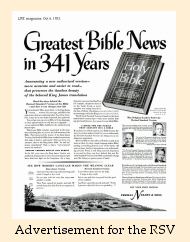 The members of the RSV OT committee were not entirely insensitive to traditional expectations. In a few cases they retained familiar language of the ASV and KJV because of its liturgical or devotional importance among English-speaking Christians, despite their opinion that the traditional renderings were inaccurate in some respect. An example of this is in the twenty-third Psalm (“The Lord is my shepherd ...”), a Psalm which is often memorized and used in ministry. In verse 4 of this Psalm the phrase “shadow of death” is retained as a rendering of the Hebrew word צלמות (vocalized tsalmaveth in the Masoretic text), although in every other occurrence of the word the RSV has changed the ASV's “shadow of death” to “gloom,” which involves a different vocalization of the word (tsalmuth). It was the committee's opinion that this word does not really mean “shadow of death,” but they retained the traditional phrase in this Psalm because it is so familiar. 13 They had regard for the fact that the traditional rendering of this Psalm has comforted multitudes of Christians in the hour of death. But it now seems that the condescension of the RSV translators was needless, because more recent scholarship has tended to support the traditional understanding of the word as a compound of צל “shadow” and מות “death.” 14 This seems to be an example of the “scholarly herd” phenomenon that has become all-too-common in academic biblical studies—a new idea about the meaning of some word is presented as an advance beyond the knowledge of all previous generations, it gains almost universal acceptance in a few years, makes its way into a new Bible version, and is then rejected by scholars of the next generation. Scholarly claims concerning “the best results of modern scholarship as to the meaning of the Scriptures” (RSV preface) are too often of this nature, being ill-supported and ephemeral. Conservative skepticism about such claims is often justifiable and even salutary. We may thank God that the RSV translators made an exception in this important passage, but it is not a good reflection on liberal “mainline” scholarship that a correct translation was retained here only by an overriding pastoral concern.
On the other hand, we may say that the RSV committee went too far in accommodating tradition when, for their second edition, they decided to re-insert the Story of the Adulteress in the eighth chapter of John's Gospel. In the 1946 RSV New Testament and in the first edition of the complete Bible, the committee omitted this apocryphal story (relegating it to the margin), in accordance with the longstanding and unanimous judgment of textual scholars. It took some courage for them to do this, because the story is quite popular in the churches—especially among those who find it convenient as a supporting text for antinomian teachings. There must have been many complaints about this, and the restoration of the passage in the RSV's second edition was not surprising. The claim made in the preface to the second edition, that it “profits from textual and linguistic studies published since the Revised Standard Version New Testament was first issued in 1946,” seems rather hollow in view of this. If there was anything in the first edition of the RSV that can be called a substantial improvement over past English versions in the presentation of textual scholarship, it was the omission of this passage.
The second edition rightly restores the sentences in Luke 22:19b-20, which were omitted for insufficient reasons in the first edition. The omission depended upon a theory of “Western non-interpolations” developed by F.J.A. Hort at the end of the nineteenth century, in which verses that have solid attestation in ancient manuscripts are nevertheless omitted because they are absent from a handful of manuscripts which do not ordinarily omit things. This theory of “Western non-interpolations” was the most questionable part of Hort's contribution to textual studies, and it was generally abandoned by scholars during the 1970's. The restoration of Luke 22:19b-20 in the RSV second edition was an early sign of movement away from Hort's theory, but the second edition continued to omit a number of Hort's “non-interpolation” sentences and phrases (in Luke 24:3, 6, 12, 36, 40, 51, and 52). By 1989 this theory of the text was so much out of favor that Kurt Aland declared that it “can only be regarded today as a relic of the past.” 15
The rejection of the RSV by evangelicals had serious consequences for the future of the version. At the time that it was replaced by the New Revised Standard Version in 1990, the RSV was one of the least popular versions in America, having only about 5 percent of the market share in Bibles.
The Old Testament Committee (prior to 1952)
- Luther A. Weigle, Yale University, Chairman.
- Fleming James, University of the South, Executive Secretary.
- Julius A. Bewer, Union Theological Seminary.
- James Moffatt, Union Theological Seminary. (died 1944)
- William R. Taylor, University of Toronto.
- George Dahl, Yale University.
- Willard L. Sperry, Harvard University.
- Leroy Waterman, University of Michigan.
- Millar Burrows, Yale University. (joined 1938)
- Kyle M. Yates, Southern Baptist Theological Seminary.
- William F. Albright, Johns Hopkins University.
- J. Philip Hyatt, Vanderbilt University.
- Herbert G. May, Oberlin Graduate School of Theology.
- Harry M. Orlinsky, Jewish Institute of Religion.
Apocrypha, 1957. The Apocrypha, Revised Standard Version of the Old Testament. Translated from the Greek and Latin tongues, being the version set forth A. D. 1611, rev. A. D. 1894, compared with the most ancient authorities and rev. A. D. 1957. New York: Nelson, 1957.
Prepared by Floyd V. Filson, Bruce M. Metzger, Robert H. Pfeiffer, and Allen P. Wikgren, together with members of the New Testament committee.
Roman Catholic Editions:
- The New Testament of Our Lord and Saviour Jesus Christ: Revised Standard Version: Catholic Edition ... prepared by the Catholic Biblical Association of Great Britain: with a foreword by H.E. Cardinale. London: Nelson, 1965 (with Imprimatur dated Pentecost 1964).
- The Holy Bible: Revised standard version, containing the Old and New Testaments. Catholic edition, prepared by the Catholic Biblical Association of Great Britain; with a foreword by His Eminence John Cardinal Heenan, Archbishop of Westminster. London: Nelson, 1966.
Although the RSV translators in their revisions of 1952, 1959 and 1971 turned a deaf ear to the criticisms offered by conservative Protestants, they did cooperate with Roman Catholics in the production of this edition. A small number of changes (sixty-six in all) were made in the New Testament. The text of the Old Testament was not revised, but extra books included in the “deuterocanon” of the Roman Catholic Church were inserted (from the RSV “Apocrypha” published in 1957) in their usual places according to traditional Catholic practice. The alterations made in the New Testament are those which the revising committee believed were necessary “to make it acceptable to Catholics.” Their aim was “to make the minimum number of alterations and to change only what seemed absolutely necessary in the light of Catholic tradition” (Introduction). One prominent Catholic scholar observed that the alterations seem to reflect a “preoccupation with the Marian problem” (e.g., “full of grace” substituted for “favored one” in Luke 1:28), and that “they are extremely few and almost of no importance at all.” 16 The RSV commitee approved this minor revision of the text as an ecumenical gesture, and the chairman of the RSV committee (Luther Weigle) was subsequently honored by Pope Paul VI, who conferred upon him the “Papal Knighthood of St. Gregory the Great” in 1966. 17 In 1969 six Roman Catholic scholars joined the RSV Committee. The RSV Catholic edition received the imprimatur (i.e. it was officially declared to be acceptable for use by Catholics) and it went on to become a Bible of choice among many conservative Catholics who did not care for the “inclusive language” of later versions sponsored by the Roman Catholic hierarchy (i.e. the New American Bible and the New Jerusalem Bible). For more information on changes made in this edition, and further changes made in subsequent editions published by Ignatius Press in San Francisco, see the article “Changes in the Revised Standard Version–Catholic Edition” on this site.
Ecumenical Edition (“Common Bible”), 1973. The Holy Bible, Revised Standard Version. Containing the Old and New Testaments with the Apocrypha/Deuteroncanonical books: An Ecumenical Edition. Cover title: Common Bible. (New York and London: Collins, 1973).
This volume was designed as an edition of the RSV which would include the Apocryphal books in an arrangement that would be acceptable to Protestants and Catholics alike. A compromise was worked out, providing for the publication of a Bible that would contain four sections, in this order: the Old Testament, the “deuterocanonical” books of the Catholic Church, the three books of the Protestant Apocrypha that are not included in the Roman Catholic canon, and the New Testament. The edition was presented to and approved by Pope Paul VI. Metzger reports that “In a private audience granted to a small group, comprising the Greek Orthodox Archbishop Athenagoras, Lady Priscilla and Sir William Collins, Herbert G. May, and the present writer, Pope Paul accepted the RSV ‘Common’ Bible as a significant step in furthering ecumenical relations among the churches.” 18
Ecumenical Study Bible, 1977. Herbert G. May and Bruce M. Metzger, eds., The New Oxford Annotated Bible with the Apocrypha: Revised standard version, containing the second edition of the New Testament and an expanded edition of the Apocrypha. (New York: Oxford University Press, 1977).
This edition of the RSV, was the first to include a translation of the three additional books which are received as Scripture only in the Eastern Orthodox churches: 3 and 4 Maccabees and Psalm 151. The translation was done by five members of the RSV committee. Bruce Metzger reports that “At the close of 1976, the writer presented to His All Holiness Demetrios I, the Ecumenical Patriarch of Constantinople and titular head of the several Orthodox Churches, a pre-publication copy of The New Oxford Annotated Bible with the Apocrypha, expanded edition. In accepting the gift, the Ecumenical Patriarch expressed satisfaction at the availability of an edition of the Sacred Scriptures which English readers in all branches of the Christian church could use.” 19 However, this can only be seen as a polite ecumenical gesture, because it ignores the implications of the fact that in Greek Orthodox churches the Greek Septuagint version of the Old Testament has always been regarded as authoritative, not merely in the matter of what books are included, but also in its specific renderings, upon which the interpretations of the Greek Fathers are based. In the Greek Orthodox churches, a modern translation of the Hebrew that regularly ignores the Septuagint and Greek Fathers cannot be received as authoritative or reliable. Also, concerning the the Greek text of the New Testament, we may observe that the Greek Orthodox churches use an officially sanctioned “Byzantine” form of the text which does not agree with the critically edited text used by the RSV translators. The Revised Standard Version would be acceptable only to the more liberal and non-traditional churchmen.
Notes
1. The English Bible: A History of Translations (New York: Oxford University Press, 1961), p. 193. Bruce does not provide details.
2. See the discussion in Charles T. Fritsch, “Biblical Typology,” Bibliotheca Sacra 104 (1947) pp. 88-9. Fritsch suggests the following translation: “And these things have become our types, with the purpose in view that we should not be desirous of evil things even as they were.”
3. The fifth edition of Bauer’s Wörterbuch (1958) defines it correctly: “vorbildlich, als Typus, entspr. der typolog. Deutung der Schrift.” The English edition (BAGD 1979) introduces the word warning into the definition, as a qualifier: “typologically, as an example or warning, in connection w. the typological interp. of Scripture.” But one cannot say that the word means “warning” just because it is used in the context of a warning.
4. Oswald Allis correctly observes that the “RSV presupposes a lower grade of intelligence on the part of the reader” than either the KJV or the ASV. (Revised Version or Revised Bible? [Philadelphia: Presbyterian and Reformed, 1953], p. 15.)
5. See Milligan’s excursus “On ατακτεω and its cognates” in his commentary St Paul’s Epistles to the Thessalonians (London: MacMillan, 1908), pp. 152-154. Also in Moulton and Milligan, Vocabularly of the Greek New Testament, pp. xviii, xix, 89f.
6. Bauer and his assistants, and the editors of the English version of their lexicon, were eager to include new ideas about the meanings of Greek words proposed by scholars in journal articles over the years, often with less than compelling reasons.
7. Vocabulary of the Greek New Testament, p. 527.
8. See B.F. Westcott, The Gospel According to St. John: The Greek Text with Introduction and Notes, vol. 2 (London: John Murray, 1908), p. 12. In his comment on ἐπίστευσαν εἰς αὐτόν Westcott says it means they “believed on him in the fullest sense: cast themselves upon Him, putting aside their own imaginations and hopes, and waiting till He should show Himself more clearly. This energy of faith in a person (πιστευειν εις) is to be carefully distinguished from the simple acceptance of a person’s statements as true (πιστευειν τινι), which is noticed in the next verse.” And on verse 31: “Among the body of new converts were some Jews—men, that is, characterised as retaining the mistaken views of the nation —who believed Him, who acknowledged His claims to Messiahship as true, who were convinced by what He said, but who still interpreted His promise and words by their own prepossessions (comp. vi. 15). They believed Him and did not believe in Him (comp. ix. 40). The addition of the word ‘Jews’ and the change in the construction of the verb distinguish sharply this group from the general company in v. 30; and the exact form of the phrase makes the contrast more obvious.” Usage in the non-literary papyri does not affect this point of exegesis. J.H. Moulton discusses at length the difference between the simple dative and εἰς with the accusative in the first volume of his Grammar of New Testament Greek (Edinburgh: T & T Clark, 1906), and concludes that a distinction in meaning is important: “The really important matter is the recognition ofa clear distinction between believe on or in and with the dative simply.” (p. 68.)
9. See the article ὁμοθυμαδον by Heidland in TDNT vol. 5, pp. 185-6. The BAGD lexicon (1979, p. 566) agrees, but concedes that “the weakened meaning together is at least possible” in some places, citing Edwin Hatch, Essays in Biblical Greek (Oxford, 1889), pp. 63-4; Henry J. Cadbury, “Lexical Notes on Luke-Acts. 1,” Journal of Biblical Literature 44 (1925), p. 216; and the RSV. But the arguments given by Hatch and Cadbury are insufficient, as demonstrated by Steve Walton, “ὁμοθυμαδον in Acts: Co-location, Common Action or ‘of One Heart and Mind’?,” in The New Testament in its First Century Setting: Essays on Context and Background in Honour of B.W. Winter on his 65th Birthday, edited by P. J. Williams (Eerdmans, 2004), pp. 89-105. Moreover, the fact that the RSV translators also used “with one accord,” “in a body,” and “united” as renderings shows that they recognized the fuller sense.
10. Nigel Turner, Christian Words (Nashville: Thomas Nelson, 1982), p. 178. In a note here, Turner refers to a fuller discussion of the problem by P. Parker in the Anglican Theological Review (Evanston) 46 (1964), pp. 251-60. We should mention that in many places the RSV does render sarx accurately as “flesh,” but in many places (esp. in Paul's epistles to the Corinthians) it does not.
11. Inspiration and Canonicity of the Bible: An Historical and Exegetical Study. Contemporary Evangelical Perspectives. 2nd ed. (Grand Rapids: Zondervan, 1969), p. 58.
12. Allan A. MacRae, writing in the Theological Wordbook of the Old Testament edited by Harris, Archer and Waltke (Chicago: Moody Press, 1980) explains that while almah may not be a technical word for a “virgin,” it does mean “a young woman, one of whose characteristics is virginity. This is borne out by the fact that the LXX translates it as parthenos in two of its seven occurrances, and that its use in Isaiah 7:14 was quoted to Joseph by the angel as a prediction of the virgin birth. Some translators interpret Mat. 1:22-23 as being simply a comment by Matthew, but it is more reasonable to consider that the argument that convinced Joseph was the fact, pointed out to him by the angel, that such an event had already been predicted by Isaiah. There is no instance where it can be proved that almah designates a young woman who is not a virgin.” (vol. 2, p. 672).
13. See J.A. Wharton, “Shadow,” in The Interpreter's Dictionary of the Bible, vol. 4 (New York: Abingdon Press, 1962), p. 302. Wharton explains the thinking of the RSV translators: “The familiar KJV phrase 'shadow of death' is based upon a popular etymology of צלמות [in which the word is understood to be a combination of] צל, 'shadow,' plus מות, 'death' ... whereas the word is now seen as a form derived from צלם (unused in Hebrew; Akkadian tsalamu, 'grow black') and should be translated with the RSV: 'gloom,' 'deep darkness' (the RSV retains 'shadow of death' in Ps. 23:4 for the sake of the traditional phrase, which is not seriously msleading in this verse). The error probably goes back to a very ancient homiletical interpretation of the word, which is accepted by the Greek translations (σκια θανατου, 'shadow of death') and appears in free adaptations of Isaiah 9:2—Hebrews 9:1 in the New Testament (Matthew 4:16; Luke 1:79).” But subsequent scholarship has tended to support the traditional etymology.
14. See Walter L. Michel, “SLMWT, 'Deep Darkness' or 'Shadow of Death'?” Biblical Research (Papers of the Chicago Society of Biblical Research) 29 (1984), pp. 5-20; David Winton Thomas, “salmawet in the Old Testament,” Journal of Semitic Studies 7 (1962), pp. 191-200; and Mitchell Dahood, Psalms I, Anchor Bible, p. 147. Thomas and Dahood maintain that in this compound of צל and מות, the מות “death” should not be understood literally but only as a way of adding a superlative force to צל, and so the RSV translation “gloom” is still seen as an adequate equivalent. However, it should be noted that their philological analysis rejects the speculative etymology accepted by the RSV translators, supports the traditional etymology and vocalization, and thus makes “shadow of death” once again a respectable literal rendering. And it is not likely that מות in this rare poetic word has lost all of its proper meaning and gives only a “superlative force” to צל.
15. Kurt Aland, The Text of the New Testament: An Introduction to the Critical Editions and to the Theory and Practice of Modern Textual Criticism, translated by Erroll F. Rhodes, 2nd ed. (Grand Rapids: Eerdmans, 1989), p. 236.
16. Joseph A. Fitzmyer, Review article in the Jesuit journal Theological Studies 26/4 (December 1965), p. 674.
17. See Thuesen, In Discordance with the Scriptures, p. 142.
18. Bruce Metzger, “The RSV-Ecumenical Edition,” Theology Today 34/3 (October 1977).
19. Bruce Metzger, “The RSV-Ecumenical Edition,” Theology Today 34/3 (October 1977).
Literature
- RSV Preface (1971).
- Oswald T. Allis, Revision or New Translation? The Revised Standard Version of 1946: A Comparative Study. Philadelphia: Presbyterian and Reformed Publishing Co., 1948.
- Oswald T. Allis, Revised Version or Revised Bible? A Critique of the Revised Standard Version of the Old Testament. Philadelphia: Presbyterian and Reformed Publishing Co., 1953. Allis argues that the RSV is “not merely a ‘modern
speech’ but a ‘modernist’ or ‘higher critical’ revision of the version of 1611.” (Available on this site in HTML and PDF format.)
- Kurt Aland, Matthew Black, Carlo Martini, Bruce Metzger, Allen Wikren, Greek-English New Testament. Stuttgart: Deutsche Bibelstiftung, 1986. The apparatus for the English text gives nearly all differences of the Revised Standard Version from both the King James Version and the Revised Version of 1881.
- Millar Burrows, Diligently Compared, the Revised Standard Version and the King James Version of the Old Testament. New York: Thomas Nelson, 1964.
- Joseph H. Cohn, The Revised Standard Version: A Sad Travesty. New York: American Board of Missions to the Jews, 1952.
- Edgar J. Goodspeed, As I Remember. New York: Harper and Brothers, 1953.
- Neil Lightfoot, “Textual Base of the RSV New Testament” in Restoration Quarterly 5 (1961) pages 62-66. An examination of the underlying text where it differs from Nestle.
- Allan A. MacRae, “Why I cannot Accept the Revised Standard Version” (New York: American Council of Christian Churches, no date). Discusses a number of OT passages.
- Clinton Morrison, ed., “Appendix II” of An Analytical Concordance to the Revised Standard Version of the New Testament. Philadelphia: Westminster, 1979. Lists all changes in printings from 1946 to 1971.
- The Papers of the Revised Standard Version Committee reside in the Princeton Theological Seminary Library, Department of Archives and Special Collections. Microfilm reels of most of the collection are also available at the Princeton Seminary Library, the Oberlin College Archives (Oberlin, Ohio) and at the Library of Congress. The RSV committee's drafts of biblical books are in the collection of the Papers of the Standard Bible Committee at the Yale Divinity School Library. The Papers of Luther Allan Weigle are in the Sterling Memorial Library at Yale University.
- Peter J. Thuesen, In Discordance with the Scriptures: American Protestant Battles over Translating the Bible. New York: Oxford University Press, 1999. Gives much information on the history of the RSV and its reception.
- C. P. Lincoln, Merrill F. Unger, S. Lewis Johnson, and J. Ellwood Evans, “A Critique of the Revised Standard Version,” Bibliotheca Sacra 110 (January 1953), pp. 50-66. An important review by the faculty of Dallas Theological Seminary that articulated and solidified conservative opposition to the RSV.
- Luther A. Weigle et al., An Introduction to the Revised Standard Version of the New Testament, by members of the Revision Committee. New York: International Council of Religious Education, 1946. A general explanation and defense of the version.
- Luther A. Weigle et al., An Introduction to the Revised Standard Version of the Old Testament. New York: Thomas Nelson and Sons, 1952.
- Luther A. Weigle, “The Making of the Revised Standard Version of the New Testament,” Religion in Life 15 (1946): 163-173.
- Richard D. Weigle, ed., The Glory Days: From the Life of Luther Allan Weigle. New York: Friendship Press, 1976.
- Allen Paul Wikren, “A Critique of the Revised Standard Version of the New Testament” in The Study of the Bible Today and Tomorrow, edited by Harold R. Willoughby. Chicago: University of Chicago Press, 1947. An examination of the underlying text.