The Holman Christian Standard Bible
by Michael Marlowe
(revised, August 2011)
New Testament. Edwin Blum, ed., Holman Christian Standard Bible: Experiencing the Word New Testament. Nashville: Broadman & Holman, 2001.
Bible. Edwin Blum, ed., Holy Bible: Holman Christian Standard Bible. Nashville: Holman Bible Publishers, 2004. Revised in 2009.
The Holman Christian Standard Bible is a publishing project of Broadman & Holman Publishers, the trade books division of LifeWay Christian Resources of the Southern Baptist Convention. LifeWay (formerly known as the Sunday School Board of the Southern Baptist Convention) is a non-profit agency of the Southern Baptist Convention, the largest Protestant denomination in America.
The version originated in 1984 as an independent project of Arthur Farstad, who had formerly served as general editor for the New King James Version. Farstad’s original concept was to produce a modern English translation of the New Testament based on the Greek Majority Text which he had edited with Zane Hodges and published in 1982. At the time, Farstad was employed as a professor at Dallas Theological Seminary. In his translation work he was joined by another man on the DTS faculty, Edwin A. Blum. Together they produced translations of some portions of the New Testament.
In 1998 the people at Broadman & Holman were seeking to buy the copyright of some already-existing Bible version for use in their publishing projects. For many years they had been using the New International Version, but this was not convenient for them, because the copyright holder of the NIV (the International Bible Society) had sold exclusive North American publishing rights for their translation to the Zondervan corporation in Grand Rapids, and Zondervan would allow other publishers to use the NIV only under some very expensive and restrictive license agreements. Also, there was at the time no small concern about a planned revision of the NIV. In 1997 it had become public knowledge that the International Bible Society was preparing a politically correct “inclusive language” revision which would make the NIV less accurate but more acceptable to feminists. This move toward liberalism on the part of the IBS was very destructive of the trust which many Southern Baptists had formerly placed in the NIV, and there was a feeling that the denomination’s publishing agency should not be dependent on the people who now control the text of the NIV. The desire of conservatives to have a version under their control was later expressed by David R. Shepherd, vice president of Bible publishing for Broadman & Holman:
Some recent translations have reinterpreted the Bible to make it consistent with current trends and their own way of thinking ... Current trends in Bible translation have been a real wake-up call for everybody who’s concerned about preserving the integrity of Scripture. The HCSB will be under the stewardship of Christians who believe we should conform our lives and culture to the Bible - not the other way around. (1)
The Introduction of the version does not mention these economic and ecclesiastical reasons in its list of “several good reasons why Holman Bible publishers invested its resources in a modern language translation of the Bible.” Instead, we find there only the old canards about how “each generation needs a fresh translation of the Bible ... in its own language,” and how “rapid advances in biblical research” are making the former versions obsolete. Both of these claims should be rejected. If there has been any real progress in biblical research in the past fifty years, it does not concern anything that can easily be conveyed to the masses in a “modern English” version of the Bible; and the notion that each generation must have a new version of the Bible is not only false, it is spiritually harmful.
After some unsuccessful attempts to buy the copyright of some existing versions (including the NASB, which many Southern Baptists favor), Broadman & Holman finally expressed an interest in Farstad’s unfinished project, and offered to make him the general editor of a complete translation of the Bible to be financed by them. But they required a New Testament based on the critical text of Nestle-Aland.
In an interview published online in 2007, Edwin Blum had some interesting things to say about this early stage of the version’s history:
He [Arthur Farstad] wanted to do a MT [Majority Text] translation of the NT. The Southern Baptists who were paying the freight, they agreed to do a parallel translation. We would do a critical text translation, and we would have an electronic MT translation that would be given to Art at the completion of the project. Unfortunately Art only lived 5 months into the project, and so that was dropped. So, our translation is based on the Nestle text.... Art had always had an interest in textual criticism. He and Zane Hodges published their own critical text. But they made a distinction between the Textus Receptus (TR) and the MT. So they published this critical text with Thomas Nelson and there were two editions done of it, so he was interested in the MT tradition, not necessarily the TR which was the translation that the KJV was based on. So when he was working on the NKJV, he wanted to change the text in about 260 places that he felt the KJV text did not represent the MT. In other words, he made a distinction between TR, the Byzantine tradition and the critical text. And they did publish an interlinear, and each time there’s a variant reading, down at the bottom it will say, ‘Critical Text,’ ‘TR,’ or ‘MT,’ so you’ll be able to tell which is which. But the people who were backing the NKJV did not want to do any textual critical changes. So he was not too happy with that. The TR is based on one manuscript, and that manuscript was written in the 16th century. So, as he had time, Art wanted to do a modern translation that was based on the MT. He would write it out, and his cousin would put it in a database. And he was working on that in 1995, and there was a foundation in Glide, Oregon. The guy had a bunch of money he had made in computer chips, and he had a foundation he had set up called Absolutely Free. The purpose of the foundation was to provide Bibles or portions of the Bible and evangelistic booklets for various purposes, and when Art was working with them, they distributed something like nine million different booklets. One that was done was called ‘Living Water,’ and it was based on this text that Art was working on. When I came back to Dallas, Texas in ‘96, they already had the gospel of John in print, and Art asked me if I would want to work with him on the translation of these booklets. So we worked on Matthew, Mark and Luke, and we were starting work on Acts and Romans, and the people who were funding the thing decided that they didn’t want to fund a whole new translation. So, at that point, Broadman and Holman, who wanted to have their own translation—and that’s another reason you’ll see why that was done—Southern Baptists liked the NASB. They published Sunday school literature in it, and so on. They tried to buy the NASB three times, and they had it under contract, and the guy reneged, so, they looked at three or four other translations that were in process, and they came back to Art, because Art had been the Executive Editor of the NKJV, and they thought that he had the expertise and so on. So they made a deal, and Art was going to get a version of the MT translation, and he would have to have someone else work on the OT. (2)
After the untimely death of Farstad in September 98 (only five months into the project), Broadman & Holman asked Edwin Blum to take over the general editorship. The version was then rapidly produced by a large team of translators, editors, and stylists under contract with Broadman & Holman. Most of the team members were Baptists, and all of the New Testament translators were Baptists. But, as usual, much of the harder work in the Old Testament was done by scholars from the Presbyterian seminaries. There were also people on the team from various other denominations. Looking at the list of translators, we see that a woman who was employed as an editor at Lifeway (Janice Meier) is credited with the translation of Psalms 1-51. (3)
The first edition of the completed New Testament appeared in June 2001 as the text for the Experiencing the Word New Testament, with devotional notes by the popular Baptist author Henry Blackaby. The Old Testament was first published in electronic form on the internet in December 2003, and the first printed edition of the complete Bible was published in the Spring of 2004. A revised edition was published electronically in 2009, and it appeared in printed editions beginning in 2010.
Textual Basis
The Introduction states that the Greek text used by the HCSB translators was the Nestle-Aland text, but advises the reader that “in a few places in the NT, large square brackets indicate texts that the translation team and most biblical scholars today believe were not part of the original text. However, these texts have been retained in brackets in the Holman CSB because of their undeniable antiquity and their value for tradition and the history of NT interpretation in the church.” The bracketed insertions include not only the larger passages Mark 16:9-20 and John 7:53-8:11, which are found in brackets in nearly all versions of the Bible, but also some other verses and parts of verses which are ordinarily relegated to the footnotes in modern versions of the Bible. For example, the doxology added to the Lord’s Prayer at the end of Matthew 6:13 appears in the HCSB text, rather than in the footnotes. The Ethiopian’s confession of faith in Acts 8:37, which has very little manuscript support (the earliest manuscript that contains it is from the sixth century), is also retained. Unfortunately, the footnotes in these places read simply, “other mss omit bracketed text,” which gives no indication that in the judgment of the translators these are later additions, and not doubtful cases. We note that the editors have not included the Johannine Comma in 1 John 5:7-8. (4)
Character of the Translation
In general, the HCSB translation is slightly more literal than the New International Version, but much less literal than the New American Standard Bible or the English Standard Version. In various ways the text is simplified (long and complex Greek sentences are broken up into smaller and simpler ones) and made easy to understand by interpretive renderings. The style is on a level much lower than the NKJV, RSV and ESV. It sometimes fails to convey the literary qualities of the text. But an attempt is made to present the Psalms in a suitable literary style. I give now Psalm 69 from the 2009 edition of the HCSB, followed by some remarks on the translation.
Psalm 69
A Plea for Rescue
For the choir director: according to “The Lilies.”
1 Save me, God,
for the water has risen to my neck.
2 I have sunk in deep mud, and there is no footing;
I have come into deep waters, and a flood sweeps over me.
3 I am weary from my crying; my throat is parched.
My eyes fail, looking for my God.
4 Those who hate me without cause are more numerous than the hairs of my head;
my deceitful enemies, who would destroy me, are powerful.
Though I did not steal, I must repay.
5 God, You know my foolishness,
and my guilty acts are not hidden from You.
6 Do not let those who put their hope in You be disgraced because of me, Lord God of Hosts;
do not let those who seek You be humiliated because of me, God of Israel.
7 For I have endured insults because of You,
and shame has covered my face.
8 I have become a stranger to my brothers
and a foreigner to my mother’s sons
9 because zeal for Your house has consumed me,
and the insults of those who insult You have fallen on me.
10 I mourned and fasted,
but it brought me insults.
11 I wore sackcloth as my clothing,
and I was a joke to them.
12 Those who sit at the city gate talk about me,
and drunkards make up songs about me.
13 But as for me, Lord,
my prayer to You is for a time of favor.
In Your abundant, faithful love, God, answer me with Your sure salvation.
14 Rescue me from the miry mud; don’t let me sink.
Let me be rescued from those who hate me, and from the deep waters.
15 Don’t let the floodwaters sweep over me
or the deep swallow me up;
don’t let the Pit close its mouth over me.
16 Answer me, Lord, for Your faithful love is good;
in keeping with Your great compassion, turn to me.
17 Don’t hide Your face from Your servant,
for I am in distress. Answer me quickly!
18 Draw near to me and redeem me;
ransom me because of my enemies.
19 You know the insults I endure—my shame and disgrace.
You are aware of all my adversaries.
20 Insults have broken my heart, and I am in despair.
I waited for sympathy, but there was none;
for comforters, but found no one.
21 Instead, they gave me gall for my food,
and for my thirst they gave me vinegar to drink.
22 Let their table set before them be a snare,
and let it be a trap for their allies.
23 Let their eyes grow too dim to see,
and let their loins continually shake.
24 Pour out Your rage on them,
and let Your burning anger overtake them.
25 Make their fortification desolate;
may no one live in their tents.
26 For they persecute the one You struck
and talk about the pain of those You wounded.
27 Add guilt to their guilt;
do not let them share in Your righteousness.
28 Let them be erased from the book of life
and not be recorded with the righteous.
29 But as for me—poor and in pain—
let Your salvation protect me, God.
30 I will praise God’s name with song
and exalt Him with thanksgiving.
31 That will please Yahweh more than an ox,
more than a bull with horns and hooves.
32 The humble will see it and rejoice.
You who seek God, take heart!
33 For the Lord listens to the needy
and does not despise His own who are prisoners.
34 Let heaven and earth praise Him,
the seas and everything that moves in them,
35 for God will save Zion
and build up the cities of Judah.
They will live there and possess it.
36 The descendants of His servants will inherit it,
and those who love His name will live in it.
In this Psalm there are only two changes from the original edition of 2004: the removal of the brackets around “their” before “allies” in verse 22, and the substitution of “Yahweh” for “the Lord” in verse 31.
In verse 1, the rendering “risen to my neck” for באו ... עד־נפש is very questionable, though it has been adopted in several recent versions. The word נפש (nephesh) ordinarily means “breath,” “life,” or “soul.” There is reason to think that in some contexts it has a more concrete sense of “throat” (i.e. the trachea, through which we breathe), but little reason to think that it was used in reference to the “neck” (contra Koehler-Baumgartner). We may want to understand it concretely as “throat” here, and render “come even to my throat,” but the use of “neck” instead of “throat” fails to convey the connotation of breath and life. The phrase עד־נפש occurs also in Jonah 2:5 (ESV “the waters closed in over me to take my life”) and Jeremiah 4:10 (“the sword has reached their very life”).
In verse 3, the translator has borrowed the NIV’s clever rendering “looking” for מיחל (lit. “waiting”) because of the collocation with “my eyes fail.”
In verses 13 and 16 the Hebrew word חסד (hesed) is aptly rendered “faithful love.” This is the usual way of rendering the word in the HCSB. In other places we find it rendered “loyalty” (also good) and sometimes just “love” or “kindness” (not as good, but acceptable). This is a key word in the Old Testament, and the HCSB handles it much better than most English versions do.
The Tetragrammaton (יהוה) occurs five times in this Psalm, but in the 2009 edition of the HCSB it is rendered three different ways. In verse 31 it is transliterated “Yahweh,” but in verse 6 “God” is used; and in verses 13, 16, and 33 it is rendered “the Lord.” In the first edition it was rendered “the Lord” in verse 31 also. It has been changed to “Yahweh” in this one place because the editors of the version felt that it was appropriate after the mention of “God’s name” (שֵׁם־אֱלֹהִים) in the preceding verse.
The Use of “Yahweh” in the Version
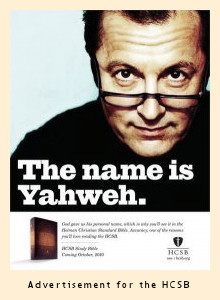 The Tetragrammaton occurs 6,828 times in the Hebrew Bible. Nearly all English versions follow the ancient tradition of rendering the Divine name as “the Lord.” The King James Version makes only four exceptions (Exodus 6:3, Psalm 83:18, Isaiah 12:2, and Isaiah 26:4), where it renders the name as “Jehovah.” The first edition of the HCSB used “Yahweh” seventy-five times, and the 2009 revision increased the number to 476, although the ordinary rendering continues to be “the Lord.” One of the editors of the version has explained why the version uses “Yahweh” in the places where it does:
We use it as the rendering of YHWH (which the Hebrew Bible editors first rendered as Adonai, “Lord”) whenever God’s “name” is being given (either explicitly, using the word “name,” or implicitly), when He is being identified (“I am Yahweh”), when He is being contrasted to other gods such as Baal, in certain repeated phrases such as “Yahweh the God of your fathers,” or when YHWH has been rendered by Yahweh in the immediate context. … our objective is to introduce to the contemporary church what is the most likely pronunciation of the divine name YHWH in the Hebrew Bible. We did not render the majority of occurrences of YHWH as Yahweh because our goal is not only to be accurate but to use an English style that is most familiar to people. Since most Christians today probably do not commonly speak of “Yahweh,” but rather of “the Lord,” we felt it would be insensitive to use Yahweh for YHWH in every case and would make the Bible seem too uncomfortable for most people. (5)
Advertisements for the version have emphasized the version’s use of “Yahweh” as a token of its accuracy. The small print on the ad reproduced here reads: “God gave us his personal name, which is why you’ll see it in the Holman Christian Standard Bible. Accuracy, one of the reasons you’ll love reading any of the HCSB digital or print editions.” Another advertisement states, “In the HCSB, when God is using His own personal name, that's how you will find it said,” and that this is “important.” (6) However, in regard to this we would make three points: (1) About ninety-three per cent of the occurrences of יהוה are still rendered “the Lord” in the Holman Christian Standard Bible, as in other versions; (2) in the quotations of the Old Testament in the New Testament the word יהוה is always rendered Κυριος—the common Greek word meaning “Lord”—and so it must be recognized that the regular use of “Lord” in English versions conforms to the practice of the Apostles, who did not use “Yahweh” in reference to God; and (3) the traditional avoidance of pronouncing the Name has some theological significance and ramifications. Many Christians are not only “uncomfortable” with the departure from apostolic practice, they also find it theologically objectionable. (7)
The Use of Brackets for “Supplied Words”
In the first edition of the HCSB, “supplied words” were indicated by putting them in brackets. The brackets were eliminated in the 2009 revision, but I will retain the following paragraphs from my original review of the HCSB, for the sake of those who are still using the first edition. In some cases the elimination of the brackets is a change for the better, but sometimes it is for the worse. In Philippians 2:13 the words “enabling you” should never have been inserted in the rendering, “For it is God who is working in you, [enabling you] both to desire and to work out His good purpose,” and the removal of the brackets makes the insertion less excusable.
The idea of the brackets is to let readers know where the translators have “added” English words which do not have any corresponding words in the original, in order to produce an English translation that makes sense. Other Bible versions (e.g. KJV, ASV, NKJV) have used italics for this purpose. It can sometimes be helpful, but it should be used sparingly. When the appropriateness of the “supplied word” is in doubt, it serves to warn readers that the translators have offered an interpretation which may not be correct; but when the accuracy of the interpretation is not in doubt, there is no good reason to mark any of the English words that are used to express it. (8)
We will comment on the places where “supplied word” brackets appear in the translation of Philippians.
In Philippians 1:11 there is no need to bracket the word “comes” in “[comes] through Jesus Christ.” In 1:17 the brackets are misleading: “the others proclaim Christ out of rivalry, not sincerely, seeking to cause [me] trouble in my imprisonment.” This will give readers the idea that a precise translation of the Greek (minus the bracketed word) would be “cause trouble in my imprisonment”—allowing the interpretation that the insincere preachers “cause trouble” for others in some general way. But this not the case. The phrase is literally, “make distress arise in my bonds” (tois desmois mou being understood as an associative dative), and there can be no doubt that “for me” is implied here. So it should not have been put in brackets. In 2:4 the “only” in “look out not [only] for his own interests” is rightly bracketed; but the word does not really belong here, and it weakens the impact of the saying. (In the second half of the verse the “also” in “also for the interests of others” should also have been omitted, because the Greek phrase alla kai here is ascensive in sense, as in 1:18—translated “yes.”) In 2:13 the words “enabling you” are inserted with brackets in the sentence, “For it is God who is working in you, [enabling you] both to will and and to act for his good purpose.” But again, the supplied words weaken the sense, and do not belong here. (9) In 3:10 we have “[My goal] is to know him,” but it should be “[My goal is] to know him.” In 3:12 “reached [the goal]” mistranslates the verb elabon, which means “received, obtained,” and so supplied word “goal” is inappropriate; the unexpressed object of elabon is the “prize” of verse 14. In 3:16 the sentence “we should live up to whatever [truth] we have attained” is a paraphrastic rendering. The phrase “live up to” (cadged from the NIV) does not convey the meaning of the Greek word stoichein, which means “procede in line” with others, in orderly fashion. This word was used of soldiers on the march, and as Marvin Vincent says, “the idea of a regulative standard is implied” in it. (10) F.F. Bruce translates literally: “let us march by the same (rule as we have followed) to the point we have already reached,” and explains that the use of stoichein carries “the implication that this is not a matter of individual attainment, but one in which the whole community should move forward together” (11) How all this might be put into an English translation we cannot say; but the HCSB’s use of brackets to flag a “supplied word” here will give readers the false impression that the other words in the sentence correspond closely to the Greek words. In 4:10 the added words “opportunity [to show it]” are appropriate. In 4:12 “learned the secret [of being content]—whether well-fed or hungry” is acceptable, but it would be more accurately rendered “learned through [my] initiation both to be filled and to be hungry.”
In general, it seems that the HCSB’s use of bracketed “supplied words” in Philippians is not very helpful. They occur in places where a footnote is really needed to explain some intepretive difficulty or disagreement.
Treatment of Gender
The translation of generic masculine nouns and pronouns in this version is conservative — that is, the version does not aim to conceal the fact that the authors of Scripture regularly use what modern feminists have called “sexist” language. But the plural of the Greek word ανθρωπος (“man”) is regularly translated “people” instead of “men,” and occasionally we also see a gender-neutral rendering of the singular ανθρωπος. For example, in Romans 3:4 γινέσθω δὲ ὁ Θεὸς ἀληθής, πᾶς δὲ ἄνθρωπος ψεύστης is translated “God must be true, even if everyone is a liar.” Masculine forms are also avoided where the Greek or Hebrew texts have participles, substantival adjectives, and pronouns which may be rendered with gender-neutral equivalents such as “someone,” “one,” “no one,” “another,” etc. The HCSB is more gender-neutral than the NASB, the NKJV, and the 1984 NIV.
Old Testament Issues
In the Old Testament the translation follows the custom of conservative protestant Bibles by rendering the messianic passages in accordance with their interpretation in the New Testament. For example, in Isaiah 7:14 it has “the virgin will conceive” (though a footnote gives the alternate “the virgin is pregnant”). Genesis 22:18 reads, “And all the nations of the earth will be blessed by your offspring” (with the alternative “Or will bless themselves, or will find blessing” in a note). Psalm 2:12 reads “Pay homage to the Son” (with a note indicating that the text reads literally “Kiss the Son”).
A ‘Baptist’ Translation?
We have noted that most of the people involved in the production of this version are Baptists. It is in fact owned by the Southern Baptist Convention. So it is appropriate to ask how far this may have affected the translation. For the most part we find that a Baptist bias has been avoided. We do not see baptizo translated “immerse” or anything of that sort. But there are a few places where Baptist teachings probably did have some weight in the balance, where the translation could go one way or the other. An example is the famous “power of the keys” saying in Matthew 16:19, which in the HCSB is translated “I will give you the keys of the kingdom of heaven, and whatever you bind on earth will have been bound in heaven, and whatever you loose on earth will have been loosed in heaven.” (See also the repetion of the saying in 18:18.) This rendering, in which the verbs are translated as future perfects in English (“will have been ...”), has some claim to accuracy, because the Greek verbs are also future perfects. But there are good reasons to doubt the correctness of it, because the future perfect in Greek is often used simply to express the future sense in an emphatic way; and the context suggests, rather strongly, that an emphatic future sense is meant. (12) That is why other versions have translated the verbs with the English future tense: “whatever you bind on earth shall be bound in heaven,” etc. The implications of this traditional rendering are not congenial to modern Baptists who tend to minimize the importance of the institutional church. Their individualistic spirit and “low” ecclesiology will not permit much spiritual authority to be given to men. But the rendering put in the HCSB is much more acceptable to them.
The Marginal Notes
The Holman Christian Standard Bible has an unusually large number of marginal notes giving other manuscript readings and alternative renderings of the text. There seems to be at least twice as many of these notes as is usual for English versions. When the notes offer an alternative rendering, it is usually more literal than the rendering in the text. Some of the notes are explanatory, as for example the note to Acts 7:19, which explains that the abandonment of infants outdoors was “a common pagan practice of birth control.” A note on John 1:1 explains that “the Word (Gk Logos) is a title for Jesus as the communication and revealer of God the Father.” The word logos here means much more than this note indicates, but at least the HCSB tries to explain it (other versions do not). Unfortunately there is no marginal note at Galatians 6:16, where the HCSB gives the unusual rendering “May peace be on all those who follow this standard, and mercy also be on the Israel of God!” There ought to have been a note here telling the reader about the more commonly accepted interpretation, in which kai epi ton Isael tou Theou (and upon the Israel of God) is understood as Paul’s way of asserting that “all those who follow this standard” are the true and spiritual Israel. The rendering here, and the absence of a note, seems to indicate a dispensationalist bias. In the first chapter of Philippians there are some footnotes of little value (in verse 6 a footnote gives the alternative “work among you” for “work in you”); but in verse 10 there is no indication that the Greek may mean “approve what is best” instead of “determine what really matters.” The difference in interpretation here is surely more interesting and important than some of the trivial alternatives that are presented in the chapter’s footnotes. Is Paul tellling the Philippians not to worry about secondary issues (as “determine what really matters” seems to imply) or is he warning them to choose carefully what is best in all things? The practical implications for us are quite different. (13) We can hardly complain about the number of footnotes, seeing that the HCSB has many more than most versions—but a better sense for what is important to Christian readers may be in order.
In addition to the marginal notes, there are also some “bullet notes” in an appendix. When the text has some frequently-occuring words or phrases which might need explanation (i.e. “centurion”), rather than add so many notes to the margin these words are marked with a bullet in the text, which refers the reader to the explanation in the appendix.
The marginal equipment of the HCSB is clearly its best feature, and (despite the few lapses noted above) in this reviewer’s opinion it more than compensates for any weaknesses of the text. Probably in the future there will be some inexpensive “text editions” of the Holman CSB which omit the notes, but I can recommend the use of this version for study purposes on the condition that the student uses an edition which includes them.
Michael Marlowe
July 2004, revised October 2008, revised August 2011.
1. John Perry, “Broadman & Holman Publishers announces new Bible translation” Baptist Press, May 7, 1999.
2. “Interview with Dr. Ed Blum, General Editor for the HCSB,” by Will Lee (dated 19 December 2007). See also the interview by Andy Cheung (dated 26 February 2008).
3. Edwin Blum, in the interview referenced above, protests that the HCSB is “not a Baptist translation.” He argues that “Art [Farstad] was not a Baptist; he was Brethren. I’m not a Baptist; I’m a Presbyterian. So the General Editor in both cases was not a Baptist. The Southern Baptist contingent was maybe 1/3 of the translators,” and so forth. But this is potentially misleading. Certainly more than a third of the people working on this version were Baptists. One does not have to be a member of a church affiliated with the Southern Baptist Convention in order to be a Baptist; and many churches that do not call themselves Baptist (e.g. Christian Brethren, Independent “Bible” Church) are Baptist in everything but name. And although Blum calls himself a Presbyterian, the description of his training and ministry found on the website of the publisher does not include any Presbyterian credential. It indicates, rather, that his education and experience are in the world of non-denominational evangelical churches. He was educated at Bob Jones University and Dallas Theological Seminary, and served as pastor at “Believers’ Chapel” and “Trinity Fellowship” near Dallas. “Believer’s Chapel” was originally formed as a Plymouth Brethren assembly, and is now best described as a non-denominational “Bible” church. “Trinity Fellowship” is also non-denominational. For a time he served as pastor of a small church called “Bethel Independent Presbyterian Church” in Houston, but it seems that people at this church have styled themselves “Presbyterian” only because their congregation is governed by a group of elders (presbyters) instead of a pastor and board of deacons. They have never been connected to any Presbyterian denomination. See the pages entitled What We Believe and Frequently Asked Questions at the website of that church for more information. This chuch does not even baptize infants now, but Blum informs us that while he was pastor there, they did baptize some. He also informs us that his use of the word “Presbyterian” is meant to express a belief that a congregation should be governed by a group of elders, and that he is a Calvinist in some respects, but that he is best described as a “modified Augustinian dispensationalist.”
4. In a note on 1 John 5:7 the clause is mentioned and the reason for its omission is obliquely indicated. The note reads, “Other mss (the Lat Vg and a few late Gk mss) read testify in heaven ...” But this statement is inaccurate. It should have said that the clause appears in most medieval copies of the Latin Vulgate and in a few late Greek manuscripts. The clause does not appear in the earliest copies of the Vulgate.
5. E. Ray Clendenen, as quoted in A. Roy King, New Translation of Holman Bible Increases Use of Yahweh in Its Text, 23 Nov. 2010.
6. “9 Reasons You’ll Love the HCSB,” Facts and Trends, Fall 2011, p. 23.
7. See the “Letter to the Bishops Conferences on The Name of God” issued by the Vatican in June 2008.
8. For a detailed discussion of this see Jack Lewis, “Italics in English Bible Translation,” in The Living and Active Word of God: Studies in Honor of Samuel J. Schultz, edited by Morris Inch and Ronald Youngblood (Winona Lake, Indiana: Eisenbrauns, 1983), pp. 255-270.
9. With the addition of the words “enabling you” (also found in the NRSV) we seem to have an injection of the Wesleyan concept of “prevenient grace” into the verse. God is enabling now, rather than simply working in the heart and life of the believer. This is “a quite unwarranted weakening of the compatibilism that Paul here assumes.” (D.A. Carson, “Review of the New Revised Standard Version,” The Reformed Theological Review 50/1 [January-April 1991], p. 6).
10. Marvin Vincent, Word Studies in the New Testament, vol. 3 (Hendrickson reprint, n.d.), p. 460. Cf. also H.C.G. Moule’s remarks on the verse in his commentary Philippians in the Cambridge Bible series (1903), and H.A.W. Meyer, Critical and Exegetical Handbook to the Epistles to the Philippians and Colossians and to Philemon, trans. by John Moore (Edinburgh, 1883). The article on stoicheo in the BAGD lexicon (1979, p. 769) offers the gloss “hold on to” for Phil. 3:16, but this is paraphrastic. Despite the argument presented by Delling in TDNT (vol. 7, pp. 667-8), contexts in which the word occurs (esp. Romans 4:12) do indicate that “walk” was a component of the verb’s meaning. The words peripatountas kathos echete tupon hemas “walk according to the pattern you have in us” in Phil. 3:17 unfold the meaning of the word stoichein in Phil. 3:16.
11. F.F. Bruce, Philippians, in the Good News Commentaries series (New York: Harper & Row, 1983), p. 101.
12. See the discussion of this by F.F. Bruce in his History of the Bible in English, third ed. (New York: Oxford University Press, 1978), pp. 180-81. Bruce says that the rendering with future perfects in English is “almost certainly wrong.”
13. We can well imagine that in the midst of the ongoing controversy about worship music someone might use the HCSB rendering to support the idea that the style of music is not among the essential things that “really matter.” With this familiar plea, much inferior and juvenile music has come to dominate the worship services of evangelical churches, while mature Christians are discouraged from expressing their unhappiness and concern about it. But if we are urged to “approve what is excellent” (ESV) or “discern what is best” (NIV), a different light is thrown upon the question. Sometimes even what is “good” becomes the enemy of the “best.” And so J.A. Bengel in his Gnomon of the New Testament (1742) interprets Paul’s saying as an instruction to discern “the best among the good.”
Links to further information:
Editors and Translators
The Editorial Team
- Edwin A. Blum, General Editor/Translator; Th.M., Th.D., Dallas Theological Seminary; Ph.D., University of Basel; additional study, Rice University
- Trent Butler, Editor/translator; B.D., The Southern Baptist Theological Seminary; Ph.D., Vanderbilt University, Joshua
- E. Ray Clendenen, Associate general editor/translator; Th.M., Dallas Theological Seminary; M.A., Dropsie University; Ph.D., University of Texas at Arlington, Haggai, Malachi
- Garry Fulton, Stylist; B.A., M.A., The Criswell College
- Sheila E. Moss, Stylist; B.A., Trevecca Nazarene University; M.Ed., Peabody College of Vanderbilt University
- David R. Shepherd, Executive Editor/Stylist; Publisher, Broadman & Holman; B.A., David Lipscomb University
- David K. Stabnow, Old Testament editor/translator; M.Div., Bethel Theological Seminary; Ph.D., Westminster Theological Seminary
- Lloyd W. Mullens, Managing Editor; B.A. Belmont University; additional studies, New Orleans Baptist Theological Seminary; Southern Baptist Theological Seminary
Other Editors
- Todd Beall, Old Testament editor/translator; Professor of Old Testament & Hebrew, Capital Bible Seminary; Th.M., Capital Bible Seminary; Ph.D., The Catholic University of America, Isaiah 36 - 66
- Robert Bergen, Old Testament editor/translator; Professor of Old Testament & Hebrew, Hannibal-LaGrange College; M.Div., Ph.D., Southwestern Baptist Theological Seminary, 1 Samuel
- Frank Carmical, Editor/Stylist; Founder & Evangelist for Harvester Ministries; Th.M., Dallas Theological Seminary
- James Davis, Editor/Translator; M.Div., Th.M., Capital Bible Seminary; Ph.D. candidate, Dallas Theological Seminary
- Barrett Duke, Vice-President of Research, Ethics & Religious Liberty Commission; M.A., Denver Seminary; Ph.D., Iliff School of Theology, Ezra
- Joe A. Friberg, Old Testament editor/translator; B.S., The University of Texas at Austin; M.A., The University of Texas at Arlington; M.A. Southwestern Baptist Theological Seminary
- Duane Garrett, Old Testament editor/translator; Professor of Old Testament & Hebrew, Gordon-Conwell Theological Seminary; M.Div., Trinity Evangelical Divinity School; Ph.D., Baylor University, Proverbs, Song of Solomon, Hosea
- Richard Hess, Professor of Old Testament & Hebrew, Denver Seminary; M.Div., Th.M., Trinity Evangelical Divinity School; Ph.D., Hebrew Union College, Exodus 22 - 40
- Harold R. Holmyard, Old Testament editor/translator; Th.M., Grace Theological Seminary; Th.D., Dallas Theological Seminary
- David M. Howard, Old Testament editor/translator; Professor of Old Testament, Bethel Seminary; M.A., Wheaton College; Ph.D., University of Michigan
- Tremper Longman III, Old Testament editor/translator; Professor of Old Testament, Westmont College; Ph.D., Yale University
- Eugene H. Merrill, Old Testament editor/translator; Distinguished Professor of Old Testament studies, Dallas Theological Seminary; Ph.D. Columbia University; Ph.D. Bob Jones University
- Calvin Miller, English Stylist; professor of Homiletics, Beeson Divinity School; M.Div., D.Min., Midwestern Baptist Theological Seminary
- Frances Mosher, English stylist/secretary; B.S., The University of North Texas; additional studies, Southwestern Baptist Theological Seminary
- John Perry, English Stylist; B.A. cum laude, Vanderbilt University; additional studies, University College, Oxford, England
- James Price, Old Testament editor/translator; Professor of Old Testament & Hebrew, Temple Baptist Seminary (Chattanooga, Tennessee); M.Div., Los Angeles Baptist Theological Seminary; Ph.D., Dropsie University, 2 Chronicles
- Mark Rooker, Old Testament editor/translator; Professor of Old Testament & Hebrew, Southeastern Baptist Theological Seminary; Th.M., Dallas Theological Seminary; M.A., Ph.D., Brandeis University, Leviticus
- Joe M. Sprinkle, Professor of Old Testament & Hebrew, Toccoa Falls College; M.Div., Trinity Evangelical Divinity School; M.Phil., Ph.D., Hebrew Union College, Genesis 1 - 27
- Kevin R. Warstler, Old Testament editor/translator; Th.M., Ph.D. candidate, Dallas Theological Seminary
- R. Gregg Watson, Old testament editor; pastor, Brandon, Texas; M.Div., Ph.D., Southwestern Baptist Theological Seminary
- Marianne Wilson, English stylist/secretary; A. A., San Jacinto College; B.S., Southwestern College
Old Testament Translators
- Martin Abegg, Director, Dead Sea Scrolls Institute & Associate Professor and Chair Religious Studies, Trinity Western University (Langley, British Columbia); M.Div., Northwest Baptist Seminary; M.Phil., Ph.D., Hebrew Union College, Jeremiah 1 - 28
- James Allman, Professor of Bible, Theology, & Biblical Languages, Crichton College; Th.M., Th.D., Dallas Theological Seminary, Psalms 52 - 101
- Stephen J. Andrews, Professor of Old Testament & Hebrew, Midwestern Baptist Theological Seminary; M.Div., Eastern Baptist Theological Seminary; Th.M., Southeastern Baptist Theological Seminary; M.Phil., Ph.D., Hebrew Union College, Zephaniah
- Richard Averbeck, Professor of Old Testament & Semitics, Trinity Evangelical Divinity School; M.Div., M.A., Grace Theological Seminary; Ph.D., Dropsie College Numbers 18 - 36
- Bryan Beyer, Dean of Students, Columbia International University; M.Div., Denver Conservative Baptist Seminary; Ph.D., Hebrew Union College, Jeremiah 29 - 49
- Roy Brown, Retired professor of physics; programmer for Accordance; Ph.D., Baylor University (Physics); Post Doctoral Studies, Technion Israel Institute (Haifa), Joshua
- Hassell Bullock, Professor of Biblical Studies, Wheaton College; Ph.D., Hebrew Union College, Ezekiel 1 - 25
- Rick Byargeon, Pastor, Temple Baptist Church, Ruston, LA; M.Div., Ph.D., Southwestern Baptist Theological Seminary, Ecclesiastes
- Stephen Carlson, Lifeway Christian Resources; M.Div., Ph.D., Mid-America Baptist Theological Seminary, Habakkuk
- Rodney Cloud, Professor of Old Testament emeritus, David Lipscomb University; M.A., Harding Graduate School of Religion; M.A., Peabody College; Ph.D., Hebrew Union College
- Dennis Cole, Professor of Biblical Archaeology, New Orleans Baptist Theological Seminary; M.Div., Th.M., Western Conservative Baptist Seminary; Th.D., New Orleans Baptist Theological Seminary, Numbers 1 - 17
- Jack Collins, Professor of Old Testament & Hebrew, Covenant Theological Seminary; M.Div., Faith Evangelical Lutheran Seminary; Ph.D., University of Liverpool, Psalms 102 - 150
- Iain Duguid, Professor of Old Testament & Hebrew, Westminster Theological Seminary (Escondido, California); Th.M., Westminster Theological Seminary (Philadelphia); Ph.D., Cambridge University, Ezekiel 26 - 48
- Archie England, Professor of Old Testament & Hebrew, North Greenville College; M.Div., Ph.D., Mid-America Baptist Theological Seminary, Nehemiah
- Art Farstad, HCSB project founder and first general editor (deceased); Th.M., Th.D., Dallas Theological Seminary
- Alan Groves, Professor of Old Testament & Hebrew, Westminster Theological Seminary; Th.M., Westminster Theological Seminary; Ph.D. candidate, Free University of Amsterdam, Judges 1 - 21
- Larry Helyer, Professor of Biblical Studies, Taylor University; M.Div., Western Conservative Baptist Theological Seminary; Ph.D., Fuller Theological Seminary, 2 Samuel
- Paul House, Professor of Old Testament & Hebrew, Trinity Episcopal School of Ministry; M.A., University of Missouri-Columbia; M.Div., Ph.D., The Southern Baptist Theological Seminary. Additional studies: Ecumenical Institute for Theological Research, Jerusalem; The Whitefield Institute, England; Oxford University, England, 2 Kings
- Walt Kaiser, President & professor of Old Testament & Hebrew, Gordon-Conwell Theological Seminary; M.A., Wheaton College; Ph.D., Brandeis University, Lamentations
- Brian Kelly, Professor of Old Testament & Hebrew, Canterbury College (Canterbury, England); M.Phil., Trinity College (Bristol); Ph.D., University of Bristol (England), 1 Chronicles
- George Klein, Professor of Old Testament, Southwestern Baptist Theological Seminary; M.Div., Southwestern Baptist Theological Seminary; Th.M., Dallas Theological Seminary; Ph.D., Dropsie College, Zechariah
- Kirk Lowery, Associate Director, The Westminster Hebrew Institute, Westminster Theological Seminary; M.Div., Talbot Graduate School of Theology; M.A., Ph.D., UCLA, 1 Kings
- Karen Maticich, Professor of Old Testament & Hebrew, International School of Theology; Th.M., Dallas Theological Seminary; Ph.D., Cambridge University, Ruth, Esther
- Janice Meier, Editor, Adult Sunday School Ministry Department, Lifeway Christian Resources; M.Div., Th.D., New Orleans Baptist Theological Seminary, Psalms 1 - 51
- Stephen Miller, Professor of Old Testament & Hebrew, Mid-America Baptist Theological Seminary; Th.M., Ph.D., Mid-America Baptist Theological Seminary, Daniel
- Jeff Niehaus, Professor of Old Testament & Hebrew, Gordon-Conwell Theological Seminary; M.Div., Gordon-Conwell Theological Seminary; Ph.D., Harvard University, Job
- Richard Patterson, Retired professor of Old Testament & Hebrew; M.Div., Northwest Baptist Seminary; Th.M., Talbot Theological Seminary; Ph.D., UCLA, Amos
- Michael Rydelnik, Professor of Jewish Studies, Moody Bible Institute; Th.M., Dallas Theological Seminary; D.Miss., Trinity Evangelical Divinity School, Joel, Obadiah
- John Sailhamer, Professor of Old Testament & Hebrew, Western Conservative Baptist Theological Seminary; Th.M., Dallas Theological Seminary; Ph.D., UCLA, Genesis 28 - 50
- Philip Satterthwaite, Professor of Biblical studies, Biblical Graduate School of Theology (Singapore); Ph.D., Manchester University (England), Deuteronomy 1 - 34
- Richard Schultz, Professor of Old Testament & Hebrew, Wheaton College; M.Div., Trinity Evangelical Divinity School; M.A., Ph.D., Yale University, Isaiah 1 - 35
- Gary Smith, Professor of Old Testament & Hebrew, Midwestern Baptist Theological Seminary; Ph.D., Dropsie College, Micah
- Doug Stuart, Professor of Old Testament & Hebrew, Gordon-Conwell Theological Seminary; Ph.D., Harvard University, Exodus 1 - 21
- Paul Wright, Professor of Old Testament & Hebrew, Jerusalem University College; Ph.D., Hebrew Union College, Nahum
New Testament Translators
- David Allen, Professor of Homiletics, Criswell College; M.Div., Southwestern Baptist Theological Seminary; Ph.D., University of Texas at Arlington, Hebrews 11 - 13
- Lawrence Burks, Pastor, Grand Avenue Baptist Church, Gainesville, Texas; M.A., Texas Christian University; M.Div., Southwestern Baptist Theological Seminary; D.Min., Southwestern Baptist Theological Seminary, Colossians
- Stephen Carlson, Lifeway Christian Resources; M.Div., Ph.D., Mid-America Baptist Theological Seminary, Ephesians
- Thomas Edgar, Professor of New Testament Literature & Exegesis, Capital Bible Seminary; Th M., Th.D., Dallas Theological Seminary, Romans 1 - 13
- Art Farstad, See under Old Testament for vita
- Zane Hodges, Retired professor of New Testament & Greek, Dallas Theological Seminary; Th.M., Dallas Theological Seminary, Luke, John, James
- Peter Johnston, Professor at Nairobi Evangelical Theological Seminary; Ph.D., Canterbury University (England), Mark, Galatians, 1&2 Timothy, Philemon, 1&2 Peter
- Richard Melick, Provost & professor of New Testament & Greek, Golden Gate Baptist Theological Seminary (Mill Valley, California); M.Div., Trinity Evangelical Divinity School; Ph.D., Southwestern Baptist Theological Seminary, 2 Corinthians
- Robert Wilkin, Founder & Executive Director of Grace Evangelical Society; Th.M., Ph.D., Dallas Theological Seminary, John
New Testament Reviewers
- Clinton Arnold, Professor of New Testament Language and Literature, Director of Th.M. Program, Talbot School of Theology; M.Div., Talbot School of Theology; Ph.D., University of Aberdeen, Ephesians, Colossians
- Craig Blomberg, Professor of New Testament & Greek, Denver Seminary; M.A., Trinity Evangelical Divinity School; Ph.D., University of Aberdeen, Mark
- Steve Cox, Professor of New Testament & Greek, Mid-America Baptist Theological Seminary; M.Div., Erskin Theological Seminary; Ph.D., The Southern Baptist Theological Seminary, Jude
- Ken Easley, Professor of New Testament & Greek, Mid-America Baptist Theological Seminary; M.Div., Trinity Evangelical Divinity School; Ph.D., Southwestern Baptist Theological Seminary, Revelation
- Gene Green, Professor of New Testament & Greek, Wheaton College; Ph.D., University of Aberdeen, 2 Thessalonians
- George Guthrie, Professor of New Testament & Greek, Union University; Ph.D., Southwestern Baptist Theological Seminary, Hebrews
- Brent Kinman, Pastor, Castle Rock, Colorado; Th.M., Dallas Theological Seminary; Ph.D., Cambridge University, 1 Corinthians
- Andreas Kostenberger, Professor of New Testament & Greek, Southeastern Baptist Theological Seminary; Ph.D., Trinity Evangelical Divinity School, John
- Boyd Luter, Associate Provost for Academic Affairs, Dean of Faculty and Professor of Biblical Studies, Criswell College; Th.M., Ph.D., Dallas Theological Seminary, Galatians
- Michael Martin, Associate academic dean and professor of New Testament interpretation, Golden Gate Baptist Theological Seminary; M.Div., Ph.D., Southwestern Baptist Theological Seminary, 1 Thessalonians
- Robert Mounce, Retired professor (Bethel college and Seminary), dean (Western Kentucky University), and college president emeritus (Whitworth College); B.D., Th.M., Fuller Theological Seminary; Ph.D., University of Aberdeen; D.D. Seattle Pacific University, Matthew
- Stanley Porter, Research Professor in New Testament, School of Humanities and Cultural Studies, University of Surrey Roehampton, UK; M.A., Claremont Graduate School; M.A., Trinity Evangelical Divinity School; Ph.D., University of Sheffield, Acts
- Thomas R. Schreiner, Professor of New Testament Interpretation, The Southern Baptist Theological Seminary; M.Div., Th.M., Western Conservative Baptist Seminary; Ph.D., Fuller Theological Seminary, 1&2 Timothy, Titus
- Robert H. Stein, Professor of New Testament Interpretation, The Southern Baptist Theological Seminary; B.D., Fuller Theological Seminary; S.T.M., Andover Newton Theological School; Ph.D., Princeton Theological Seminary; Additional studies: University of Tübingen
- Chris Thomas, Professor of New Testament & Greek, Church of God School of Theology, Ph.D., University of Sheffield (England), 1, 2, 3 John
- Alan Tomlinson, Professor of New Testament & Greek, Midwestern Baptist Theological Seminary; Th.M., Dallas Theological Seminary; Ph.D., The Southern Baptist Theological Seminary, 2 Corinthians
- Curtis Vaughan, Professor emeritus, Southwestern Baptist Theological Seminary; M.Div., Th.D. Southwestern Baptist Theological Seminary, Romans
- Paul Wolfe, Professor of New Testament & Greek, Criswell College; Ph.D., University of Aberdeen, 1&2 Peter
- Robert Yarbrough, Professor of New Testament & Greek, Trinity Evangelical Divinity School; M.A., Wheaton College; Ph.D., University of Aberdeen, James